Brussels – The Council of the European Union has restored the full application of the EU-Syria Cooperation Agreement. The agreement dates back to 1977 and provides the framework for economic and trade relations between the parties. “This is a historic day,” commented Dubravka Šuica, the Commissioner for the Mediterranean, at a press briefing today (11 May). “Syria has the EU’s support: we want to hear what its priorities are and understand how we can best support it,” Šuica added.
The agreement was partiallly suspended in 2011 and extended in 2012, due to human rights violations committed by the regime of Bashar al-Assad. The suspension affected specific trade provisions of the agreement, in particular those removing quantitative restrictions on imports of certain Syrian products, such as oil and its derivatives, gold, precious metals, and diamonds. According to the Council, with the fall of the Assad regime in December 2024, and the subsequent decisions to lift EU economic sanctions against Syria in May 2025 – with the exception of those based on security grounds – the conditions that had justified the suspension no longer apply. The reinstatement of the agreement is the next step: Syria now falls within the ordinary legal framework governing trade and cooperation relations with the EU.
The EU has therefore opened a new chapter in its relations with Damascus by initiating a dialogue with the transitional authorities. This morning, the Syria Partnership Coordination Forum held a meeting, chaired by Šuica and the Syrian Minister of Foreign Affairs and Expatriates, Asaad Hassan al-Shaibani. “Reconstruction on the ground has already begun,” Al-Shaibani stated at the start of his address. On the method, the position is clear. The recovery process must be led by Syrian institutions, “without the government’s authority being bypassed,” the minister said. The priorities are “infrastructure – energy, transport, and basic services such as healthcare and education.” Syria, al-Shaibani added, is aiming for “transparent management of funds, the consolidation of state institutions as a precondition for any reconstruction, and a long-term vision for the country, based on human capital and national leadership.”
The EU, however, aims to see Syria play an active role in the Mediterranean. “It is time for action,” said Commissioner Šuica, who announced that “a hub will soon be operational – launched with funding of €15 million – for European technical assistance, designed to transfer skills and knowledge to Syrian institutions.” Commissioner Šuica also announced an EU contribution of €14 million for the reconstruction of Al-Rastan Hospital in Homs. The initiative is part of the €175 million socio-economic recovery package announced by the Commissioner during her June 2025 visit to Damascus. The EU is working on a further allocation of €280 million for 2026 and 2027: all these funds form part of the overall €620 million package announced by Ursula von der Leyen, President of the European Commission, in January 2026.
Meanwhile, on 5 May, Human Rights Watch (HRW) sent a letter to High Representative Kallas and Commissioner Šuica, calling on the EU to adopt a ‘more for more’ approach, linking the strengthening of relations with Damascus to concrete and measurable progress on justice and security. The organisation expressed concern that the proposal to reinstate the cooperation agreement did not contain explicit references to outstanding human rights challenges. On the issue of refugees, HRW warned that promoting or facilitating returns to Syria without conditions permitting it would be premature. On this issue, during the press briefing, Commissioner Šuica stated that “the EU is not pushing anyone to leave; return is possible if it takes place in a safe, dignified and voluntary manner.”
English version by the Translation Service of Withub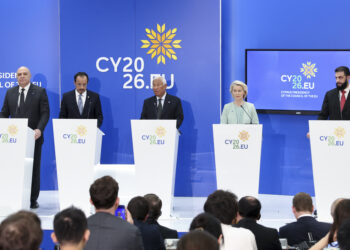


![Il ministro dei Trasporti, Matteo Salvini [Bruxelles, 5 dicembre 2024. Foto: Emanuele Bonini per Eunews]](https://www.eunews.it/wp-content/uploads/2024/12/salvini241205-120x86.jpeg)