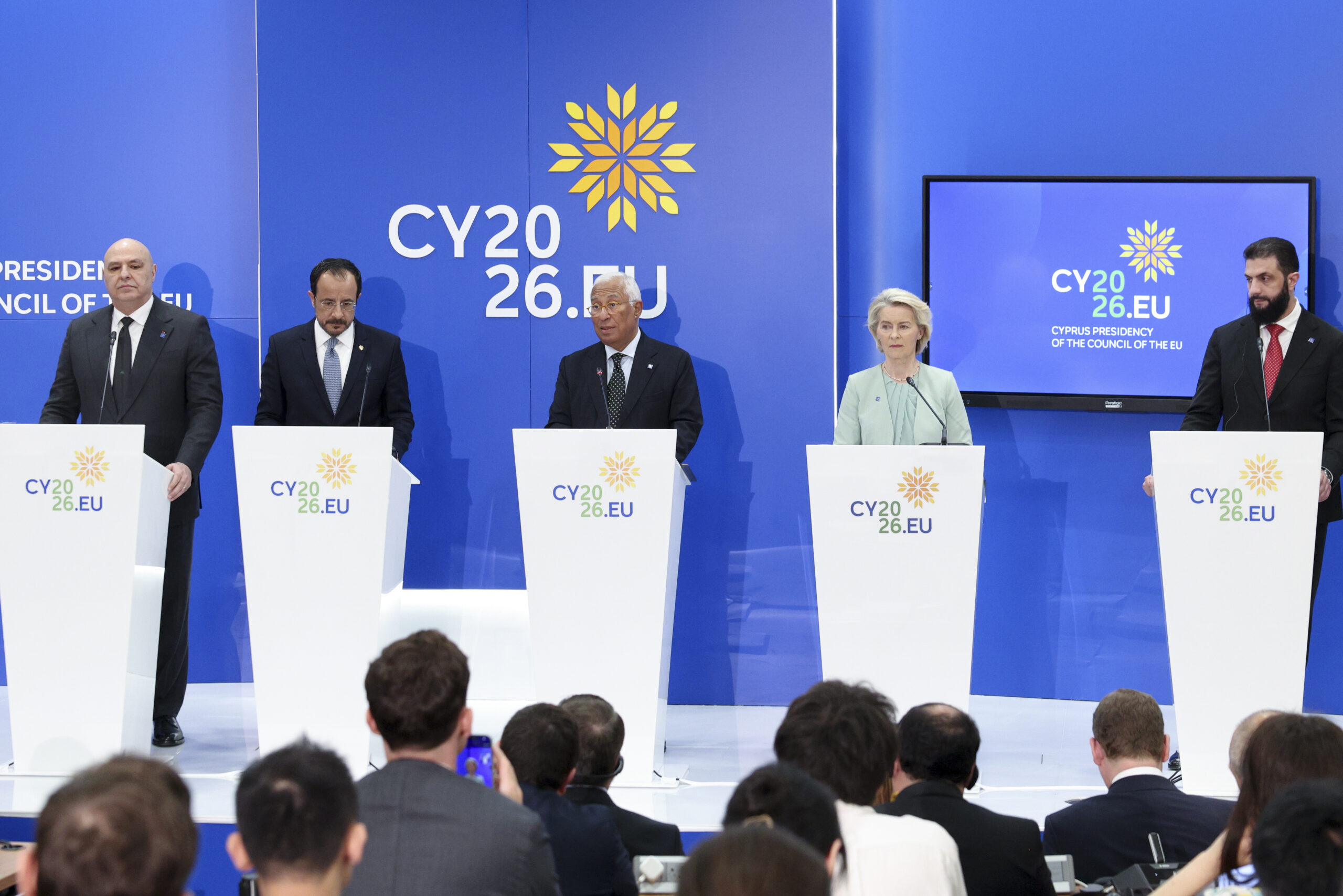
Brussels – Restoration of freedom of navigation in the Strait of Hormuz; a stable and lasting ceasefire leading to sustainable peace in the region; a ban on Iran possessing nuclear weapons. These are the priorities that the European Union has in the context of the war in the Middle East, while also looking towards closer future cooperation with Middle Eastern partners, and which she has made clear to the leaders of Jordan, Lebanon, Syria, Egypt, and the Gulf Cooperation Council. Who, however, have also brought other key issues to the table: the “extremely high humanitarian cost” which “Lebanon is paying“; the call on the international community and Europe to commit to “putting an end to Israel’s aggression on Syrian territory and the violation of Syria’s sovereignty“; and the strengthening of Syria and Lebanon’s cooperation with EU partners. The setting was an informal working lunch held today (24 April) in Nicosia, on the sidelines of the two-day informal summit.
From the Cypriot capital, a city split between Cyprus and Turkey, European leaders have welcomed the “extension of the ceasefire between the United States and Iran, as well as the one between Lebanon and Israel,” explains the President of the European Commission, Ursula von der Leyen, in her statement to the press following the meeting with Middle Eastern leaders. “Our common goal is now to negotiate a lasting end to the war,” which “includes the restoration of full and permanent freedom of navigation in the Strait of Hormuz, without tolls.” Furthermore, “it is clear that any peace agreement will have to address the issue of Iran’s nuclear and ballistic missile programmes” because “the events of the last seven weeks have demonstrated the real danger that a nuclear-armed Iran would pose to the world,” she continues.
Von der Leyen emphasises that she has sent “twofold” messages to her partners. First and foremost, “our absolute solidarity with our partners in the region” because “security is indivisible” and “there can be no stability in the Middle East or the Gulf while Lebanon is in flames.” Therefore, “we call for respect for Lebanon’s sovereignty and territorial integrity” and “a temporary truce is not enough: we need a permanent path to peace.” Along the way, “we will continue to support the Lebanese people,” she assured, noting that six flights of the EU Humanitarian Air Bridge have delivered over 250 tonnes of aid, as part of a €100 million humanitarian assistance package. On this point, the President of the Italian Council, Giorgia Meloni, provided further insight. “The UN has decided that the mandate expires at the end of this year, but I believe that an international presence on the border between Lebanon and Israel remains necessary and fundamental, and this is what we are discussing with our partners,” she explained at the conclusion of the informal European Council meeting in Cyprus.
Von der Leyen’s second message “is that in times of crisis, bonds are strengthened, because we are not only partners in crisis management, but also partners for the future,” she told the leaders of Lebanon and Syria. She then lists recent and upcoming meetings with Jordan, Egypt, and Syria: the first high-level political dialogue between Damascus and Brussels will take place in two weeks’ time, and the Gulf states—the EU-GCC summit will take place by the end of the year. “We are also ready to work with the Gulf countries to diversify export infrastructure, reducing dependence on the single bottleneck of the Strait of Hormuz. The time has come to promote promising connectivity projects such as IMEC, the India-Middle East-Europe Economic Corridor,” she notes.
For the President of the European Commission, one “hard truth” is clear: namely, that “our security is not merely interlinked, but intrinsically linked” and that “a threat to a merchant ship in the Strait of Hormuz is a threat to a factory, for example, in Belgium.” With this in mind, “I therefore propose today that we move beyond reactive crisis management. Firstly, we could consider expanding the scope of missions such as the Operation ASPIDES” – an EU military operation currently working to protect freedom of navigation and safeguard maritime security, particularly for merchant and commercial vessels in the Red Sea, the Indian Ocean and the Persian Gulf – “evolving from mere protection to sophisticated joint maritime coordination,” she explains. And, secondly, “the threat of the mass proliferation of drones and missiles is, unfortunately, a shared reality: we should establish structural cooperation” with the countries of the Persian Gulf “to boost production in the defence sector,” von der Leyen hopes, without going into detail.
According to the President of the European Council, António Costa, “the war in the Middle East has already had disastrous consequences for people, for infrastructure, and for the global economy, and with every day that passes without a solution, the situation only gets worse.” The former Portuguese Prime Minister also recalls “how closely Europe’s security is linked to that of the Middle East and how vital our cooperation on security and defence has become” and reiterates that “the European Union stands in full solidarity with your countries and your peoples.” Therefore, whilst the extension of the ceasefire with “Iran is a positive step,” now “negotiations must continue with the aim of finding a lasting solution to end this war and address the fundamental issues.” These are: the “immediate, unrestricted, and toll-free reopening, in full compliance with international law and the principle of freedom of navigation” of the Strait of Hormuz. To achieve this, “diplomacy is the only sustainable path to follow and the EU stands ready to contribute to all ongoing efforts” which also includes “the nuclear issue and support for the restoration of the Gulf’s energy infrastructure in order to stabilise global energy markets.” The same position is expressed regarding Lebanon, where “the situation continues to give rise to serious concern.” Here, the EU calls for “a sustained ceasefire on the ground” and urges “that diplomatic efforts continue, in full respect of international law, Lebanon’s sovereignty, and territorial integrity.” However, Costa emphasises that “Hezbollah poses an existential threat to Lebanon and is a dangerous destabilising factor for peace and security in the region” and praises Lebanese President Joseph Aoun for having “taken a truly historic decision by banning Hezbollah’s military activities,” because “disarming Hezbollah is the only sustainable solution to restore stability in Lebanon.” For the President of the European Council, “it is encouraging to see the start of talks between Lebanon and Israel,” which “it is essential that continue.”
While EU leaders merely allude obliquely to Israel and its responsibilities in the situation, Lebanese President Aoun points out that the “war broke out at a time when Lebanon had not yet recovered from the wars and problems of the past, and that it has had a severe impact on the socio-economic situation.” The president does not mince his words: “Lebanon is paying a very high humanitarian price, with a massive influx of displaced people and refugees and the resulting pressure on infrastructure, as well as on vital sectors of the economy.” Yet, “the region has great potential for economic integration, as well as for the interconnection of services and trade,” and “this potential cannot be guaranteed in a period of instability.” For this reason, at today’s meeting with the EU in Nicosia, “we reiterated that Lebanon’s stability is an integral part of the region’s stability” and “what happens in Lebanon is not confined to its borders, but has an impact on the region and its partners.” Consequently: “We confirmed the importance, in terms of the transition from crisis management to recovery, of strengthening our partnership and cooperation with our European partners, not only in terms of security, but also in terms of investment and with a view to ensuring economic connectivity between the regions.”
The Syrian president, Ahmed al-Sharaa, takes a firmer stance towards Tel Aviv: “I would like to call on the international community to assume its responsibility regarding all Israeli aggressions of any kind affecting our lands and territories,” and, “for this reason, Europe’s commitment to Syria’s stability and security will be decisive. The aim is to put an end to Israel’s aggression on Syrian territory and the violation of Syria’s sovereignty,” he emphasises. Despite this, al-Sharaa wishes to present to Europeans the transformation of Syria, which, “once a theatre of conflict, now wishes for its people to become a bridge and a fundamental pillar for the resolution of the geographical issue.” And “for this reason, we reaffirm our commitment to the Four Seas Initiative, which emphasises the importance of connecting Syria with Asia, the Gulf, and Europe ”. For the Syrian leader, today’s meeting in Cyprus, the neighbouring island of the Middle East region, a land divided between Cyprus and Turkey and a fault line between East and West, “represents a moment of political maturity that marks a new geopolitical situation within a framework of cooperation: we believe this is a reality. The stability and security of our region and of Europe constitute geopolitical stability and balance, and that is why a major joint commitment in this direction is necessary.”
English version by the Translation Service of Withub![Il presidente del Consiglio europeo, Antonio Costa [Doha, 15 aprile 2026]](https://www.eunews.it/wp-content/uploads/2026/04/costa-260415-350x250.png)