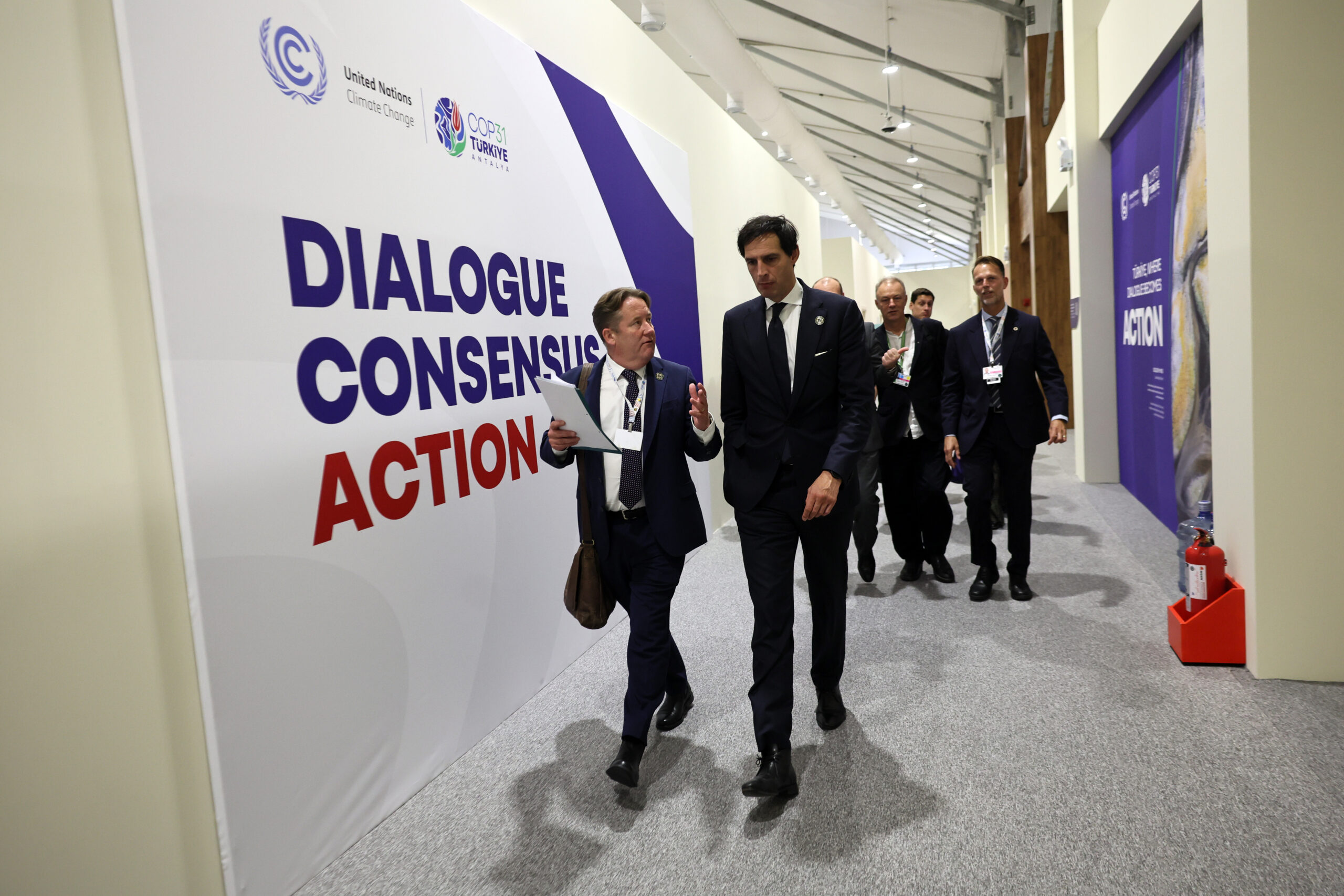
Brussels – This is the COP of implementation. This was reiterated by both the European Commissioner for Climate Action, Wopke Hoekstra, and the Irish Minister for Transport, Darragh O’Brien, during a press conference in Antalya, Turkey, where, for over a week, COP31, the United Nations Climate Change Conference, is currently underway. The European Union’s position is clear: to implement the commitments already made, rather than introduce new regulations. “There is no reason to devise new mechanisms. We must be very careful about adding further layers of regulation, as they would complicate the process, and that is the last thing we need,” the Irish minister emphasised.
“To be clear, the EU is indeed staying the course on all its efforts and commitments, honouring them all both at home and abroad. At the same time, it is extremely important that here, at a COP dedicated to implementation, we do not allow ourselves to be distracted by other issues. And, to be honest, this is unfortunately what the draft final decision is doing, with the risk of making the process unsustainable,” said Hoekstra in his speech at the conference.
At the heart of European concerns lies the First draft of the Cover Decision prepared by the Presidency, an 18-page document published on 16 November, which sets out a series of particularly ambitious proposals and targets. These include recognition of the need for “developed countries to take a leading role,” including by achieving net-zero emissions by 2030 and negative net emissions by 2040: targets that go well beyond those set out in the European Climate Law. The draft also calls for “accelerating the phase-out of fossil fuels,” including through their immediate phasing out of energy systems. These two recommendations, if confirmed, would set particularly stringent targets for developed countries.
There are, however, a number of points that give cause for concern. Among these is the target of increasing global electrification to 35 per cent by 2035, up from the current 23 per cent. A target which, as currently worded, does not necessarily entail the exclusive use of renewable sources, but could also be achieved through the use of fossil fuels and nuclear energy. This is an issue on which the European delegation has long insisted, but which, when included in these terms in the document, risks shifting the focus away from decarbonisation targets.
The concerns are not limited to the content. Several delegations are calling for a shorter, more balanced document that is firmly rooted in the mandates already agreed upon. Others take issue with the presence in the draft of a multitude of national positions and their respective “red lines,” which give the impression of a fragmented text in which shared priorities struggle to emerge.
On the issue of funding, Hoekstra pointed out that “in 2025, the EU and its Member States were the world’s largest contributor of public climate finance, totalling 32.3 billion,” as previously highlighted by the Commission ahead of COP31. “We are honouring each of the commitments made under the new collective quantified targets. Naturally, when it comes to finance, as we have previously stated, resources must reach the countries and communities most vulnerable to climate change, and we are ready to play our part in all efforts to this end.” The European priority is to ensure that funding reaches the regions and communities most exposed to the effects of climate change.
“It is crucial that all financial flows are aligned with the Paris Agreement, and we will have to work resolutely to broaden the base of contributors,” added the Commissioner. “We are committed not only to a transition, but to a just transition. And we are here to engage constructively, build on agreed outcomes and support multilateralism.”
Finally, there remains the issue of China, an indispensable partner for any global climate agreement. Beijing finds itself in a contradictory position: it is the world’s largest emitter of CO₂ and continues to face significant problems linked to air pollution, yet it is also one of the key players in the green transition and a global leader in the production of sustainable technologies. This balance makes China’s involvement in the negotiations essential. Hoekstra and O’Brien confirmed that they had held “constructive discussions” with representatives from Beijing, adding that further meetings are scheduled for later this week.
English version by the Translation Service of Withub