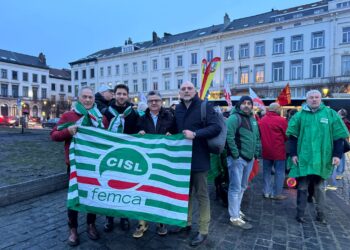

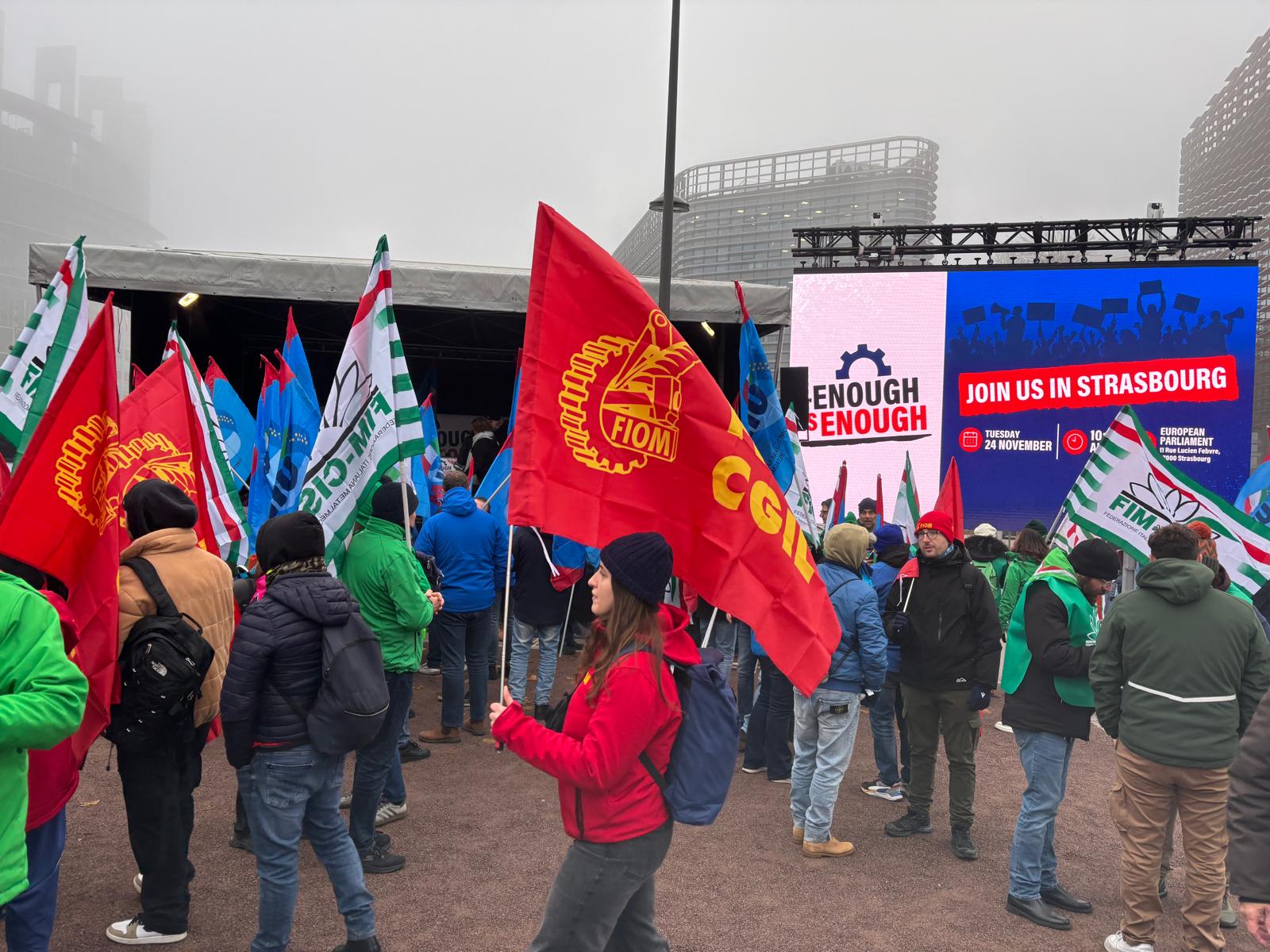
from our correspondent in Strasbourg – The English phrase “Enough is Enough” encapsulates a whole range of emotions. The anger, frustration, exhaustion and dissatisfaction of European and Italian trade unions, gathered in Strasbourg to call for an industrial policy that will revitalise investment in development, production and technological innovation within EU industries, placing workers in strategic sectors at the centre, without compromising on decarbonisation, which “is the right path”.
The event organised by IndustriAll Europe, the federation bringing together the continent’s leading industrial trade unions, has borrowed the English expression to describe the crisis currently affecting the European industrial sector. A crisis that, according to unions, risks leading to a gradual loss of production capacity and jobs, as international competition becomes increasingly fierce.
“Across Europe, we are witnessing a process of deindustrialisation in every country,” stressed Ferdinando Uliano, general secretary of Fim-Cisl, calling for the industrial issue to be placed back at the heart of the European agenda. According to the trade unionist, it is necessary to move beyond certain economic paradigms that are now inadequate: “The free market does not exist. There is a need to preserve European manufacturing and component production, and to grant autonomy to industry”. This is a goal in which “the state must play a significant role”, with policies that integrate the environment, health and innovation. Because, he warned, “safeguarding jobs is fundamental to the overall stability of our countries’ economic and social heritage”.
Samuele Lodi, general secretary of Fiom-Cgil, echoes the call for immediate action: “There is no more time to waste. We are putting, in Italy and across Europe, entire strategic industrial sectors at risk,” he said, referring in particular to the steel, automotive and household appliance sectors. According to Lodi, public and private resources must be focused on reviving these sectors rather than on an arms race. But this does not mean calling the ecological transition into question: “We cannot consider halting this process, as it would be counterproductive. We’ll give ourselves a bit of breathing space for a few more years, but then we’d literally be overwhelmed.”
The problem, he explained, is that Europe has not backed up its environmental decisions with sufficient investment in production capacity and social stability, as the automotive sector demonstrates. “The decision was the right one and far-sighted, not least with future generations in mind, but the timeframe is too long, and the necessary resources have not been allocated.” The transition, Lodi insisted, must be tackled in partnership with workers, through investment in technology and production, and through measures that safeguard jobs.
This message is also reflected in the words of Davide Sperti, general secretary of Uilm, who criticised unconditional public aid to businesses. “Enough of giving public money to companies without tying it to investment, production and job protection. Enough of the exploitation of workers. Above all, enough of deindustrialisation.”
Trade unions are calling for incentives to be made conditional on safeguarding the European supply chain: “We want 80 per cent of components produced within the EU to be protected, and for manufacturing to once again account for 20 per cent of European GDP by 2035.” Sperti added that “decarbonisation must not mean deindustrialisation”, criticising a regulatory framework that, in his view, places a burden on European businesses without achieving equivalent results in terms of global emissions.
Also in Strasbourg, Lillo Oceano, president of Fitec, spoke out, highlighting the international dimension of the crisis. The chemical, automotive and other industrial sectors end up competing in a global market, but “we have a system geared towards internal competition”. For this reason, he argued, we need “a European system that invests in development, research and technological competition”, to ensure that Europe does not fall behind its competitors.
The mobilisation is part of a broader initiative by European trade unions calling on EU institutions to adopt a common industrial strategy that links investment, technological autonomy and job protection. Behind the call for resources and new policies lies not only the survival of businesses, but also that of the communities and regions that depend on industry. And the message brought before the European Parliament this time is summed up in three words: Enough is Enough.
English version by the Translation Service of Withub