- Europe, like you've never read before -
Wednesday, 2 September 2026
No Result
View All Result
  • it ITA
  • en ENG
Eunews
  • Politics
  • World
  • Business
  • News
  • Defence
  • Health
  • Agrifood
  • Other sections
    • Culture
    • Rights
    • Energy
    • Green Economy
    • Finance & Insurance
    • Industry & Markets
    • Media
    • Mobility & Logistics
    • Net & Tech
    • Sports
  • Newsletter
  • European 2024
    Eunews
    • Politics
    • World
    • Business
    • News
    • Defence
    • Health
    • Agrifood
    • Other sections
      • Culture
      • Rights
      • Energy
      • Green Economy
      • Finance & Insurance
      • Industry & Markets
      • Media
      • Mobility & Logistics
      • Net & Tech
      • Sports
    No Result
    View All Result
    Eunews
    No Result
    View All Result

    Home » World politics » After over two months of protests, a “general civil disobedience” strike begins in Serbia

    After over two months of protests, a “general civil disobedience” strike begins in Serbia

    After the incident at the Novi Sad train station, in which 15 people died, anger erupted in the country. Students demand transparency from the government and formal charges against those responsible for violence against protesters. President Vucic denounces interference by "Western foreign agents." Brussels calls for "dialogue"

    Simone De La Feld</a> <a class="social twitter" href="https://twitter.com/@SimoneDeLaFeld1" target="_blank">@SimoneDeLaFeld1</a> by Simone De La Feld @SimoneDeLaFeld1
    24 January 2025
    in World politics
    serbia


    This aerial photograph shows demonstrators and students as they gather in front of Serbia's Constitutional Court building during a protest to demand accountability for the Novi Sad railway station tragedy, in Belgrade, on January 12, 2025. Thousands of Serbians protested in the capital Belgrade on January 12, 2025, against corruption and demanding justice for those killed in a train station roof collapse. The demonstrations have been ongoing for two months since a roof in a train station in the northern city of Novi Sad, which had recently undergone restoration work, collapsed on November 1, 2024, and killed 15 people. (Photo by TADIJA ANASTASIJEVIC / AFP)

    Brussels – In Serbia, the wave of protest triggered by the tragedy of the collapse of the bus shelter at the Novi Sad train station on Nov. 1, 2024, killing15 people and injuring two seriously, has not subsided. After nearly three months of demonstrations in Belgrade and the country’s major cities — during which tension between student movements, authorities, and law enforcement escalated — a strike of “general civil disobedience” began today (Jan. 24).

    Students and professors — some 5,000 faculty and academic staff joined student collectives — called on all Serbian citizens to join the protest and suspend activities. In addition to the faculties of the country’s major universities, which have been occupied for almost two months, some schools, non-governmental organizations, companies, stores, restaurants, and small businesses remained closed. As the Nova news agency reported, several media outlets, cultural institutions, state service unions, and city governments have joined the call, as have some categories, including doctors, lawyers, and farmers. Some opposition parties also announced protests and blockades for today.

    Students are demanding full transparency in public projects–starting with the publication of the entire documentation on the renovation of the Novi Sad train station– the withdrawal of false accusations against those arrested during the first anti-government protests in November, and the filing of criminal charges for those responsible for the violence committed on protesters, in several cases people proven to be affiliated with the ruling party, the Serbian Progressive Party (SNS) of President Aleksandar Vucic. In addition, student collectives leading the protests are calling for the resignation of the prime minister, Miloš Vučević, and the mayor of Novi Sad.
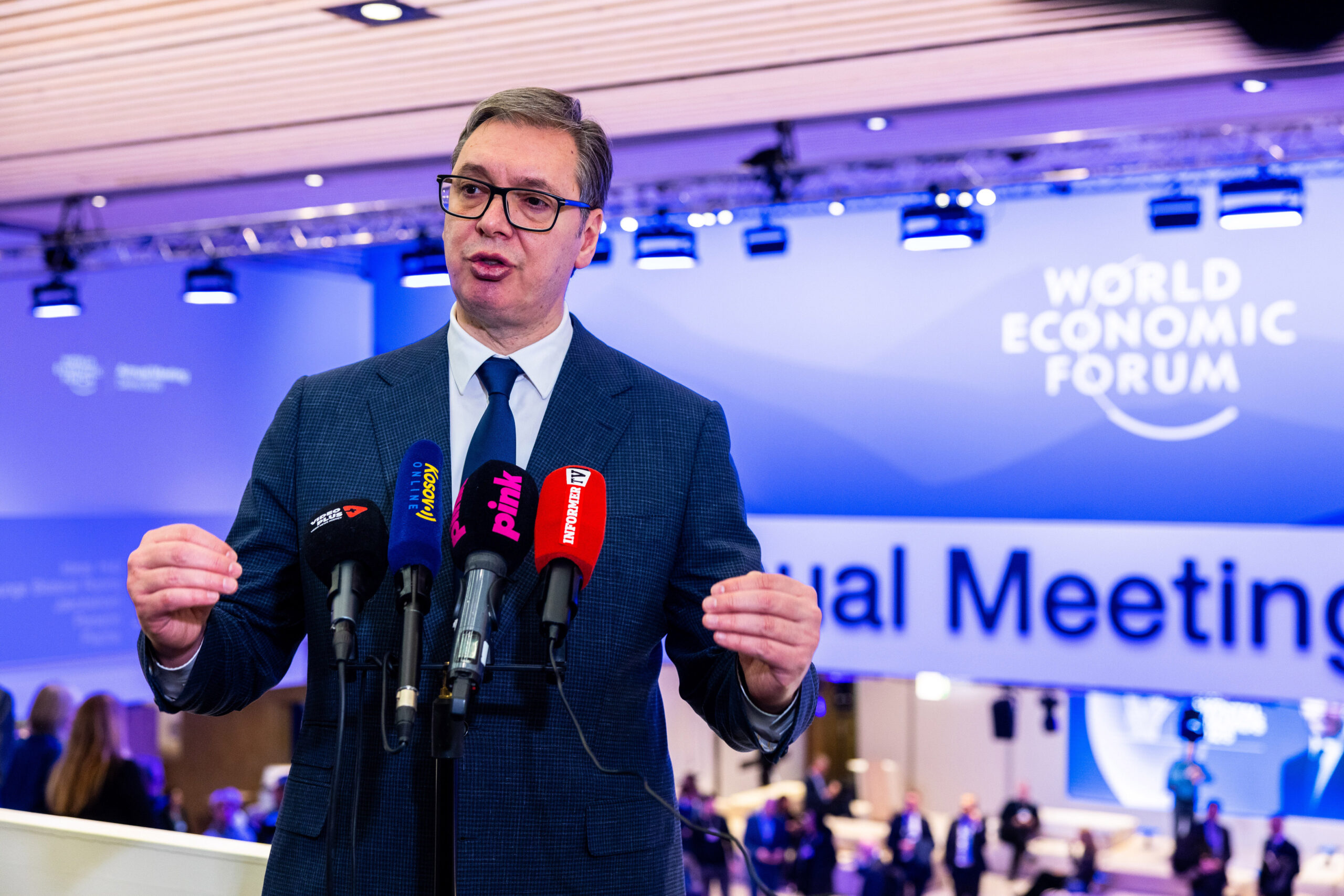
     

    Serbian president Aleksandar Vucic at the World Economic Forum in Davos, Switzerland [Photo via Imagoeconomica]
     

    Vucic, the first in the spotlight as the leader of the party in power in Belgrade for 13 years, has no choice but to counterattack. From the showcase of the World Economic Forum in Davos, he denounced the interference of “foreign agents from several Western countries” who are fueling the protests that have erupted in Belgrade. “We know this for a fact,” accused the president of the longtime candidate country for EU membership.

    Vucic proposed holding a non-binding “advisory referendum” on his presidency. However, the opposition rejected the proposal, instead urging the establishment of a transitional government toward new regular elections.

     Brussels is watching with concern the chaos that has erupted in Belgrade, which entered its 11th year since the start of EU accession negotiations on Jan. 21. European Commission spokesman for Enlargement, Guillaume Mercier, reiterated today that “freedom of assembly is a fundamental right of the EU, which must be protected and exercised peacefully and with full respect for the rule of law and public order.” The EU “continues to encourage all stakeholders who support European integration to contribute, through dialogue and compromise, to Serbia’s progress towards the path of accession to the EU,” Mercier continued.

    A path that – as noted in the European Commission’s latest report on enlargement, well before the Novi Sad incident – remains rather complicated. The snapshot that Brussels took on Oct. 30 described Belgrade as “misaligned” with the strategic priorities of EU foreign policy, very close to Moscow, not constructive on the complex dialogue with Kosovo, and sluggish in the implementation of the rule of law reforms needed to be part of the European club. “The pace of negotiations” for Belgrade’s entry into the EU “will continue to depend on reforms on the rule of law and the normalization of Serbia’s relations with Kosovo,” Brussels said in the report.

    English version by the Translation Service of Withub
    Tags: aleksandar vucicenlargementserbia

    Related Posts

    Marta Kos
    World politics

    Enlargement, Kos: “Member states also do their part”

    14 January 2025
    Vladimir Putin Donald Trump
    World politics

    Switzerland and Serbia offer to host Ukraine talks between Trump and Putin

    13 January 2025
    PORTO ATTRACCATA LA NAVE SOS HUMANITY 1  CON CIRCA 290 MIGRANTI SOCCORSI NEL MAR MEDITERRANEO CENTRALE IN TRE OPERAZIONI DI SALVATAGGIO MIGRANTE   MIGRANTI
    World politics

    EU wants Western Balkans aligned on returns and immigration pact

    18 December 2024
    Allargamento
    World politics

    EU Enlargement -3/ When Moscow is too close: obstacles to the accession of Georgia, Serbia, and Turkey

    30 October 2024
    map visualization
    Occhiali: Kevin Ku via Unsplash

    “Smart glasses”: a new Big Brother that is causing alarm across Europe

    by Iolanda Cuomo
    2 September 2026

    Some countries are pushing for a ban because those who wear them could use them as cameras and/or microphones. A...

    L'Alta rappresentante per la Politica estera e di sicurezza dell'UE, Kaja Kallas (destra), con la ministra degli Esteri dell'Irlanda

    Ukraine—Kallas’s anger: “There are too many Western and Asian components in Russia’s arsenal”

    by Emanuele Bonini emanuelebonini
    2 September 2026

    The EU’s High Representative has condemned the approximately 5,500 military components fitted to Moscow’s weapons and vehicles. “After four years...

    Carlo Comporti. Source: Imagoeconomica

    The European Parliament gives the green light to Italian Carlo Comporti to head ESMA

    by Annachiara Magenta annacmag
    2 September 2026

    Brussels – The European Parliament’s Committee on Economic and Monetary Affairs (ECON) today gave its approval to the appointment of...

    Da sinistra a destra il segretario generale, Mark Rutte, e la presidente della Commissione europea, Ursula von der Leyen. Crediti: Commissione europea

    Von der Leyen: “The attack in Leipzig marks an escalation on EU soil and a new normal”

    by Iolanda Cuomo
    2 September 2026

    The President of the European Commission and the Secretary-General of NATO met to discuss the events that took place in...

    • Director’s Point of View
    • Opinions
    • About us
    • Contacts
    • Privacy Policy
    • Cookie policy

    Eunews is a registered newspaper
    Press Register of the Court of Turin n° 27

    Copyright © 2025 - WITHUB S.p.a., Via Savona 127/B, 20144 Milano
    VAT number: 10067080969 - ROC registration number n.30628
    Fully paid-up share capital 50.000,00€


    No Result
    View All Result
    • it ITA
    • en ENG
    • Politics
    • Newsletter
    • World politics
    • Business
    • General News
    • Defence & Security
    • Health
    • Agrifood
    • Altre sezioni
      • Culture
      • Rights
      • Energy
      • Green Economy
      • Gallery
      • Finance & Insurance
      • Industry & Markets
      • Media
      • Mobility & Logistics
      • Net & Tech
      • News
      • Opinions
      • Sports
    • Director’s Point of View
    • Draghi Report
    • Eunews Newsletter

    No Result
    View All Result
    • it ITA
    • en ENG
    • Politics
    • Newsletter
    • World politics
    • Business
    • General News
    • Defence & Security
    • Health
    • Agrifood
    • Altre sezioni
      • Culture
      • Rights
      • Energy
      • Green Economy
      • Gallery
      • Finance & Insurance
      • Industry & Markets
      • Media
      • Mobility & Logistics
      • Net & Tech
      • News
      • Opinions
      • Sports
    • Director’s Point of View
    • Draghi Report
    • Eunews Newsletter

    Attention