- Europe, like you've never read before -
Tuesday, 8 September 2026
No Result
View All Result
  • it ITA
  • en ENG
Eunews
  • Politics
  • World
  • Business
  • News
  • Defence
  • Health
  • Agrifood
  • Other sections
    • Culture
    • Rights
    • Energy
    • Green Economy
    • Finance & Insurance
    • Industry & Markets
    • Media
    • Mobility & Logistics
    • Net & Tech
    • Sports
  • European 2024
    Eunews
    • Politics
    • World
    • Business
    • News
    • Defence
    • Health
    • Agrifood
    • Other sections
      • Culture
      • Rights
      • Energy
      • Green Economy
      • Finance & Insurance
      • Industry & Markets
      • Media
      • Mobility & Logistics
      • Net & Tech
      • Sports
    No Result
    View All Result
    Eunews
    No Result
    View All Result

    Home » World politics » Student protests in Serbia lead to resignation of Prime Minister Vučević

    Student protests in Serbia lead to resignation of Prime Minister Vučević

    PM announced his resignation following a new incident of violence against students in Novi Sad. Brussels: "We expect swift investigations by Serbian authorities."

    Simone De La Feld</a> <a class="social twitter" href="https://twitter.com/@SimoneDeLaFeld1" target="_blank">@SimoneDeLaFeld1</a> by Simone De La Feld @SimoneDeLaFeld1
    28 January 2025
    in World politics
    Miloš Vučević

    Serbian new elected Prime Minister Milos Vucevic walks after swearing in his cabinet before members of parliament in Belgrade on May 2, 2024. The government was approved by 152 votes in the 250-seat assembly during a marathon parliamentary session that started on Wednesday. (Photo by OLIVER BUNIC / AFP)

    Powered by powered by evolution group

    Brussels – At a press conference called in Belgrade this morning, Serbian Prime Minister Miloš Vučević announced his resignation, attempting to quell the wave of protests shaking the country for nearly three months. However, the demands of the population, led by the strong student mobilization, go far beyond that, and Vučević’s step back is unlikely to be enough to restore order.


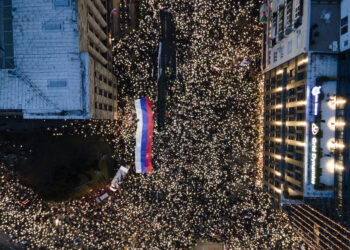
    Serbia has been paralyzed since the collapse of a bus shelter at the Novi Sad train station on Nov. 1, 2024, killing 15 people and seriously injuring two. The incident opened a can of worms about rampant corruption in the Balkan country, with thousands of people spilling into the streets shouting ‘Corruption kills.’ The escalating tensions between protesters and Serbian authorities led – on Monday, Jan. 24 – to a general civil disobedience strike and a roadblock, by students and farmers, of two major arteries into central Belgrade.

    Vučević, who was at the center of the storm because he was mayor of Novi Sad at the time of the renovation of the train station while defending the work of his government, admitted that Serbia “seems to have come to a standstill” after the tragic incident, which opened “deep divisions” in the country. Vučević reportedly decided to resign after, last night, in Novi Sad itself, some students were attacked by a violent group, causing the serious injury of a woman. According to the state media, the ambush was a sort of retaliation against the students, guilty of vandalizing an office of the Serbian Progressive Party (SNS) with anti-government graffiti and stickers. The nationalist party that has been in power for twelve years is an expression of Premier Vučević and President Aleksandar Vučić.
    serbia
    An aerial view of the anti-government protests in Belgrade (Photo by TADIJA ANASTASIJEVIC / AFP)

    “I expect the perpetrators of the attack to be arrested,” the resigning premier said in condemning the attack by the violent wing of SNS sympathizers. However, providing no evidence, he then revived accusations of foreign interference in the spread of the protests. Vučević also pointed his finger at the opposition, which he said was guilty of wanting to profit politically from the Novi Sad incident.

    From Brussels, the European Commission is closely watching developments in the Balkan country, which has been a candidate for EU membership for 11 years. “We are concerned about the incidents against protesters, for which we expect swift investigations by the Serbian authorities,” EU executive spokesman for Enlargement, Guillaume Mercier, said today, citing the attack on students in Novi Sad. “We recall that under EU law, authorities must protect participants in demonstrations from armed or violent groups,” he added.
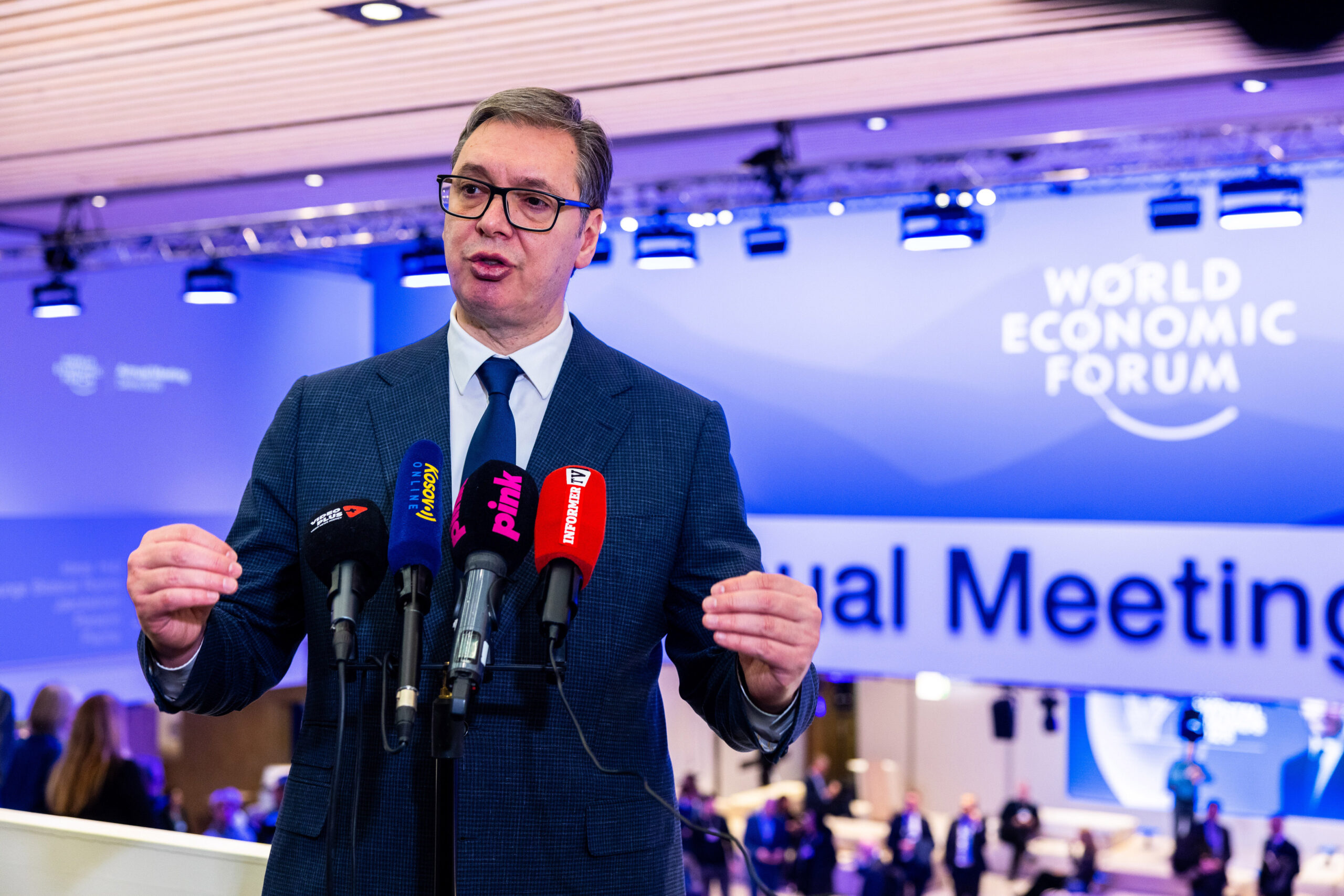
    Serbian president Aleksandar Vucic at the World Economic Forum in Davos, Switzerland [Photo via Imagoeconomica]

    In response to Belgrade’s vague accusations against Western countries – with President Vučić denouncing from the Davos forum the interference of “foreign agents, from several Western countries” to stir protests – the European Commission responded sharply: “The spread of disinformation and hostile political rhetoric, including against the EU and its citizens, has no place in the EU’s integration path.”

    Albeit cautiously, Brussels sides with the protestors, reminding them that “citizen participation plays a key role in the development of a healthy society, including promoting transparency and accountability, values we expect all candidate countries to embrace.” In addition to full transparency in public projects — starting with the publication of all of the documentation on the renovation of the Novi Sad train station — students and protesters are calling for the withdrawal of false accusations against those arrested during the protests and the filing of criminal charges against those responsible for the violence committed on protesters, in several cases people proved affiliated with Vučić’s SNS. The student collectives leading the protests also demanded the resignation of Prime Minister Vučević and the mayor of Novi Sad.

     Now that they have obtained the premier’s step back and that Vučić ordered the release of some important documents on the Novi Sad station, students and protesters are unlikely to stop. The president has thirty days to decide whether to appoint a new executive or call snap elections, which could break the SNS hegemony over the country’s political life. The public squares are waiting for him.

    English version by the Translation Service of Withub
    Tags: alexandr vucicmilos vucevicprotestsserbia

    Eunews Newsletter

    Related Posts

    serbia
    World politics

    After over two months of protests, a “general civil disobedience” strike begins in Serbia

    24 January 2025
    Marta Kos
    World politics

    Enlargement, Kos: “Member states also do their part”

    14 January 2025
    Vladimir Putin Donald Trump
    World politics

    Switzerland and Serbia offer to host Ukraine talks between Trump and Putin

    13 January 2025
    Allargamento
    World politics

    EU Enlargement -3/ When Moscow is too close: obstacles to the accession of Georgia, Serbia, and Turkey

    30 October 2024
    map visualization
    Rimpatri migran

    33,000 repatriations in the first six months of 2026, but it’s not enough. Frontex calls for further strengthening of the system

    by Annachiara Magenta annacmag
    7 September 2026

    Migration management in the EU is proceeding according to the plans set out by the Berlaymont Building: compared with the...

    Sede centrale di Eurojust a L'Aja (Paesi Bassi). Crediti: Eurojust

    Fight against transnational crime: the EU is exploring new partnerships between Eurojust and third countries

    by Iolanda Cuomo
    7 September 2026

    Brussels – To promote greater cooperation between courts and public prosecutors in the fight against organised crime is the aim...

    [credits: Dietmar Rabich / Wikimedia Commons / “Münster, Stadtweinhaus, Beflaggung Ukraine und EU -- 2022 -- 0219” / CC BY-SA 4.0]

    Weekend Round-Up War in Ukraine Brief — Europe

    by Antonia Williams
    7 September 2026

    7 September 2026 Europe heads into the new week with air and missile defence moving rapidly up the political agenda,...

    Da sinistra a destra il primo ministro della Groenlandia, Jens-Frederik Nielsen, la presidente della Commissione europea, Ursula von der Leyen, la prima ministra della Danimarca, Mette Frederiksen. Crediti: Commissione europea

    Greenland: a renewed partnership with the EU and €200 million in investment

    by Iolanda Cuomo
    7 September 2026

    Connectivity, clean energy, and critical raw materials are at the heart of the relationship. But the President of the European...

    • Director’s Point of View
    • Opinions
    • About us
    • Contacts
    • Privacy Policy
    • Cookie policy

    Eunews is a registered newspaper
    Press Register of the Court of Turin n° 27

    Copyright © 2025 - WITHUB S.p.a., Via Savona 127/B, 20144 Milano
    VAT number: 10067080969 - ROC registration number n.30628
    Fully paid-up share capital 50.000,00€


    No Result
    View All Result
    • it ITA
    • en ENG
    • Politics
    • Newsletter
    • World politics
    • Business
    • General News
    • Defence & Security
    • Health
    • Agrifood
    • Altre sezioni
      • Culture
      • Rights
      • Energy
      • Green Economy
      • Gallery
      • Finance & Insurance
      • Industry & Markets
      • Media
      • Mobility & Logistics
      • Net & Tech
      • News
      • Opinions
      • Sports
    • Director’s Point of View
    • Draghi Report
    • Eunews Newsletter

    No Result
    View All Result
    • it ITA
    • en ENG
    • Politics
    • Newsletter
    • World politics
    • Business
    • General News
    • Defence & Security
    • Health
    • Agrifood
    • Altre sezioni
      • Culture
      • Rights
      • Energy
      • Green Economy
      • Gallery
      • Finance & Insurance
      • Industry & Markets
      • Media
      • Mobility & Logistics
      • Net & Tech
      • News
      • Opinions
      • Sports
    • Director’s Point of View
    • Draghi Report
    • Eunews Newsletter

    Attention