Brussels – “The facts prove that we were right,” Giorgia Meloni declared triumphantly yesterday (April 16), scrolling down the list of safe countries of origin the European Commission compiled. Ursula von der Leyen served her a perfect assist by including among the seven Egypt and Bangladesh, the two countries so far at the center of the Italian premier’s controversial plan to transfer to hotspots in Albania asylum seekers subject to expedited procedures. Thus, while the EU Court of Justice should rule on the issue, Brussels offers data and assessments that justify Italy choosing to consider those countries – which account for about 30 percent of asylum applications in Italy – safe countries of origin.
The European Commission relied on the EU Asylum Agency (EUAA), which suggested considering countries of origin that generate a “significant load of asylum applications in the EU” yet have a recognition rate for applicants of 5 percent or less. In addition, Brussels narrowed the scope to countries already on member states’ national lists. According to the legislative proposal, the information provided by the EUAA to assess safety is based on “a variety of sources,” including reports from the EU institutions themselves, reports from the EU Fundamental Rights Agency (FRA), and the UN High Commissioner for Refugees (UNHCR), as well as other international and non-governmental organizations, think tank analyses and verified media reports.
Egypt and Bangladesh are both on the lists of six member states, and both recorded a 4 percent recognition rate for applicants in 2024. At an EU level, last year, Bengali and Egyptian asylum seekers accounted for 7 percent of the total, about 68,000. Over two-thirds applied in Italy, where Bangladesh alone accounted for 21 percent of all asylum applications (33,455) and Egypt 8 percent (11,979).
The ongoing political transition in Bangladesh
As for Bangladesh, the European Commission points out that it is “undergoing a political transition that moves it away from a repressive system characterized by frequent human rights violations.” Dhaka is home to a parliamentary republic, where an interim government led by Nobel Peace Prize winner Muhammad Yunus took office last August. The former premier, Sheikh Hasina, was toppled by mass anti-government protests, during which authorities reportedly arrested 11,000 people and killed over 600 protesters. The interim government is expected to organize new elections and begin work to restore democratic institutions.

According to the analysis offered by Brussels, “there are no indications of expulsion, removal, or extradition of Bangladeshi nationals to countries where there is a risk of the death penalty, torture, persecution, or inhuman or degrading treatment.” While “sporadic tensions” involving Indigenous and religious minorities remain, LGBTQI people “continue to face discrimination and harassment.” Homosexuality is a crime punishable by imprisonment. Despite ratification of the Istanbul Convention against Violence against Women, in Bangladesh “gender violence remains a prevalent issue, with incidents of sexual harassment in the workplace and schools.”
The same goes for the Convention against Torture and Cruel, Inhuman and Degrading Treatment: Dhaka has ratified it, but -at least until the previous government – “there have been reports of torture and ill-treatment of detainees by law enforcement and the military.” There is still the death penalty, but “death sentences are rarely carried out.” Finally, “there are no armed conflicts taking place and therefore no threat exists by reason of indiscriminate violence in situations of international or internal armed conflict,” the Commission estimates.
The end of the state of emergency in Egypt
There are the same critical issues for Egypt. In 2021, President Adel Fattah al-Sisi, in power since 2014, abolished the state of emergency (in place, except for a brief hiatus from 2012 to 2017, for 40 years). However, authorities “continue to use emergency and military courts to prosecute people under generic provisions of counterterrorism legislation and other laws,” notes the European Commission. Although the Constitution protects religious and gender identity and the law punishes crimes of discrimination and incitement to hatred, “some religious denominations may be subject to discrimination in practice,” and “human rights defenders, political activists, and opponents may be victims of arbitrary arrest and torture and may be subject to measures such as travel restrictions and asset freezes.”
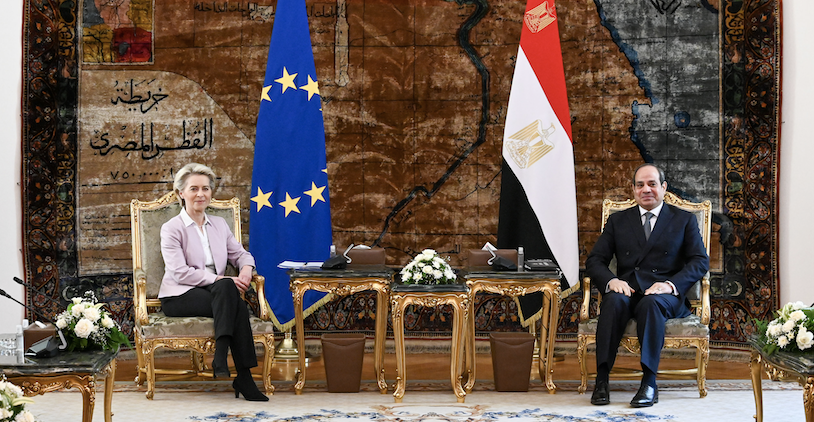
Ursula von der Leyen with Egyptian president, Abdel Fattah al-Sisi
Brussels admits that human rights challenges in Egypt “remain significant” but highlights some encouraging measures in recent years. In its National Human Rights Strategy, Cairo has put on the agenda a reform of pre-trial detention rules and an improvement in detention conditions, as well as a narrowing of crimes punishable by the death penalty and a “strengthening of the human rights culture in all government institutions.”
Despite the slew of issues put black on white in the legislative proposal, for both countries, the European Commission highlights the most recent progress and concludes that “in light of the analysis carried out and as also evidenced by the low recognition rate at the EU level,” the populations of Bangladesh and Egypt are “generally not subject to persecution or a real risk of suffering serious harm.” The same is true of Tunisia, whose authoritarian President Kais Saied “has made arbitrary detentions a cornerstone of his policy of repression to deprive citizens of their civil and political rights,” according to a report released yesterday by Human Rights Watch.
English version by the Translation Service of Withub



![Il ministro dei Trasporti, Matteo Salvini [Bruxelles, 5 dicembre 2024. Foto: Emanuele Bonini per Eunews]](https://www.eunews.it/wp-content/uploads/2024/12/salvini241205-120x86.jpeg)