- Europe, like you've never read before -
Friday, 13 March 2026
No Result
View All Result
  • it ITA
  • en ENG
Eunews
  • Politics
  • World
  • Business
  • News
  • Defence
  • Health
  • Agrifood
  • Other sections
    • Culture
    • Diritti
    • Energy
    • Green Economy
    • Finance & Insurance
    • Industry & Markets
    • Media
    • Mobility & Logistics
    • Net & Tech
    • Sports
  • Newsletter
  • European 2024
    Eunews
    • Politics
    • World
    • Business
    • News
    • Defence
    • Health
    • Agrifood
    • Other sections
      • Culture
      • Diritti
      • Energy
      • Green Economy
      • Finance & Insurance
      • Industry & Markets
      • Media
      • Mobility & Logistics
      • Net & Tech
      • Sports
    No Result
    View All Result
    Eunews
    No Result
    View All Result

    Home » Defence & Security » Nato, Spain to meet 2 per cent of GDP defence target by 2025

    Nato, Spain to meet 2 per cent of GDP defence target by 2025

    Socialist Prime Minister Pedro Sánchez is backtracking on his earlier commitment to hit the Alliance target by 2029 by allocating previously unused resources from other items in the national budget to military spending. But Washington is already pushing to hit 3 per cent (if not more)

    Francesco Bortoletto</a> <a class="social twitter" href="https://twitter.com/bortoletto_f" target="_blank">bortoletto_f</a> by Francesco Bortoletto bortoletto_f
    22 April 2025
    in Defence & Security, Politics
    Pedro Sánchez

    Spain's Prime Minister Pedro Sanchez gestures as he delivers a speech during a press conference following a council of Ministers' meeting at the Moncloa Palace in Madrid on April 22, 2025. (Photo by JAVIER SORIANO / AFP)

    Brussels – In the end, Spain, too, gave in to pressure from Donald Trump. Just a couple of months after announcing that he would meet the NATO-agreed target of 2 per cent of GDP in defence spending by 2029, the social-democratic premier, Pedro Sánchez, reconsidered and adjusted his goal. Now, Madrid is aiming to hit the target by the end of the year.

    It was mid-February when, bucking the trend of all other Alliance members, the Socialist prime minister announced that the Spanish government would use all the time between now and the end of the decade to gradually increase its military budget to 2 per cent of gross domestic product.

    This goal had been set at the political level by NATO partners back in 2014—after Vladimir Putin‘s Russia had unilaterally annexed the Crimean Peninsula and supported Ukrainian separatists in the Donbass—and then was translated into a binding goal in 2022, during the summit held precisely in Madrid where, moreover, Finland and Sweden had been formally invited within the Alliance. However, as certified by Secretary-General Mark Rutte last December, 2 per cent is no longer enough.

    And so Sánchez unveiled today (April 22) the “National Plan for the Development and Promotion of Defense and Security Technology,” with which he puts €10.47 billion on the table by the end of 2025, to be spent mainly on expanding the size of the armed forces, purchasing new equipment and modernising technological infrastructure (especially in satellite networking, artificial intelligence and cybersecurity). The defence budget will thus rise to a record 33.12 billion.

    Pedro Sánchez
    Spanish Prime Minister Pedro Sánchez (photo: European Council)

    The leader of the Socialist Party (PSOE) has clarified that this money comes from unused funds from NextGeneration EU and other budget items for fiscal year 2023, and will therefore require neither painful cuts in social spending nor deficit financing. Moreover, since this is essentially a reallocation of already allocated resources, they will not need to go through parliamentary approval, a potentially narrow passage for the minority executive that depends on external support from the radical left and Independents.

    The prime minister acknowledged differences in views with the government’s junior coalition partner, Sumar, especially regarding investment in armaments. But he assured that there is a “consensus” on the goal and most of the plan’s points, which are structured into five sections. He assured that the national GDP will benefit with an increase of between 0.4 and 0.7 per cent, which will allow the economy to experience a new phase of “reindustrialisation”.

    The timing of the announcement is no coincidence: tomorrow is the deadline for NATO members to notify their spending plans for the current year. These plans will then be the focus of discussions at the next Alliance summit, scheduled for late June in The Hague.

    To date, Spain is the member of the organisation that spends the least on its defence in relation to GDP. Estimates for 2024 speak of 1.28 per cent, worth more than €17 billion. Along with Madrid, six other countries have not yet reached the 2 per cent target: six EU members (Belgium, Croatia, Italy, Luxembourg, Portugal, and Slovenia) and Canada. During his recent visit to Washington, Italian Prime Minister Giorgia Meloni promised that Rome will reach the target by the Hague summit.
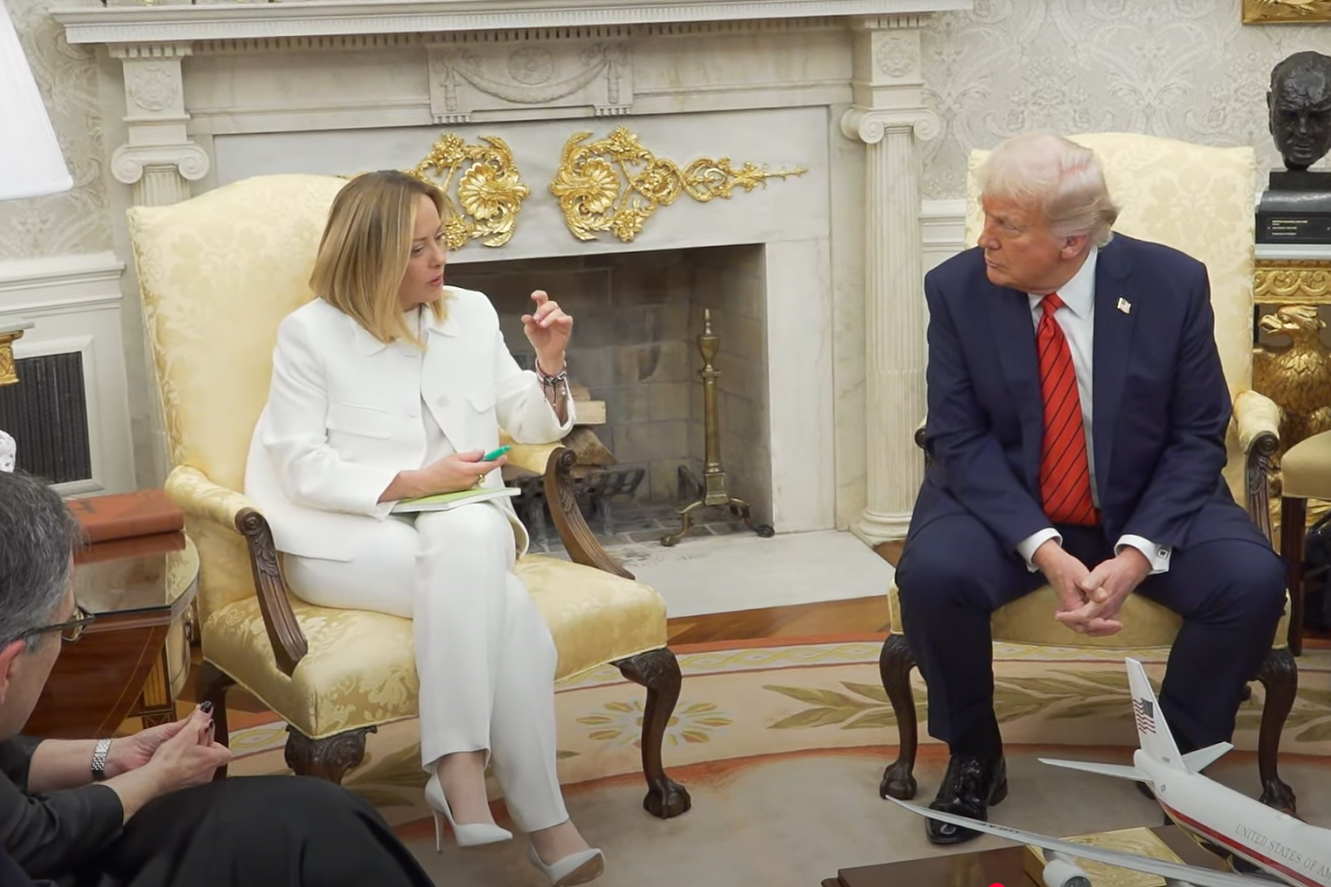
    Giorgia Meloni Donald Trump
    U.S. President Donald Trump welcomes Italian Prime Minister Giorgia Meloni in the Oval Office, April 17, 2025 (photo via Imagoeconomica)

    Sánchez has thus found himself under increasing international pressure to bring Madrid’s spending in line with that of its allies, especially in the prospect of a potential U.S. disengagement from the Old Continent (a prospect that, indeed, seems more real than ever). With her ReArm Europe plan, Ursula von der Leyen has already given the Twenty-Seven carte blanche to increase their defence spending without incurring infringement procedures under the Stability and Growth Pact.

    After all, the White House led by Donald Trump has long been urging its European partners to take direct charge of their own security, as well as the management of peace in Ukraine once hostilities are over, by prospecting new military spending benchmarks of up to 5 per cent of GDP (a target that even the US will not reach that easily, allocating less than 3.4 per cent to defense for now). For the time being, it seems more likely that at The Hague the tycoon will ask for at least 3 per cent, much to the chagrin of allies such as Rome and Madrid, who are already struggling to reach 2 per cent.

    English version by the Translation Service of Withub
    Tags: bornmark ruttemilitary spending 2%pedro sanchezspain

    Related Posts

    meloni trump
    World politics

    Meloni gets Trump’s OK to possible meeting with Europe. No news on tariffs

    18 April 2025
    Connact 2025 Roma Difesa
    Defence & Security

    ConnAct Defence: focus in Rome on synergies between NATO, EU, and Italy

    15 April 2025
    Pedro Sánchez
    Politics

    Sánchez “challenges” Trump on defense spending: “We will reach 2 per cent in 2029”

    18 February 2025
    map visualization
    Latte in polvere

    Powdered milk recalled, EU: No link established with infant deaths, but maximum vigilance

    by Annachiara Magenta annacmag
    13 March 2026

    European Commissioner Olivér Várhelyi explained that the European Commission had not found “the existing rules to be inadequate”, whilst reiterating...

    A Russian cargo ship carrying crude oil docked at the Karachi port in Karachi on June 28, 2023. (Photo by Rizwan TABASSUM / AFP)

    EU clashes with US over lifting of sanctions on Russian oil: “It jeopardises European security”

    by Giulia Torbidoni
    13 March 2026

    Zelensky believes the measure strengthens Moscow and does promote peace. Criticism from Paris and Berlin, while Moscow and Budapest welcome...

    PRONTO SOCCORSO BARELLA LETTIGA LETTO OSPEDALE MEDICI INFERMIERI PAZIENTE MEDICO INFERMIERE EMERGENZA GENERATE AI IA

    Deaths from circulatory diseases are falling slightly across the EU, whilst deaths from cancer are gradually rising

    by Emanuele Bonini emanuelebonini
    13 March 2026

    Eurostat data confirm that, by the end of 2023, stroke, hypertension, thrombosis and related conditions remain the leading cause of...

    Sigarette elettroniche

    Health: 48 per cent of e-cigarettes in Europe come from unauthorised sources

    by Annachiara Magenta annacmag
    13 March 2026

    This is the finding of a new study by the Fraunhofer Institute for Integrated Circuits IIS, which analyses the size...

    • Director’s Point of View
    • Opinions
    • About us
    • Contacts
    • Privacy Policy
    • Cookie policy

    Eunews is a registered newspaper
    Press Register of the Court of Turin n° 27


    Copyright © 2025 - WITHUB S.p.a., Via Rubens 19 - 20148 Milan
    VAT number: 10067080969 - ROC registration number n.30628
    Fully paid-up share capital 50.000,00€


    No Result
    View All Result
    • it ITA
    • en ENG
    • Politics
    • Newsletter
    • World politics
    • Business
    • General News
    • Defence & Security
    • Health
    • Agrifood
    • Altre sezioni
      • European Agenda
      • Culture
      • Diritti
      • Energy
      • Green Economy
      • Gallery
      • Finance & Insurance
      • Industry & Markets
      • Media
      • Mobility & Logistics
      • Net & Tech
      • News
      • Opinions
      • Sports
    • Director’s Point of View
    • Draghi Report
    • Eunews Newsletter

    No Result
    View All Result
    • it ITA
    • en ENG
    • Politics
    • Newsletter
    • World politics
    • Business
    • General News
    • Defence & Security
    • Health
    • Agrifood
    • Altre sezioni
      • European Agenda
      • Culture
      • Diritti
      • Energy
      • Green Economy
      • Gallery
      • Finance & Insurance
      • Industry & Markets
      • Media
      • Mobility & Logistics
      • Net & Tech
      • News
      • Opinions
      • Sports
    • Director’s Point of View
    • Draghi Report
    • Eunews Newsletter

    Attention