Brussels – Another round, more half-silences. The EU does not want to raise its voice on Serbia, choosing not to tackle two key issues: the closeness of President Aleksandar Vučić to Vladimir Putin‘s Russia and the repression of anti-government protests. On a visit to Belgrade, Kaja Kallas was just a tad more talkative than António Costa, who had preceded her by about ten days. But even she failed to pronounce a clear-cut condemnation of the Serbian leader’s authoritarianism, nor the candidate country’s slide towards Moscow.
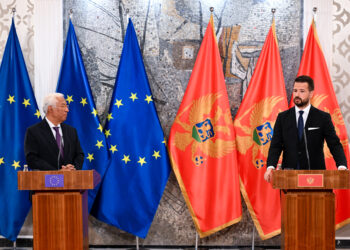
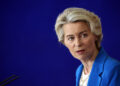
For the second time in a dozen days, one of the EU summits came to Belgrade to confront the Serbian leadership on the progress in the accession process. Today (22 May) it was the turn of Kaja Kallas, after the President of the European Council António Costa on 13 May.
Compared to the latter, the High Representative was a bit more blunt. “I want to emphasise that we need to see concrete actions from the Balkan country that demonstrate a real willingness to progress on the path to EU membership,” she said in front of reporters. The only way for Belgrade to advance on the European path, she said, is to realise real reforms, not cosmetic ones. “There are no shortcuts to membership,” she added, suggesting that “the next steps include freedom of the media, fighting corruption, and electoral reform.”
My message to the authorities in Belgrade is clear.
I want to see Serbia advancing towards the EU. For that, political leaders must deliver the necessary reforms and clarify the strategic direction.
This is best done by restoring trust and staying true to democratic principles.
pic.twitter.com/I9Jv9BV33P — Kaja Kallas (@kajakallas)
May 22, 2025
These reforms, she noted, will benefit the entire population, starting with the young animators of the fierce student movement, who have been pouring into the streets for months to demand a serious commitment against the rampant corruption and claim their European future. A future in which “the autonomy of universities must be respected”, said Kallas, explicitly recognising the demands of the protesters.
But his loquacity stopped there. No condemnation of the government-ordered repression of protests, other than vague words about the need for “candidate countries to follow the principles of human rights“, including that of a fair trial, which was denied to the students arbitrarily detained in Serbian prisons.
And no explicit condemnation either of President Vučić’s sensational trip to Moscow, where he participated in the celebrations on 9 May together with Vladimir Putin. This was a real slap in the face to Kallas herself, who had personally urged the leaders of member states and candidate countries not to show up on Red Square (representing the first category was Slovak Prime Minister Robert Fico).
Answering a question on the subject, the twelve-star diplomacy chief merely repeated that “my point of view is very clear, I do not understand why it is necessary to stand side by side with the person who is conducting this horrible war in Ukraine“. She then added, without further elaborating, that the head of state “explained to me his side of the story” during a “very long discussion.”

Vučić’s closeness to the Kremlin is one of the biggest embarrassments in Brussels as far as the candidate country’s foreign policy is concerned. The other element that is “obstructing alignment with CFSP“, i.e. EU foreign policy, is the stalemate in the process known as the Belgrade-Pristina Dialogue, the aim of which is the normalisation of diplomatic relations between Serbia and Kosovo.
“Serbia is facing important geostrategic choices“, Kallas remarked, and must decide “where it wants to stand”. “Serbia’s European future depends on the values it chooses to uphold” at home and abroad, the High Representative said: both in relations with Russia and in neighbourhood relations, starting with Kosovo and Bosnia-Herzegovina.
Kallas’s invitation: “It is time to overcome the past and focus on our common future“. Brussels encourages the Western Balkan partners to “build on the current momentum of enlargement” while recognising the slow pace of a process that has so far produced few concrete results. Kalla acknowledges that if the candidate countries implement reforms but the Twenty-Seven do not do ‘their homework’, the risk is to fuel ‘frustration’ in citizens.
Her visit to Belgrade was the first leg of a tour of the region that traces, albeit in a shortened version, that of Costa: having left Serbia, the High Representative travelled to Kosovo. From Pristina, she announced that the EU “has begun to gradually lift the measures introduced in June 2023,” i.e. the sanctions that followed the clashes in the country’s north, but that the total removal remains “conditional” on a complete de-escalation. Tomorrow, the High Representative will conclude her trip to North Macedonia.
English version by the Translation Service of Withub