- Europe, like you've never read before -
Friday, 17 April 2026
No Result
View All Result
  • it ITA
  • en ENG
Eunews
  • Politics
  • World
  • Business
  • News
  • Defence
  • Health
  • Agrifood
  • Other sections
    • Culture
    • Diritti
    • Energy
    • Green Economy
    • Finance & Insurance
    • Industry & Markets
    • Media
    • Mobility & Logistics
    • Net & Tech
    • Sports
  • Newsletter
  • European 2024
    Eunews
    • Politics
    • World
    • Business
    • News
    • Defence
    • Health
    • Agrifood
    • Other sections
      • Culture
      • Diritti
      • Energy
      • Green Economy
      • Finance & Insurance
      • Industry & Markets
      • Media
      • Mobility & Logistics
      • Net & Tech
      • Sports
    No Result
    View All Result
    Eunews
    No Result
    View All Result

    Home » Green Economy » Circular economy: new EU measures against the destruction of unsold clothing

    Circular economy: new EU measures against the destruction of unsold clothing

    To tackle the problem of waste, the European executive suggests that companies adopt good practices: "evaluate alternatives such as resale, recycling, reuse, and donations"

    Annachiara Magenta</a> <a class="social twitter" href="https://twitter.com/annacmag" target="_blank">annacmag</a> by Annachiara Magenta annacmag
    9 February 2026
    in Green Economy
    Producer :
CE - Service audiovisuel
Photographer :
Sergei Gapon

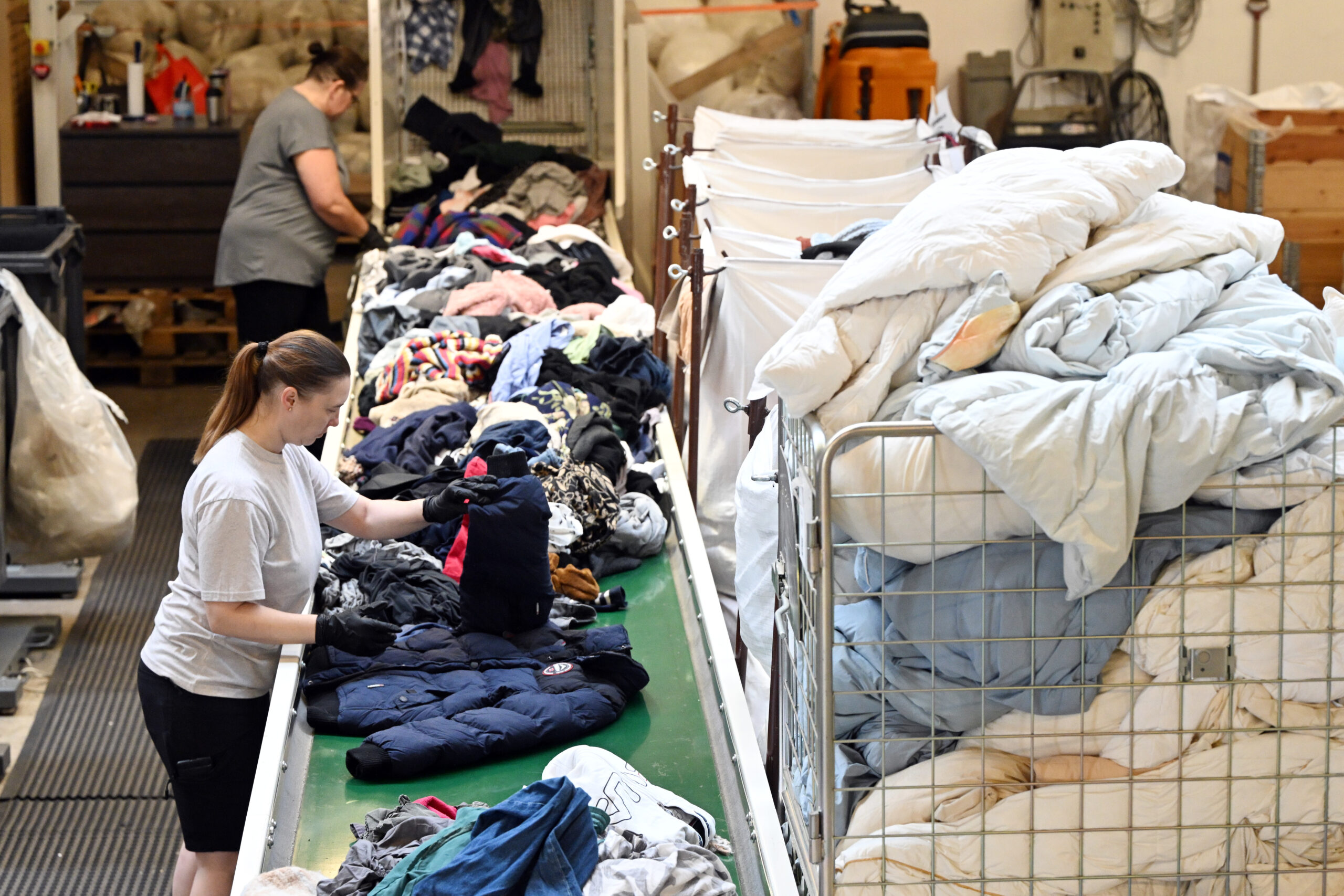
    Employees work at the world's first fully automated textile sorting facility of NewRetex A/S company in Bjerringbro on July 11, 2025.

    Brussels – New rules on the disposal of unsold textiles were adopted today (9 February) by the European Commission under the Ecodesign for Sustainable Products Regulation (ESPR), which aims to prevent the destruction of unsold clothing, accessories, and footwear. “Every year in Europe, around 4-9 per cent of unsold textiles are destroyed before they are even worn. This waste generates around 5.6 million tonnes of CO2 emissions, a figure almost equivalent to Sweden’s total net emissions in 2021,” writes the European Commission. According to EU data, for example, in France alone, approximately €550 million worth of unsold products are destroyed each year. This harmful practice is also fuelled by online shopping: in Germany, nearly 20 million returned items are discarded each year. In this context, the new measures aim to clarify the circumstances under which destruction will be permitted and to introduce a standardised format that allows companies to report the volumes of unsold consumer goods they dispose of. 

    In particular, to address carbon waste, the new measures require companies to disclose the volumes of unsold consumer goods they dispose of in a standardised format and to clarify the circumstances under which destruction will be permitted, for example, for safety reasons or due to product damage. The ban on destruction will apply to large companies from 19 July 2026. Medium-sized companies will be required to comply by 2030. “The new measures,” continues the European executive, “will help to reduce waste, reduce environmental damage and create a level playing field for businesses,” and, to tackle the problem of waste, “we encourage businesses to consider viable alternatives such as resale, recycling, reuse, and donations“. 

    “The textile sector is leading the way in the transition to sustainability, but there are still challenges to be addressed. Waste data demonstrates the need for action. Thanks to these new measures, it will be able to move towards sustainable and circular practices, enabling us to increase our competitiveness and reduce our dependencies,” comments Commissioner for the Environment, Water Resilience and a Competitive Circular Economy Jessika Roswall. 

    The ESPR, which came into force on 18 July 2024, is part of a broader package of measures to achieve the objectives of the Circular Economy Action Plan 2020, a strategy that aims to promote the transition to a circular, sustainable, and competitive economy and help the EU achieve its environmental and climate goals, double its rate of circularity in the use of materials and achieve its energy efficiency targets by 2030.

    English version by the Translation Service of Withub

    Tags: circular economyeco-sustainabilitygreen economyrecyclingreuse

    Related Posts

    (Archivio Eunews)
    Business

    Connact Annual Meeting. Fitto: “Status quo not an option for EU. Key words are simplification and flexibility”

    5 February 2026
    Green Economy

    Recycled plastic packaging: petrochemical industry mesmerises Brussels

    27 January 2026
    Andrea D'Amato (dx). Foto: Federazione carta e grafica Confindustria
    Briefs

    92 per cent paper recycling in packaging: Made in Italy leads European challenge

    11 December 2025
    map visualization

    Bulgaria votes again: Rumen Radev leading amid anti-corruption rhetoric and allegations of pro-Putinism

    by Giorgio Dell'Omodarme
    16 April 2026

    In what will be the eighth election in five years, the coalition led by the former President of the Republic...

    Tabacco, mercato illecito, Parlamento europeo

    Clash in the European Parliament over the illicit tobacco market: a real problem or an overreaction?

    by Annachiara Magenta annacmag
    16 April 2026

    Experts Hana Ross and Kristijan Fidanovski argue that "the only annual estimates of illicit rates we have are commissioned by...

    I vigili del fuoco lavorano tra le macerie di una sezione di un condominio di nove piani nel quartiere di Sviatoshynskyi, distrutto dall'attacco missilistico e con droni russi a Kiev, il 31 luglio 2025. Sei persone sono morte nella capitale, tra cui un bambino di sei anni e sua madre, e decine sono rimaste ferite. Fonte: Ipa Agency (Foto di Danylo Antoniuk/Ukrinform) (Foto di Ukrinform/Ukrinform/Sipa USA)

    The EU following Russian attacks on Ukrainian cities: “We will step up the pressure on Moscow”

    by Giulia Torbidoni
    16 April 2026

    A delegation of European Commission officials will be in Budapest tomorrow to discuss various issues with the incoming post-Orbán government....

    Christine Lagarde arrives at the Governing Council meeting prior to the ECB press conference on 19 March 2026 in Frankfurt.

    ECB: “Rates unchanged in March, a decision driven by prudence and responsibility”

    by Emanuele Bonini emanuelebonini
    16 April 2026

    In the minutes of its latest meeting, the Governing Council of the European Central Bank emphasises the importance of its...

    • Director’s Point of View
    • Opinions
    • About us
    • Contacts
    • Privacy Policy
    • Cookie policy

    Eunews is a registered newspaper
    Press Register of the Court of Turin n° 27


    Copyright © 2025 - WITHUB S.p.a., Via Rubens 19 - 20148 Milan
    VAT number: 10067080969 - ROC registration number n.30628
    Fully paid-up share capital 50.000,00€


    No Result
    View All Result
    • it ITA
    • en ENG
    • Politics
    • Newsletter
    • World politics
    • Business
    • General News
    • Defence & Security
    • Health
    • Agrifood
    • Altre sezioni
      • Culture
      • Diritti
      • Energy
      • Green Economy
      • Gallery
      • Finance & Insurance
      • Industry & Markets
      • Media
      • Mobility & Logistics
      • Net & Tech
      • News
      • Opinions
      • Sports
    • Director’s Point of View
    • Draghi Report
    • Eunews Newsletter

    No Result
    View All Result
    • it ITA
    • en ENG
    • Politics
    • Newsletter
    • World politics
    • Business
    • General News
    • Defence & Security
    • Health
    • Agrifood
    • Altre sezioni
      • Culture
      • Diritti
      • Energy
      • Green Economy
      • Gallery
      • Finance & Insurance
      • Industry & Markets
      • Media
      • Mobility & Logistics
      • Net & Tech
      • News
      • Opinions
      • Sports
    • Director’s Point of View
    • Draghi Report
    • Eunews Newsletter

    Attention