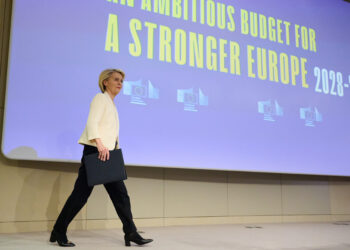
Brussels – In unveiling her post-2027 EU budget plan, Ursula von der Leyen irritated a considerable number of individuals, institutions, bodies, and organisations. In addition to the political protests that rained down on the president of the Commission for the content of her proposal, the Berlaymont helmswoman also came under crossfire from the press for the communicative and organisational management of the day, which resulted in complete chaos.
So much so that the International Press Association (API-IPA), which represents the correspondents based in Brussels, sent the twelve-star executive an open letter of formal protest. In the letter dated 18 July, API “strongly deplores the lack of transparency demonstrated by the European Commission during the presentation of the revised multiannual financial framework (MFF)” on Wednesday (16 July).
The association found “several breaches of the formal agreement between the Commission and the IPA, last updated 15 March 2023,” severely impacting “the ability of journalists to report accurately and promptly on a key political event,” reads the document, which bears the signature of President Dafyyd ab Iago.
.

Considering, on the one hand, the relevance of the issue and, on the other, the fundamental role played by the independent press, Eunews publishes the text of the letter in its entirety. As argued in the latter, “the functioning of democracy depends on timely and reliable access to information.
The repeated breaches of communication protocols risk undermining public trust and diminish the ability of the press to hold institutions accountable.”
The agreement that the IPA allegedly considers violated “establishes clear rules to provide journalists with the information they need to do their job: to provide reliable information to the public. This is clearly in the interest of both the Commission and the press. By violating the agreement, the Commission not only damages its relationship with accredited journalists, but also doubles its own reliability towards the general public.”
“It was absurd to present a highly complex €2 trillion, seven-year budget—radically different in structure from previous MFFs—without even providing a basic table of figures. This appears to be an attempt to instrumentalise and confuse, delivering PR content with no possibility of verification by correspondents. The press materials were also incomplete,” ab Iago added.
The API points the finger at the following violations: ‘Lack of planning transparency:
There were insufficient details shared on the planning of the day. No agenda was communicated until the media advisory announcing President von der Leyen’s press conference — sent just six minutes before its start. This violates the agreement requiring that the agenda for the current and following day be sent each morning on working days

In addition, there was a “delayed communication of the decisions:
The press release on the MFF was only circulated at the end of the president’s press conference—long after the conclusion of the College meeting where the legislative decisions were taken. This is a breach of the API-Commission agreement (point I.c.), which stipulates that journalists should be informed of decisions immediately.”
Finally, the API reports the lack of access to relevant legal documents and technical data. “No legislative texts were made available to the press until late on 16 July. A limited number of legislative texts were then uploaded to the Commission’s website. Even by the morning of Thursday 17 July, nearly 24 hours after the decisions were made, there was no indication from the Commission that further texts would follow. Additional documents were only discreetly published around midday.”
The same also notes that “presenting a complicated long-term budget with a new structure, without even publishing the underlying table summarising the key spending categories appears to breach your commitment to API to supply accurate technical data.”
Normally, on the occasion of the presentation of important legislative files, the documentation, legal and technical, is sent in advance to the press corps under embargo: that is, not for publication but for consultation only, so that reporters arrive prepared for press conferences and can ask precise, punctual and coherent questions. None of this happened on the occasion of the presentation of what is probably the most important legislative proposal of von der Leyen’s second term, and one that will decisively condition the EU’s ability to act in the coming years.

As a direct consequence, both von der Leyen and his Budget Commissioner, Piotr Serafin, had to conduct their respective presentations—the former at the Berlaymont, in front of journalists, when the latter had started a few minutes before, to face fierce MEPs—with only slides. Throughout the day, technical briefings, press points, hearings, and presentations were postponed nonstop, and many of them ended up being cancelled or rescheduled for the next day.
In addition to communication and organisational problems, the von der Leyen-designed MFF project immediately had to contend with strong political resistance. Starting from within the College itself: the meeting on Wednesday morning, according to the reconstructions circulated in recent hours, was protracted by several hours due to the apparent ‘rebellion’ of half a dozen commissioners against the draft budget proposed by the president. Which, according to leaks, had not been anticipated even to them.
Having calmed the tensions and reasserted her control, described by many as top-down, over the College, von der Leyen then met the press as Serafin faced the gauntlet of the EU Parliament. This morning, the Budget Commissioner informed the Twenty-Seven during the General Affairs Council.
As widely expected, there has already been considerable resistance among Member States, which will need to be overcome in order to secure the 2028-2034 MFF. Two and a half intense years are ahead. Eunews and all journalists hope to be given the opportunity to report on them.
English version by the Translation Service of Withub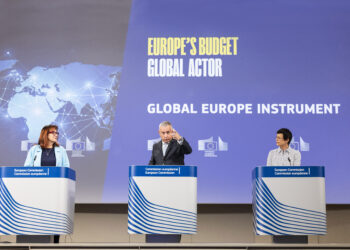
![Il vicepresidente esecutivo della Commsisione europea, Raffaele Fitto, in commissione Sviluppo delle regioni del Parlamento europeo [Bruxelles, 17 luglio 2025]](https://www.eunews.it/wp-content/uploads/2025/07/fitto-regi2-350x250.png)

![La presidente della Commissione europea, Ursula von der Leyen, presenta la proposta di bilancio pluriennale [Bruxelles, 16 luglio 2025. Foto: Emanuele Bonini]](https://www.eunews.it/wp-content/uploads/2025/07/Vdl-mff-350x250.jpeg)