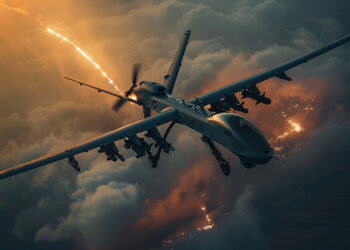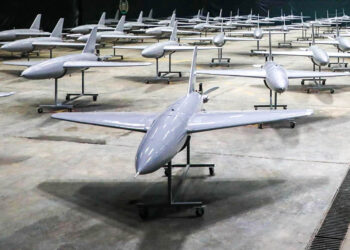

Brussels – Objective: to produce “low-cost” anti-drone and anti-aircraft defence technology in Europe. The countries of the E5 group (France, Germany, Italy, Poland, and the United Kingdom) have signed a joint declaration to develop the most advanced industrial sector in security and defence. “Drones are revolutionising the battlefield, they are changing the course of the war in Ukraine,” said Polish Defence Minister Wladislaw Kosiniak-Kamysz at the end of the meeting hosted in Warsaw. But drones “change every day” in terms of their characteristics and, above all, their “built-in artificial intelligence”, and it is not surprising, the Polish minister emphasised, that “all this is part of the joint declaration.”
This is the path to follow, as the UK Minister for Industry and Defence, Luke Pollard, is well aware and convinced: “We can do a lot together on this front,” he notes. “This is precisely what the commitment is for, to intensify technological production,” necessary to keep up with the times. Because, as the Italian Undersecretary of State for Defence, Isabella Rauti, acknowledges, as individual countries and as Europe, “we are vulnerable” in the face of new types of threats and “in this context, the response must be collective, proactive, and coordinated.”
For the EU High Representative for Foreign Affairs and Security Policy, Kaja Kallas, “Europe’s security is more uncertain than it has been in decades.” Hence, “if we want to protect our countries, we must strengthen European hard power,” she points out. “We are already investing record amounts in defence.
Today’s announcement by five countries to develop low-cost air defences to protect European skies is an example of greater responsibility for our defence,” comments the former Estonian prime minister.
The point, for German Defence Minister Boris Pistorius, is that “hybrid threats must be identified quickly,” and common defence capabilities must embrace this new frontier of drones and airspace control. Of course, he stresses, “we must be stronger at the European level and not just at the NATO level“.
Regarding the transatlantic alliance, Poland wants to make clear that, regardless of the current administration, the United States’ role remains unchanged. “We support strong relations with the US,” Kosiniak-Kamysz clarifies. “We want good relations with the US, but to be a valuable partner, more action is needed,” which means greater financial and industrial commitment to defence. Faced with US threats of retaliation if the EU fails to purchase American technology, Poland is responding by opening Europe’s doors: “The United States can participate in SAFE,” the €150 billion EU programme for the relaunch of the defence sector. “Sixty-five per cent of the total must be produced in the EU, but the remaining 35 per cent in third countries, so the United States can participate,” he assures.
English version by the Translation Service of Withub