Brussels – The US Supreme Court today (20 February) rejected the trade tariffs imposed by Donald Trump, finding that the US president violated federal law by abusing his authority in imposing them unilaterally on the United States’ trading partners worldwide. This was established by the US Supreme Court in a ruling approved by six votes in favour and three against.
In particular, the conservative-majority High Court explained that the International Emergency Economic Powers Act (IEEPA)—the 1977 law that, in certain circumstances, gives the president the authority to regulate or prohibit certain international transactions during a national emergency, and which Trump invoked to justify the “Liberation Day” tariffs—does not authorise the president to impose tariffs.
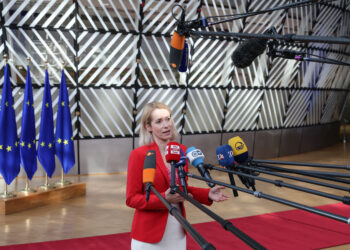
Brussels responded immediately: “We take note of the US Supreme Court ruling and are analysing it carefully,” said European Trade Commission Trade spokesperson Olof Gill. “We remain in close contact with the US Administration to obtain clarity on the measures it intends to take in response to this ruling,” he added. “Companies on both sides of the Atlantic depend on stable and predictable trade relations. We therefore continue to support low customs tariffs and are committed to reducing them,” he said.
From the European Parliament, German Socialist MEP Bernd Lange, the European Parliament’s rapporteur for the implementation of the EU-US trade agreement, announced on X that he had convened an extraordinary meeting of the European Parliament’s negotiating team for Monday. “The ruling on tariffs is a positive sign for the rule of law” because “the judges have shown that not even a US president operates in a legal vacuum,” he wrote on X. “Legal barriers have been erected, and the era of unlimited and arbitrary tariffs, impossible for the president to impose, may now be coming to an end,” he added. “We must now carefully assess the ruling and its consequences. I have therefore just convened an extraordinary meeting of the European Parliament’s negotiating team on the Turnberry agreement for Monday, in order to assess the possible implications for the work in progress and, in particular, in view of the committee vote on Tuesday, 24.”
In general, tariffs must be approved by the US Congress, which, according to the Constitution, has the exclusive authority to impose taxes. But Trump argued that he had the right to act in this way towards trading partners under the IEEPA. The Court, however, noted that “if Congress had intended to confer the distinct and extraordinary power to impose tariffs” under the IEEPA, “it would have done so expressly, as it has always done in other tariff statutes.”
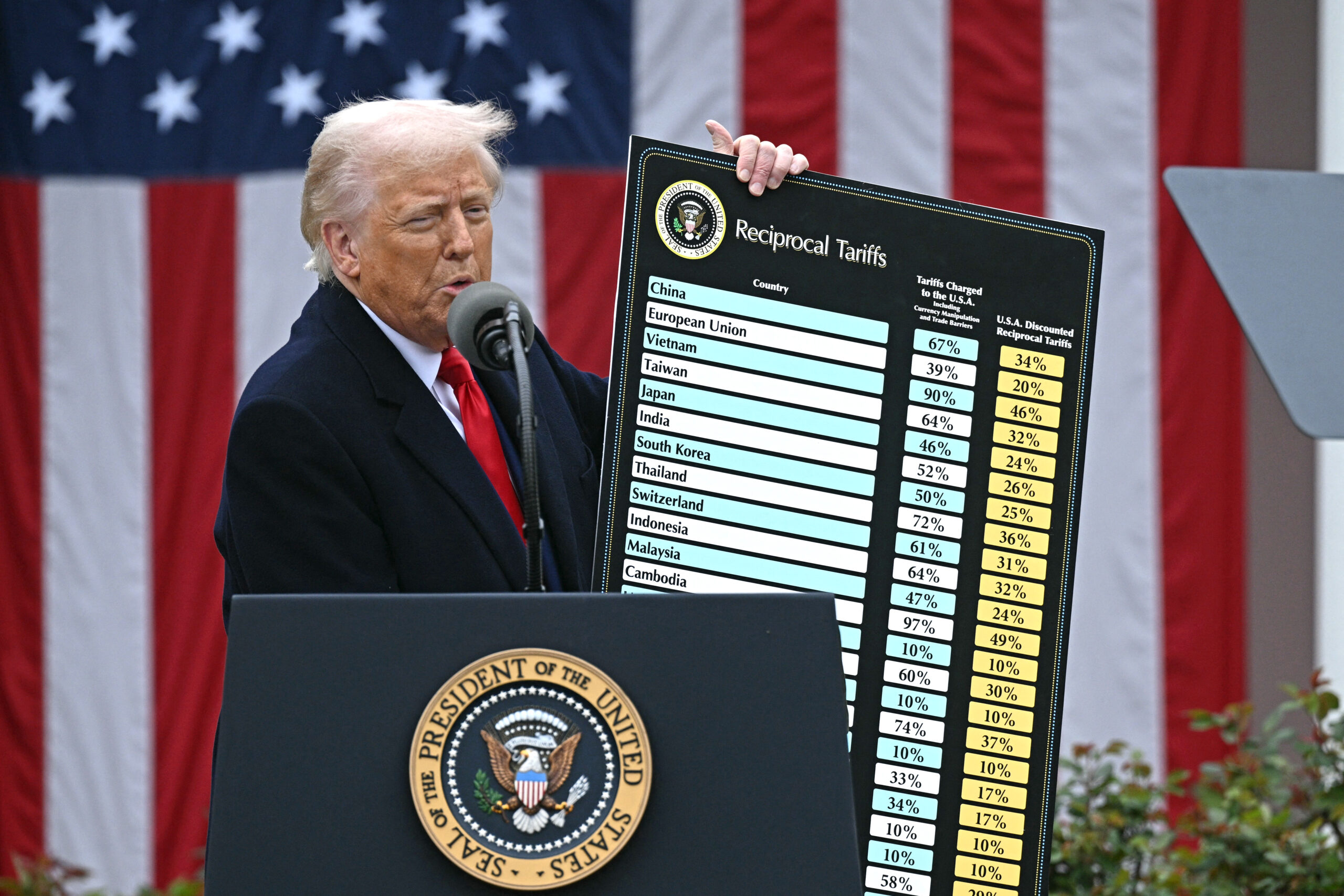
The ruling, which has no impact on the sectoral tariffs that Trump imposed separately on imports of steel, aluminium and various other goods, confirms the previous findings of lower courts that the tariffs imposed by the tycoon under the IEEP were illegal. In May, a lower court ruled that Trump had abused his authority by imposing generalised tariffs and blocked most of them, but the ruling was suspended pending the outcome of the government’s appeal. In addition, the decision overturns the country-by-country or “reciprocal” tariffs, ranging from 34 per cent for China to a base level of 10 per cent for the rest of the world, and the 25 per cent tariffs that Trump imposed on certain goods from Canada, China, and Mexico as “punishment” for these countries’ failure to curb the flow of fentanyl.
The president of the Italian Wine Union (UIV), Lamberto Frescobaldi, expressed a contrary opinion. “Paradoxically, the wine world cannot celebrate the US Supreme Court’s rejection of the legitimacy of the tariffs. A reimposition of tariffs through alternative legal channels is more than likely, added to which is the high risk of uncertainty that this decision may cause in trade relations between Europe and the United States,” he explained. “Considering the damage caused to the sector in recent months,” he added, “we hope that the stalemate can be resolved soon so as not to further alter commercial and monetary dynamics.”
Meanwhile, European stock markets closed higher on the last trading day of the week, with Paris setting a new record high, exceeding 8,500 points to reach 8,529 points (+1.39%). In Europe, markets, which were already rising before the announcement, accelerated their gains, with all stocks affected by the Supreme Court ruling and with a significant export component rising sharply. In London, the FTSE 100 index rose 0.59% to 10,690.20 points, in Frankfurt the DAX rose 0.96% to 25,258.85 points, and in Madrid the Ibex35 gained 0.90% to 18,180.22 points. On the Milan Stock Exchange, the FTSE MIB index rose by 1.48% to 46,472.98 points.