Brussels – “Ukraine has the best military force in Europe, if not the world.” For this reason, “it would be difficult to understand why we in Europe would not regard it as in our vital interest to integrate the Ukrainian army into our continental defence architecture.” Greater military synergy between Ukraine and the European Union is a cause that the EU Commissioner for Defence, Andrius Kubilius, has been championing since the start of his term, and he never fails to mention it in every public address.
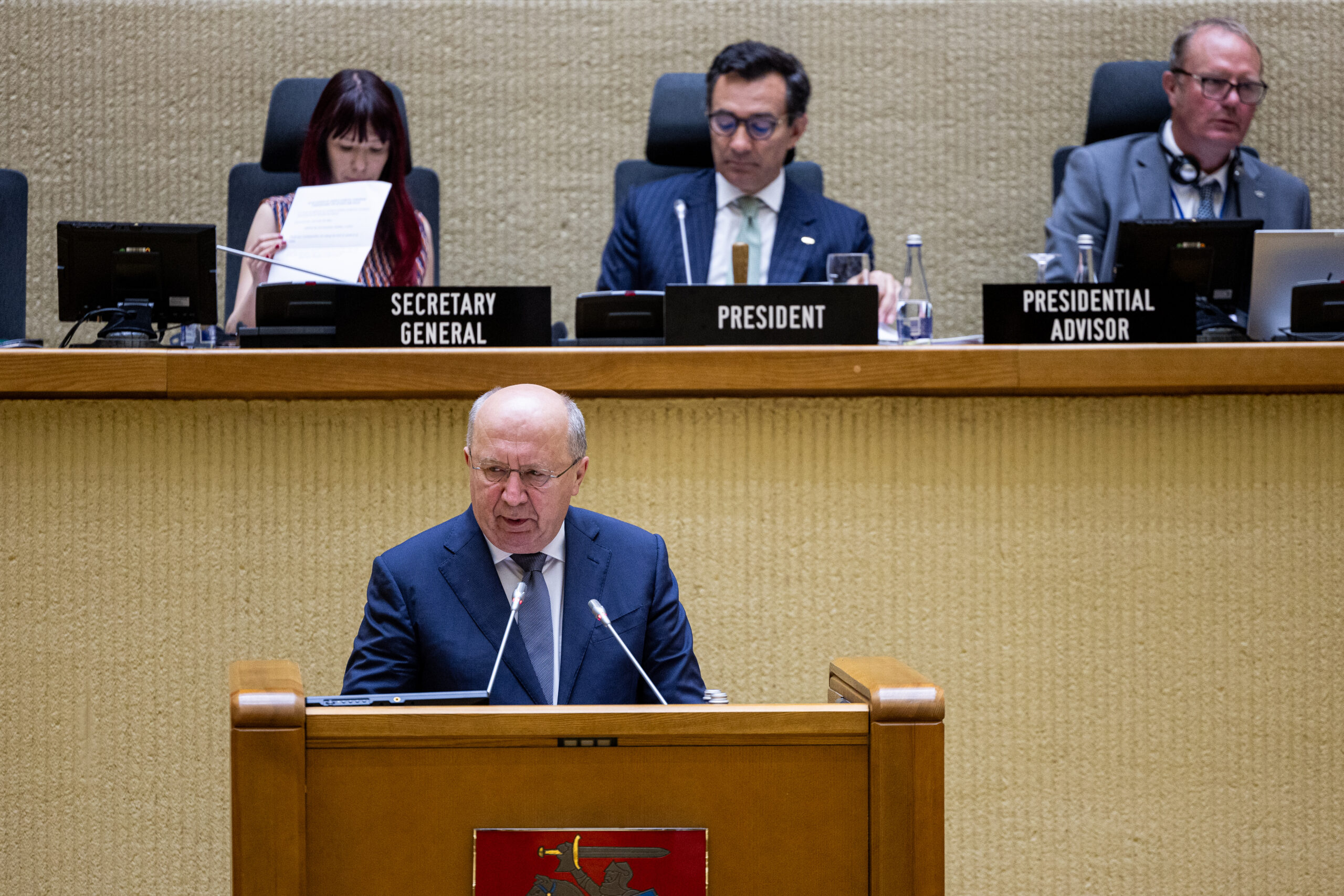
Today (1 June), however, these words were delivered at an event that lends his appeal even greater significance than usual: the spring session of the NATO Parliamentary Assembly, currently taking place in Vilnius, Lithuania.
Prior to today’s speech, the most recent occasion on which the Lithuanian politician had emphasised the need for “deep integration” of the Ukrainian defence industry with that of Europe was on 16 March. “If even the Gulf states are asking Kyiv for help in shooting down Iranian Shahed drones, why shouldn’t the EU recognise the excellence of this military expertise?”, the Commissioner asked rhetorically at an event organised by the Forum Europa platform.
Speaking today before delegates from the various national parliaments at the North Atlantic Treaty Organisation, Kubilius reiterated the call and set out an ambitious challenge: “Ukraine’s accession to a future European Defence Union, led by a European Security Council.” Proving himself to be very (perhaps overly) optimistic, the former Prime Minister of Lithuania suggested that he considers this objective something more easily achievable than “Kyiv’s accession to NATO, which has not yet been agreed, and its entry into the EU, which may require a longer period of time.”
Staying on the subject of Ukraine, Kubilius combined long-term plans with short-term ones, reiterating the need to step up NATO allies’ support for the Ukrainian army in its resistance to the Russian invasion.
For the Commissioner, the principle he has dubbed “do not back down, but redouble your efforts” remains the only viable option, all the more so following what he described as “Putin’s recent erratic attacks.” He is referring to the incidents—which have occurred several times over the past few weeks—of drones crashing on the territory of certain countries on NATO and the EU’s eastern flank (first in Latvia and more recently in Lithuania and Romania). According to Kubilius, these moves are the result of the Kremlin’s growing frustration. “Ukraine is beginning to prevail, and the more Ukraine prevails, the more nervous and desperate Putin becomes,” he stated.
For this reason—he concludes—“we must step up our support for Ukraine, so that Putin is forced to negotiate a just peace.”
Kubilius’s commitment to a “post-Cold War NATO 3.0”
However, in addition to supporting its external allies, the North Atlantic Alliance must also focus on resolving its own domestic issues. The most urgent, according to Kubilius, is that relating to “the request from our American allies that Europe assume primary responsibility for its own collective conventional defence.”
After all, the US’s gradual military withdrawal from Europe is another key challenge facing the Commissioner. According to Kubilius, the time has come to tackle it head-on, especially following the recent reductions in US troops in Germany and (although subsequently denied by the White House) in Poland.
For this reason, the Lithuanian politician reiterated his commitment to “building a post-Cold War NATO 3.0 and strengthening the European pillar of the alliance.” In this regard—he added, addressing the members of the Assembly—“the contribution of national parliaments is important because Member States play a fundamental role in building this architecture.”
Another key element in this project is the EU defence industry, which was the focus of the third point Kubilius addressed in his speech. With his baton in hand, the Commissioner lamented the fact that “the Russian military industry still produces far more than the European one, despite our companies having far more funds at their disposal than in the past.”
Once again, for Kubilius, the model to follow is Ukraine’s, which “has increased production 50-fold since 2022, reaching €50 billion and matching the annual production levels of the German and French defence industries.” The reasons for this growth are not solely linked to the war, which inevitably drives Kyiv to devote more resources to arms production. “In Ukraine,” Kubilius emphasised, “there is fierce competition, well-defined market roles and dynamic innovation within the defence industry.” Europe, on the other hand, “lacks a single defence market, lacks innovation and lacks sufficient industrial momentum,” he added.
Ultimately, Kubilius concludes that if European capitals are not yet ready to integrate their defence industries with Kyiv’s, they should at least draw inspiration from its economic model.
English version by the Translation Service of Withub