Brussels – Instead of punishing migrants and refugees who are “exploited and mistreated for political purposes”, EU countries must direct their measures “against hostile actors.” This is the indication that comes from the European Agency for Fundamental Rights (FRA), an indication aimed eastwards—towards the flows of migrants that Russia and Belarus deliberately direct towards Poland and Lithuania, but also at the Mediterranean, where the increase of departures from Libya could be linked to a hybrid war activity orchestrated by Moscow.
The document published today (23 July) by the Vienna-based agency examines how the EU can counter the instrumentalisation of migrants without undermining respect for fundamental rights. The starting point is that although Member States have “legal and legitimate instruments”, some of the “current responses could undermine” these rights, including the right to asylum.
“The use of migrants as a political tool is nothing new,” emphasises FRA director Sirpa Rautio. On the eastern border of the EU, Minsk has been pushing thousands of migrants, mainly from the Middle East, towards Poland for five years now. Warsaw has responded with an iron fist, which often ends up affecting the migrants themselves: according to the FRA, in 2023-24, almost 60 people died along the border, “many of them from hypothermia while stranded there.” In Poland, Médecins Sans Frontières treated more than 220 migrants who crossed the border in 2023 alone.
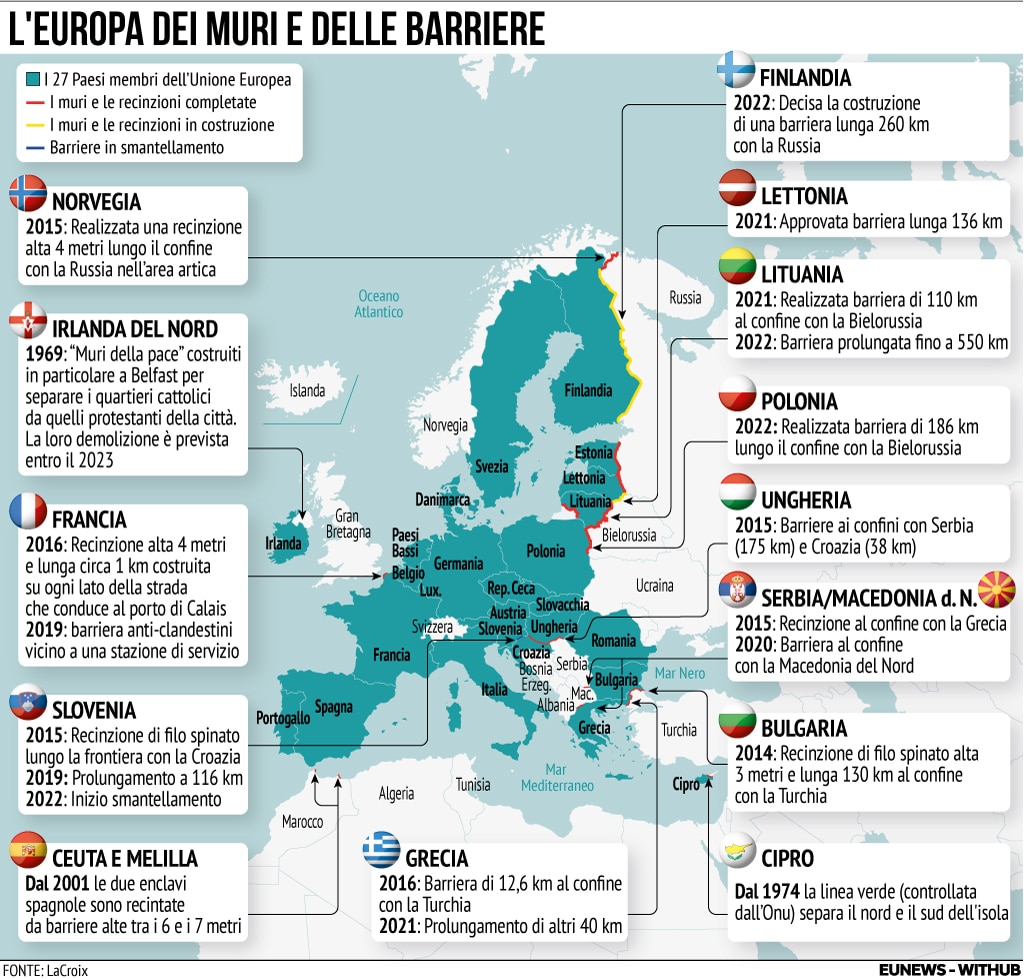
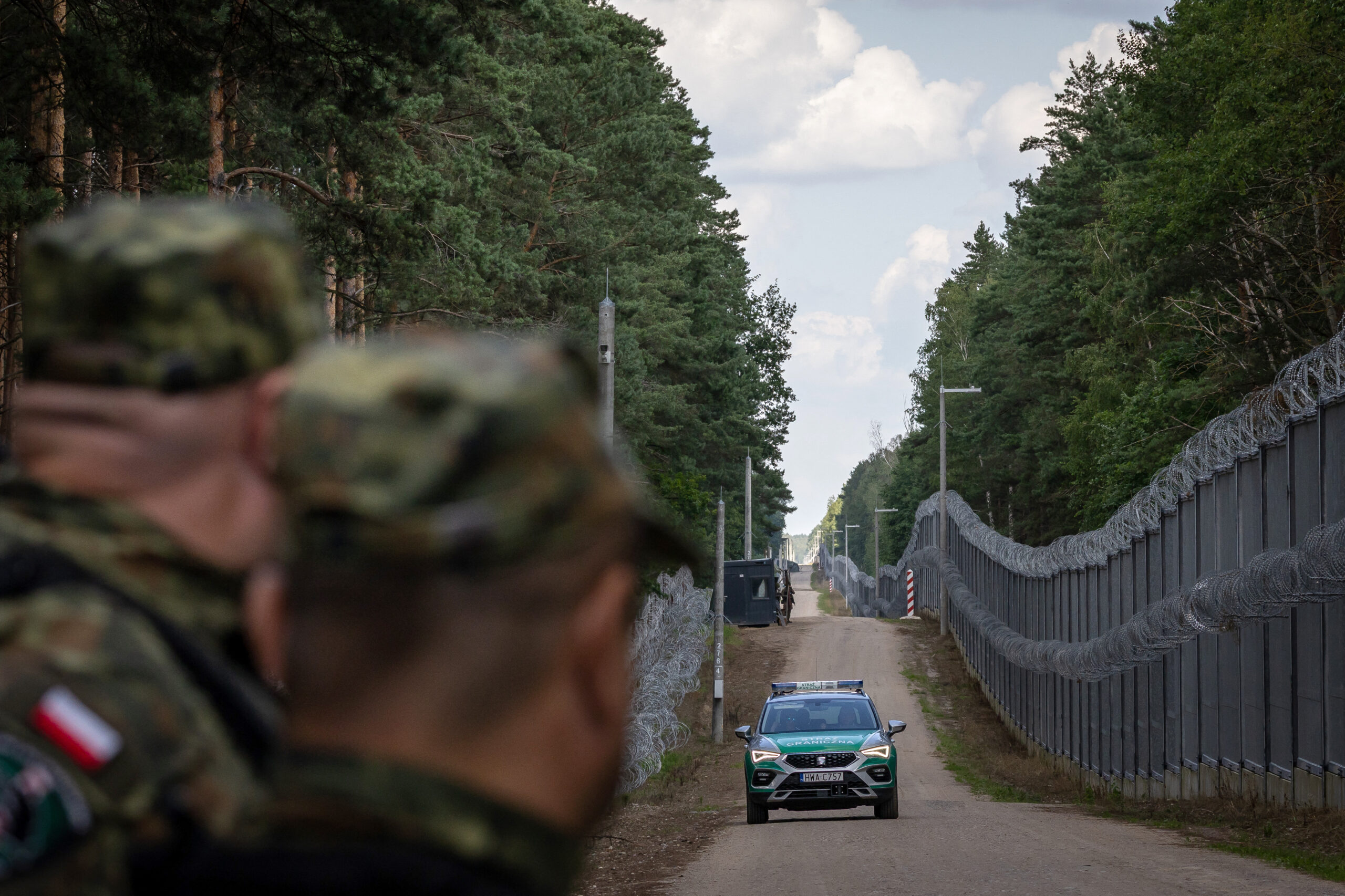
On the border with Belarus, Poland has built a 186-kilometre-long wall, 5.5 metres high, equipped with motion detectors and thermal cameras. In recent years, it has sent thousands of troops and police officers to reinforce control over the area.
Last winter, the European Commission turned a blind eye to the decision of the pro-European government led by Donald Tusk to suspend asylum rights in the country. Indeed, in February, after Tusk himself announced that Warsaw had no intention of implementing the EU Pact on Migration and Asylum, Brussels relented and issued guidelines allowing the suspension of basic rights in “exceptional” circumstances and for what is “strictly necessary”.
The EU Charter of Fundamental Rights, as the FRA report points out, stipulates that limitations to fundamental rights must be “necessary and proportionate”, and that some absolute rights cannot be derogated from, even in extraordinary times. This is the case with the principle of non-refoulement and access to asylum procedures. European law states that, for a situation to qualify as instrumentalisation, the hostile action “must be of such intensity as to endanger essential functions of the State objectively“.
In the Crisis, Exploitation and Force Majeure Regulation, part of the Pact that will apply in the EU from June 2026, provides for exceptions to the general asylum management system will be triggered if “a third country or hostile non-state actor encourages or facilitates the movement of third-country nationals and stateless persons” towards the EU external borders “with the aim of destabilising the Union or a Member State”, putting “at risk the essential functions of a Member State”. The threshold of the recognition rate for which asylum seekers can be admitted to accelerated procedures—and thus, in most cases, rejected—will rise from 20 to 100 per cent.
“Responses to instrumentalisation should not become a model for the treatment of all migrants and refugees crossing the border irregularly,” is the warning of the EU Agency for Fundamental Rights. It is clarified that not even with regard to reactions to migrant trafficking and assistance with irregular entry should this be done. “Measures against the smuggling of migrants should not target aid workers assisting migrants and asylum seekers at the external borders of the EU,” the report further stresses. Indeed, the risk is that “hostile non-state actors” will include NGOs, in a pattern of criminalising solidarity that has already been seen time and time again.
The risks of militarisation of borders
The agency indicates four types of actions to counter this phenomenon. First, “targeting” hostile actors who instrumentalise migrants, through sanctions and restrictions on visa policies. After that, the FRA suggests targeting transport companies and “other commercial operators actively involved” in transferring migrants to the EU “on behalf of a third country.” For example, by revoking operating licences from the companies.

Migrants at the border between Belarus and Poland [Archive photo]
The issue becomes more sensitive when it gets to “‘how the EU and its Member States treat abused third-country nationals.” The new rules will allow capitals, once they have processed asylum claims in an accelerated manner, to “proceed with the repatriation of rejected asylum seekers through a faster repatriation procedure.” The report makes it clear that “the use of force must always remain necessary and proportionate,” that the principle of non-refoulement must always be respected, and that collective expulsions and denial of access to asylum procedures remain illegal.
The last warning concerns the trend towards militarisation of borders: any entity performing border management functions, “including armed forces, must receive appropriate training in fundamental rights and clear and unambiguous instructions on the limits of the use of force, the prohibition of ill-treatment and the need to refer any third-country national apprehended to the competent authority.”
This trend reflects another underlying one, namely that of border management as if it were a matter of defence, a national competence “in which member states typically act outside the scope of EU law.” The risk of violating fundamental rights is very high (as is also widely demonstrated in Poland): for example, the report concludes, “physical barriers or border fences erected as a defence measure may be equipped with spiral blades or other dangerous technical features without assessing whether they are necessary and proportionate.”
English version by the Translation Service of Withub


![Da sinistra: il presidente del Consiglio europeo, Antonio Costa; il presidente dell'Ucraina, Volodymir Zelensky: la presidente della Commissione europea, Ursula von der Leyen [Bruxelles, 18 giugno 2024. Foto: European Council]](https://www.eunews.it/wp-content/uploads/2026/06/euco_ua260618-120x86.jpg)
![[foto: Saverio De Giglio/imagoeconomica]](https://www.eunews.it/wp-content/uploads/2026/10/cpt-120x86.png)