




Brussels – These are hectic days for Ukraine’s Western partners, who are trying to step up the diplomatic process to reach a negotiated solution to the war with Russia, even if the Kremlin’s demands remain unacceptable to Kyiv. While waiting for a face-to-face meeting between Volodymyr Zelensky and Vladimir Putin, the transatlantic allies are discussing which security guarantees to provide to the aggrieved country once hostilities have ceased.
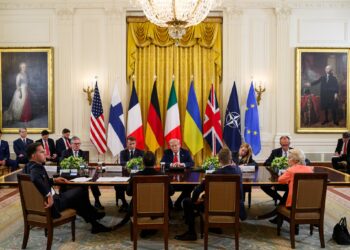
Following the historic White House meeting between Donald Trump and a group of European leaders, including Volodymyr Zelensky, NATO political and military leaders, and the coalition of the willing, held a series of meetings to define the concrete form that the much-talked-about security guarantees that have been so often vaguely promised to Kyiv.
According to reconstructions circulating in the international press, yesterday (21 August), the Chiefs of Staff of the transatlantic allies presented their respective national security advisors with several options, with some partial details beginning to emerge. The only thing sure, at this point in the discussions, is that “the lion’s share” will be up to countries from the Old Continent, as the US administration has repeatedly emphasized.

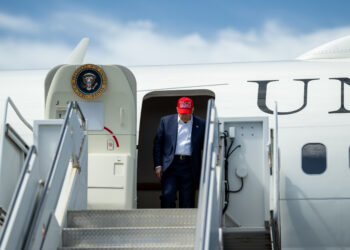
As much as Trump has expressed willingness to participate in security guarantees for Ukraine (an outcome that is far from a foregone conclusion and that chancelleries of the Old Continent see as a great success), the tycoon has made it clear that Washington will not send troops, remaining ambiguous as to what kind of support the US will be able to provide once hostilities on the ground have ceased.
Now, the Europeans are asking Uncle Sam to continue sharing valuable intelligence information and, above all, to guarantee some form of air cover. This could take various forms: through the direct employment of US pilots, for instance, to facilitate possible ground operations or to set up a no-fly zone in the Ukrainian skies, but also by providing additional anti-aircraft systems to Kyiv. A further hypothesis could involve US command of the European ground mission.
In line with talks that have been ongoing for months, however, the most sensitive issue remains the sending of troops to Ukraine. According to some estimates, tens of thousands of soldiers (in the order of 30-40 thousand at least) would be necessary to protect an eventual truce, who should remain stationed in Ukraine in the medium to long term and be ready to intervene promptly if needed.
At present, however, only France seems willing to deploy its troops to Ukraine. Among the other European military powers, Italy ruled out the option some time ago (unless it is part of a UN framework). In Germany, the discussion is heated (in any case, the Bundeswehr is
far from being in good shape). Even the United Kingdom is reportedly reconsidering the deployment of troops, which seemed certain until recently. Poland, one of Kyiv’s staunchest allies, has no intention to weaken its eastern border with Belarus and the Russian exclave of Kaliningrad.

Indeed, everyone agrees that the Ukrainian army is the crucial “front line” to repel a potential new aggression. It is the objective of Western military and financial aid. In three and a half years of war, Kyiv’s armed forces have significantly increased their preparedness while the domestic weapons industry has made substantial progress, as demonstrated by the new Flamingo ballistic missile with a range of 3,000 kilometers.
However, it is precisely on the issue of an international “reassurance force” that risks blocking everything, since the Kremlin is clearly opposed to the presence of Alliance troops in Ukraine. Russia’s Foreign Minister, Sergei Lavrov, has stated in recent days that Moscow wants to be consulted in the definition of security guarantees for Kyiv, and has even gone so far as to suggest that the permanent members of the UN Security Council, including China and Russia, should be among the guarantors of peace.
Speaking of the Kremlin, the precise demands made by Vladimir Putin during his face-to-face meeting in Anchorage, Alaska, on 15 August are also circulating these hours. To end its aggression, Moscow demands that Kyiv definitively relinquish Crimea and the entire Donbas to the Federation (the latter, made up of the oblasts of Donetsk and Luhansk, only partially occupied by the Russians), renounce forever its entry into NATO, maintain a status of permanent neutrality, and not host Western troops on its territory.

It is difficult for the Ukrainian leadership to accept all of Putin’s wishes, even if he has also diminished his ambitions since last year. At the time, he also wanted the oblasts of Kherson and Zaporizhzhia (also partially occupied and, like Donetsk and Luhansk, unilaterally annexed in a farce referendum in September 2022). Now, the Tsar would be willing to “freeze” the front in these two regions along today’s line of contact and withdraw his troops from certain areas around Kharkiv, Sumy, and Dnipropetrovsk.
While it is foreseeable that Kyiv will not join the Alliance in the immediate future (given the opposition of several members, starting with the US), Zelensky has made it clear that any territorial concession would need to be discussed at the highest level between him and Putin. For days, there has been talk of a possible bilateral meeting between the leaders of the belligerent countries, following which there would be a trilateral meeting with Trump to reach a comprehensive peace agreement. So far, the three rounds of talks between Russia and Ukraine have not led to any progress in this regard.
For his part, in the past few hours, Lavrov has tempered expectations, warning that a similar outcome would require meticulous preparation and reiterating doubts about the legitimacy of the Ukrainian president, whose term in office expired in May 2024 (the martial law in force in the country, however, prevents holding new elections). Moscow, in short, is in no hurry and can afford to mock the US president and his sense of grandiosity a little longer.
English version by the Translation Service of Withub





![[foto: Guillaume Baviere/WikimediaCommons]](https://www.eunews.it/wp-content/uploads/2026/01/Cuba_Che-120x86.jpg)
