![[foto: European Commission - Audiovisual Service]](https://www.eunews.it/wp-content/uploads/2025/09/Draghi-report.jpg)
Brussels – One year after the Draghi report on competitiveness, the European Union is not in good shape. Not so much in terms of reforms, all of which take time to implement, but because “there is a lack of a sense of urgency, and a lack of coordination on the implementation” of measures needed to enable the EU to change pace, said Antonios Nestoras, founder and director of the European Council for Policy Innovation (EPIC). Speaking at the European Parliament, he presented the special ‘Draghi Observatory’, a platform designed to track the progress of the measures outlined by the former ECB president and Italian prime minister in the report commissioned to him at the end of 2023 to help relaunch the EU.
Officially presented one year ago, on 9 September 2024, the Draghi report “is a good report,” Nestoras reiterated during the event hosted by the liberal group (Renew Europe, RE). “We know the report in its substance and quality; the key thing now is implementation,” on which the EU as a whole appears to be lagging.

The conference “Draghi Report Observatory” at the European Parliament [photo: Emanuele Bonini per Eunews]
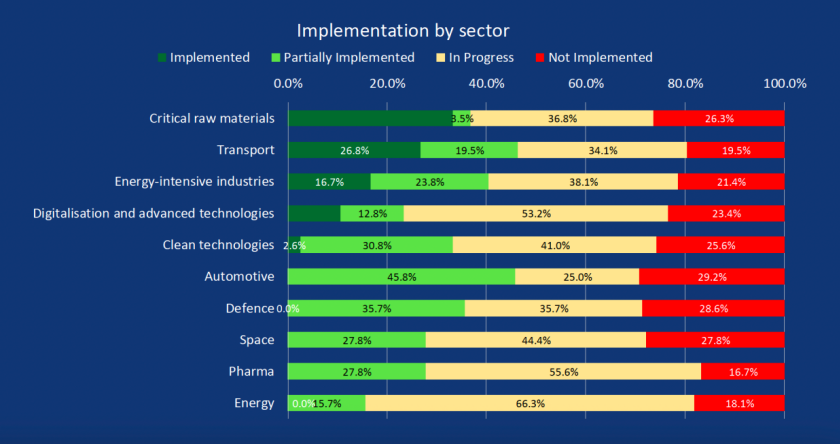
According to the data compiled so far by EPIC through its observatory, only 11.2 percent of the measures proposed to boost Europe’s competitiveness have been completed, compared to 20.1 percent partially implemented, 46 percent in progress, and 22.7 percent not implemented at all. “The work is complex, the challenges are enormous, both on the legislative side and in terms of institutional resistance, but the numbers show that there is a lack of sense of urgency,” Nestoras insists. He is all the more convinced of the usefulness of the special observatory. “This tool is also useful for the Commission itself, to evaluate efforts and work done.”
EU Parliament, Draghi report basis for the new legislature. The knot is the Council
Energy, critical raw materials, digitalisation, clean technologies, industry, automotive, transport, defence, space, and pharmaceuticals: these are the sectors that EPIC focuses on in its special monitoring of the agenda included in the Draghi report. Thus, it emerges that one year after the launch of what should be the illuminating beacon of the second von der Leyen commission’s mandate, only in the area of critical raw materials can the EU boast of encouraging results: 35 percent of the planned measures have already been completed, with the transport chapter in second place with 26 percent of targets achieved. The new priorities, defence and space, on the other hand, are at zero in terms of “measures implemented.” Much is in progress, but nothing has been finalized.
“The coming months of the Danish presidency (of the EU Council, ed.) will have to be a measure of European ambitions,” Valerie Hayer, president of the Liberal Group, said in what turns out to be an explicit call to do more. “The Draghi report is a call to action,” she insists. Echoing her remarks is João Cotrim de Figueiredo, RE’s Head of Economy and Digital Transformation: “The EU economy continues to lag and not enough has been done in the last year,” she criticises. “The Draghi report should be the model for the Commission’s activities. We must act now to make sure we remain competitive.”
English version by the Translation Service of Withub![Agnieskza Bartol, rappresentante permanente della Polonia presso l'Ue, espone le priorità della presidenza polacca del Consiglio Ue, al via l1 [Bruxelles, 12 dicembre 2024. Foto: Emanuele Bonini per eunews]](https://www.eunews.it/wp-content/uploads/2024/12/polonia25-350x250.jpeg)