Brussels – At a time of customs tariffs, a deep crisis in the industrial competitiveness of the Old Continent, and rivalry between trade superpowers, the pharmaceutical sector is one of those from which the EU can start to regain some of the ground lost to China and the United States and begin to build its own strategic autonomy. The role of this strategic industry in the global context was addressed today (18 September) by guests on one of the panels at the Connact Pharma event, dedicated to “Relaunching European Competitiveness through the Pharmaceutical Sector”.
The starting point is the cry of alarm raised at the European Commission by companies in the sector, which fear a further haemorrhaging of talent and crucial assets for research, development and production towards the US as a direct consequence of the tariffs imposed by Washington. Industry professionals, meeting in Rome to discuss with national and EU policymakers in the framework of the Connact platform, of which Eunews is a media partner, suggest urgent recourse to existing instruments such as tax levers, pricing policies, public procurement regulation, and intellectual property, environmental and chemical regulations.
According to Emanuele Degortes, Global Head of Access Policy at the Menarini Group, Europe needs to act on three main aspects. “Create a more attractive market for pharmaceutical companies,” considering that as of today the EU accounts for about 25 per cent of the global market compared to 60-65 per cent in the US, “strengthen intellectual property” and “unlock investment at EU and national level” to become “a world-leading hub.” And scale is needed, more scale: the €80 million in the Critical Medicines Act for the next budget (2028-2034), he argues, is not enough to “ensure domestic production and the security of supply chains.”

Paolo Saccò, Senior Director of Global Public Affairs at the Chiesi Group, highlights the “issue of access” to innovative pharmaceutical products for European citizens, underlining the importance of timing in the transition from innovation to commercialisation. We need to “improve the operating environment,” he says, where there is still a wild fragmentation due to a “bureaucracy that can be overcome”: not only between state jurisdictions but even within countries, for example, between Italian regions.
Member of the European Parliament Raffaele Topo, a member of several EU Parliament committees, including the Committee on Public Health (SANT), also agrees: “With 21 different health systems we are getting nowhere,” he observes. “We must protect health, which is a public good, and support those countries that have built robust welfare systems, now that tariffs end up making them unsustainable,” he argues. His solution also passes through an increase in the resources that the EU puts into pharmaceutical research in programmes such as Horizon+, while moving closer to a greater European integration to iron out differences and duplications.
A window of optimism is opened by Marco Mattei, chief of staff to the Health Minister Orazio Schillaci: “Pharmaceuticals is a sector that must be structurally modified,” he stresses, and therefore it is necessary to “make organic legislation” on the subject. The issue, once again, is “increasing the attractiveness” of the country system for foreign investors, starting with the “valorisation of research.” For him, too, there is a need for greater integration in the European sphere, and Brussels should clearly decide on which subjects it should assume exclusive competence.

After all, the guests note, pharmaceuticals is one of the driving sectors of our GDP. “One of the big sectors,” in the words of Claudia Biffoli, manager of the biotechnology and pharmaceuticals division of the Ministry of Industry and Made in Italy. However, she says, echoing Saccò’s note, “we have very strong scientific research but we struggle to develop solutions,” make products and bring them to market. To bridge this gap, some solutions would be to increase public-private synergies and the rationalisation of interventions by MIMIT.
Brussels is extending a helping hand. Or at least that is what Pietro Erba, Policy Officer in the EU executive’s DG SANT, claims. “The Commission is trying to make life easier for the industry,” he explains: “Speed up, simplify, cut through unnecessary red tape” (with the so-called Omnibus packages, for example). He already starts from an encouraging base: “European exports abroad have doubled in value over the last decade,” he notes, and the EU is pushing to shorten the time for inspections by the European Medicines Agency (EMA) and those for releasing authorisations. As for Italy, he says, “it is doing a lot from an industrial point of view” and is appreciated “as a producer not only of generic drugs but also of innovation, including as a reservoir of talent” especially in the central and northern regions.
English version by the Translation Service of Withub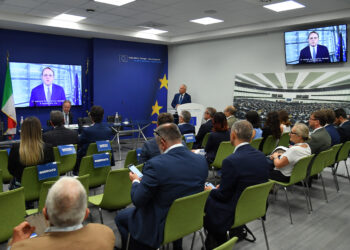
![Rainer Becker, direttore per i Prodotti medici e l'Innovazione presso la Direzione generale Salute e Sicurezza alimentare della Commissione europea (DG SANTE), ospite all'evento Connact Pharma sul rilancio della competitività europea attraverso il settore farmaceutico [Roma, 18 settembre 2025]](https://www.eunews.it/wp-content/uploads/2025/09/connact-dg-sante-350x250.png)