




Brussels – For the past ten months, Serbia has been shaken by the most participated popular protests in its recent history. At stake, in the streets where students are being clubbed and journalists assaulted, is not only the democratic stability of a country that, on paper, is a candidate for membership of the European Union. There is also the credibility of the EU itself, which is in danger of crumbling under the weight of inaction. Serbian journalist Nataša Kovačev shared with Eunews her thoughts on the perverse dynamics being triggered in her country, fueled also by the coldness of the EU’s reaction.
“The people who have been protesting for more than 10 months—that is, since fifteen people were killed in the collapse of a bus shelter in Novi Sad (Kovačev’s hometown) last November, unleashing a popular response unseen since the implosion of Yugoslavia—expected a more decisive reaction from the EU,” Kovačev says.
Instead, in recent months, only half-silences have come, like the one of the President of the European Council, António Costa, and the one of the High Representative Kaja Kallas.
What arrives from Brussels, she continues, is instead a desolating combination of “tepid reactions and mixed signals,” a political cacophony that confuses and discourages those who believed in a European future for Serbia. And who now believe in it less and less. “If we look at the polls, we notice that today only 33 per cent of respondents strongly support the prospect of membership” in the twelve-star club, illustrates the journalist. In 2015, the year after the opening of the first negotiating chapters with Belgrade, this figure was around 59 per cent.

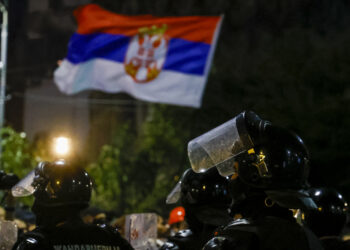
The students and their allies in the protest movement, already engaged in resisting with their own bodies (eardrums included) the brutal repression deployed by the authoritarian president Aleksandar Vućič, now fear that they will be abandoned even by those very institutions to which they have made heartfelt appeals for help in defending what remains of democracy and the rule of law in Serbia.
The spectacle coming from the EU representatives is indeed far from edifying. “During the last plenary in Strasbourg, we heard quite different things,” she explains: “Marta Kos (the Commissioner for Enlargement, ed) spoke clearly about the situation in Serbia and took a clear position on it,” Kovačev argues, while the Berlaymont’s number one, Ursula von der Leyen, “didn’t even bother to mention what’s going on in her speech on the state of the Union.”
On the other hand, concedes the journalist, Manfred Weber—the boss-leader of the European People’s Party, the most powerful political force on the Old Continent, from which the president of the Commission also hails—”has raised the possibility to suspend the SNS (Vućič’s Serbian Progressive Party, ed) from the EPP,” in which it is currently an observer member. However, she points out, “it is a unilateral decision by one political party, not a joint move by the Union.”
“Maybe something is starting to move,” Kovačev cautiously notes, “and it seems that among the EU leadership the need for a more incisive response is beginning to be felt.” “I hope that this will soon translate into concrete action, especially to give hope to those who continue to take to the streets,” she notes. She hopes for an unequivocal signal to make it clear that, besides cloying rhetoric, Brussels really does intend to “protect the rule of law everywhere, all the more so in a candidate country.”

So far, under Vućič’s illiberal regime, the spiral of violence
shows no signs of stopping. On several occasions, Kovačev explains, the president
declared himself available to discuss directly with protest leaders. “But the manifestants do not want to talk to him, they want the institutions to do their job, for corruption to end, for the Serbian state to function,” she says. Instead, she admits, “the repression of dissent becomes more suffocating and the arbitrary and extrajudicial detentions multiply.”
“Moreover,” she adds, “whenever Vućič opens up to some form of dialogue, new incidents occur.” Such as the one last January, when in Novi Sad, some men affiliated with the SNS chased students who were putting up posters, physically assaulting them. “They pulled out a baseball bat and beat them up, breaking the jaw of one girl,” she recounts. Thus, when the Head of State subsequently extended a feigned hand to the demonstrators, they responded in kind: “It’s difficult to speak with a broken jaw”, as reported in the press releases of the time.
The problem, Kovačev notes, is the “almost absolute impunity” enjoyed by the police. In the January case, she recalls, “those men were arrested and tried, but with the trial still in progress Vućič pardoned them, before any sentence was handed down.” She too has seen these dynamics with her own eyes, “since the public debate and the media space are extremely polarised and there are frequent attacks on newspapers and journalists.”
As certified by Media Freedom Rapid Response in its last report, Serbia is in a situation of “emergency”. In the first six months of this year, there were 96 attacks on media workers: a dozen more than in the whole of 2024 (84) and almost twice as many as in 2023 (49). “Even if you document the attacks, if you film them, nothing happens,” Kovačev laments. Last November, she tells us, her cameraman was thrown to the ground in front of the SNS offices in Novi Sad while she was filming the protests.

She had been attacked by a man who had come out of the building after confabulating with some members of the local party section. “We had the incident on tape“, the journalist points out, “and we took it to the police and the prosecutor, but nothing moved for months.” Then, when Kovačev and colleagues managed to prove that the assaulter was a close ally of the mayor, they were called to testify by the prosecutor. Yet, in the end, it all turned out to be a flash in the pan, and the investigators “downgraded the incident to a trivial altercation between private individuals, rather than considering it a criminal offence.”
In Serbia, as in other candidate countries (among all, Georgia), the impunity of a power that prevails over its own citizens is an urgent and very serious problem. From an EU that likes to portray itself as a champion of law and rights, deluding itself that it can still project some soft power externally, one would expect resolute action against the authoritarian slide of the fragile democracies on its own borders.
All the more so, since as they move away from Brussels, these countries often tilt closer to Moscow, Beijing, and other geopolitical actors that Europe views as adversaries. Perhaps, Kovačev hypothesises, it is precisely the awareness of being on such a steep slope that “makes the community hierarchies nervous”. “They know very well that violations are extensive in Serbia, but perhaps the lack of reaction stems from fear of pushing Vućič even further into the arms of Russia or China.”




![[foto: Guillaume Baviere/WikimediaCommons]](https://www.eunews.it/wp-content/uploads/2026/01/Cuba_Che-120x86.jpg)
