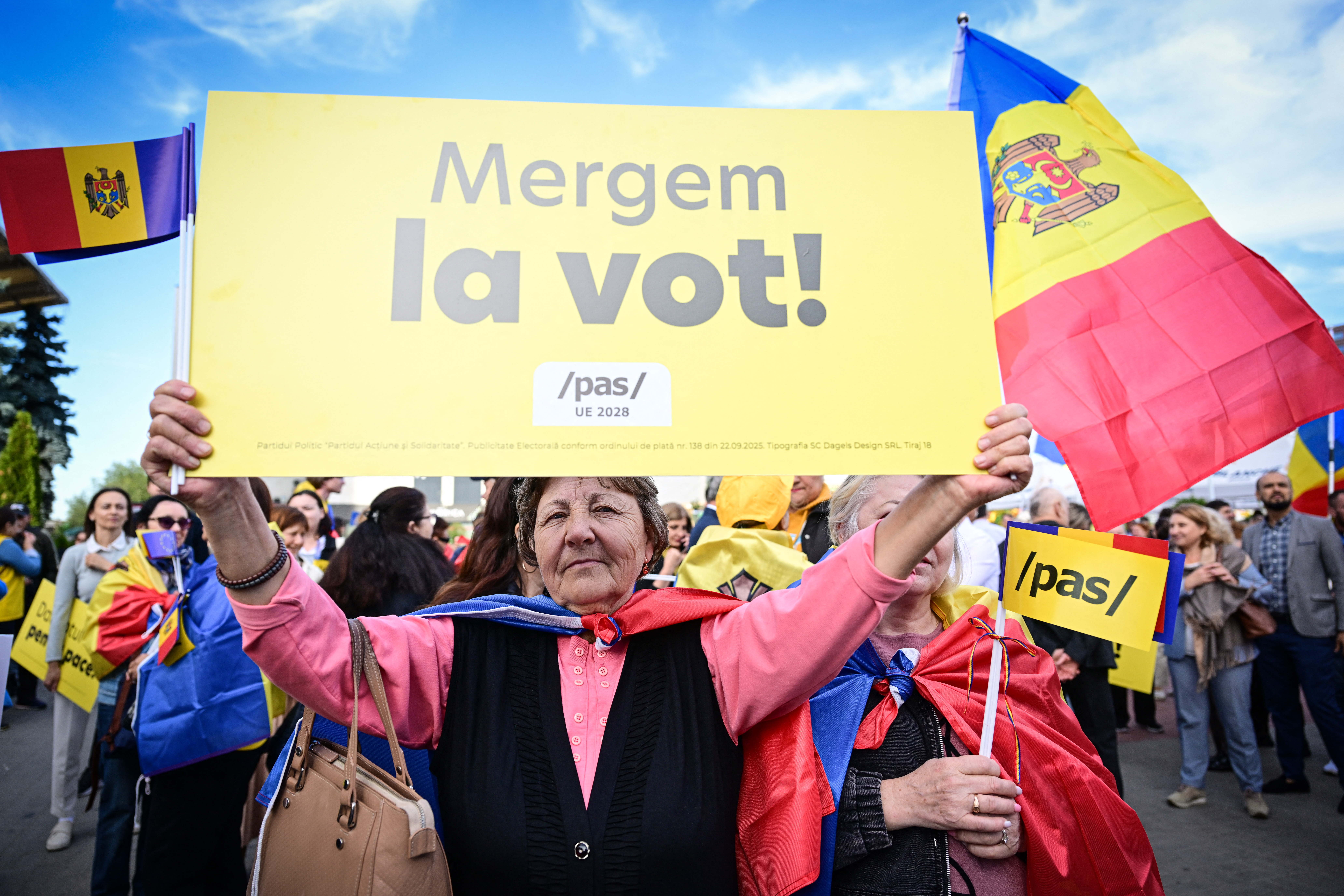
Brussels – Chişinău’s path towards the European Union remains unbroken. With only two sections still to be counted, the Party of Action and Solidarity (PAS), the expression of pro-European President Maia Sandu, has obtained 50.16% of the votes in the parliamentary elections in Moldova, thus securing the absolute majority needed to continue on the reform path towards membership of the EU bloc.
Shaking off fears of a predicted collapse, pre-poll projections gave PAS between 34 and 48 percent, and the threat of moving closer to Moscow, the party led by Igor Grosu will thus continue to hold the parliamentary majority, with 55 seats out of the 101 total. Over 1.5 million Moldovans turned out to vote, 52.17 percent of eligible voters, the highest turnout since the 2014 parliamentary elections. As in last year’s presidential elections, the diaspora played a crucial role: almost 300 thousand Moldovan citizens voted from abroad – mainly in Italy, Germany, Romania, France, and the UK – choosing the pro-European PAS in 78.48 percent of cases.
All that glitters is not gold. The EU rejoices: “Moldova, you did it again”, tweeted Ursula von der Leyen. However, the results of the election, which go far beyond a mere referendum on alignment with Brussels or Moscow, reveal a slight decline for the pro-European majority and a growing polarisation in the society of the former Soviet republic. The PAS managed to limit the damage, from 52.80 percent in 2021 to 50.16 percent, an overall physiological decline after four years of government, characterized by the economic impact of the war in Ukraine. The Patriotic Electoral Bloc (BEP), a pro-Russian leftist coalition led by former President Igor Dodon, is second with 24.20 percent of the vote. Dodon has already called a protest for today, accusing the West of interfering in the voting process.

They were followed at a distance by the centre-left Alternative Bloc (BeA), with 7.97 percent of the vote, and the left-wing pro-Russian populist party Our Party (PN), led by the former mayor of Bălți Renato Usatîi, with 6.20 percent of the vote. Another populist formation, Democracy at Home (PPDA), led by Vasile Costiuc, an ally of the far-right Romanian politician Călin Georgescu and a supporter of Moldova’s reunification with Romania, also exceeded the 5 percent threshold for entry into parliament.
As reported by the Enlargement platform, The New Union Post, the Central Election Commission received several reports of election violations. The incidents include the presence of unauthorized persons inside polling stations, violations of voting secrecy, group voting, and so-called ‘carousel voting’, where voters are transported to cast multiple votes.

Maia Sandu at the European Parliament in Strasbourg (Phooto di Frederic MARVAUX/ © European Union 2025)
On the other hand, in recent weeks, Sandu and European leaders raised the alarm about the massive election interference campaigns orchestrated by the Russian Federation to sabotage the vote. On 9 September, the Moldovan president spoke openly in the European Parliament about Moscow’s “hybrid war.” Not just vote buying, but disinformation campaigns through fake websites that artfully imitate authentic newspapers to spread pro-Russian propaganda on the web. A script already seen in Moldova itself – last autumn, when the president was re-elected, it is estimated that Moscow bought 130,000 votes – was also observed in Romania and Georgia.
“Despite Russia’s massive efforts to spread disinformation and buy votes, no force can stop a people committed to freedom,” cheered the EU High Representative for Foreign Affairs, Kaja Kallas. Von der Leyne reiterated the concept, stating that “no attempt to sow fear or division could break the determination” of the Moldovan people. According to Siegfried Mureșan, a People’s Party MEP and chair of the Parliament’s delegation to the EU-Moldova Parliamentary Association Committee, “Moldova’s pro-European victory is a lesson for the whole of Europe on how to defeat Russian interference.” Mureșan accused Russia and pro-Russian leaders of mobilising “unprecedented resources – more than 1 percent of Moldova’s GDP – to illegally finance pro-Russian parties, spread disinformation, manipulate public opinion and bribe voters.”
Moldova and Ukraine, Costa working to overcome deadlock on accession
Now, Brussels will also have to give answers to the choice of the Moldovan people. The country has officially been a candidate for membership since June 2022, the political go-ahead for the start of accession negotiations dates back to December 2023, and the first intergovernmental conference with the Twenty-Seven was convened in June 2024, in parallel with that of Ukraine. At present, substantial progress has been made primarily in the areas of justice, anti-corruption, and dismantling the oligarchic structures inherited from the Soviet Union. However, given the informal coupling with Kyiv’s (over which Budapest’s veto remains in place), Chișinău’s process also remains blocked, even though the EU executive considers both nations to be “ready” to open the Fundamentals’ Cluster. Von der Leyen assured: “Our door is open, and we will be at your side every step of the way.”
According to Politico, European Council President António Costa is considering a plan B to avoid deadlock: allowing the 27 to vote by qualified majority to open the negotiating chapters, while maintaining the unanimity rule for approving their closure. The Treaties do not provide for this, but the European Commission – guardian of the Treaties – faced with Hungarian obstructionism that “jeopardises the credibility of the accession process”, no longer rules it out: Guillaume Mercier, spokesperson for the EU executive, confirmed this morning that the plan Costa is submitting to the capitals “could be explored.”
English version by the Translation Service of Withub