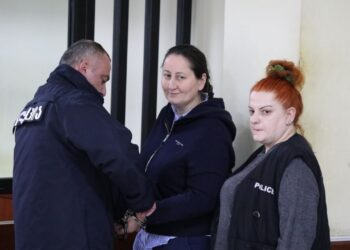
Brussels – “Before it is too late, speak out. Before it is too late, act.” This is the appeal to the European Union by Irma Dimitradze, Georgian journalist and colleague of Mzia Amaglobeli, the reporter in jail since January on charges of assaulting a public official during the protests that broke out last October in Georgia. Many, including Brussels, regard the arrest as an arbitrary choice of the authorities to silence freedom of speech.
Bringing Amaglobeli’s demands into the European institutions after nine months of detention is a way to revive media attention towards the governmental repression of the protest movement in Georgia, which exploded after the disputed elections a year ago. The European Parliament has only timidly tried to impose sanctions on politicians or members of the governing Georgian Dream party, but has always found opposition from the Member States, which decide on sanctions regimes unanimously. This was pointed out by Rasa Juknevičienė, a Lithuanian MEP from the People’s Party group, at a press conference dedicated to the Amaglobeli affair, convened today (14 October) in the EU Parliament. “In Parliament, we are ready to do everything to sanction some Georgian politicians. However, we know that in the Council—surprise, surprise—Hungary is opposed.”
Official visit to #Georgia. One thing is clear about this weekend’s elections: the people of Georgia voted for peace and prosperity in free and democratic elections. We are here to support Georgia’s European integration efforts and to strengthen relations.
Thank you for… pic.twitter.com/JuaW7yZN8A
– Viktor Orbán (@PM_ViktorOrban) October 29, 2024
Juknevičienė’s reconstruction is correct but incomplete. Placing all the blame on Orbán is not quite right. Italy, together with Hungary, Slovakia, Spain, and Romania, has put up a united front against the sanctions against Georgia. An attitude that earned a visit by the disputed prime minister Irakli Kobakhidze in Milan, for the inauguration of the Consulate General of Georgia, and the applause on X to Italy from the politician.

In the press room, named after another persecuted journalist, Anna Politkovskaya, the words dedicated to the reporter Amaglobeli take on a different meaning. The reporter for the Georgian network Batumelebi and Netgazeti has been in a prison in Batumi on the Black Sea coast for almost a year. From there, she has sent a plea to bring the spotlight of her case back to Europe. The moment for her is complex, her health is very poor, as reminded by both her former colleague Dimitradze and the prisoner’s lawyer, Caoilfhionn Gallagher. The inability to receive thorough treatment has worsened her eyesight, a deterioration due not only to the prison conditions but also to her decision to go on a 38-day hunger strike.
Petras Auštrevičius, Lithuanian MEP for the Renew group, explained the reason for her imprisonment: “Independent journalists are the greatest enemies of undemocratic regimes, which is why they end up in prison.” The numbers, indeed, are disturbing: in the South Caucasian state, more than 174 journalists have been charged, under various counts. A very high number for a small country.
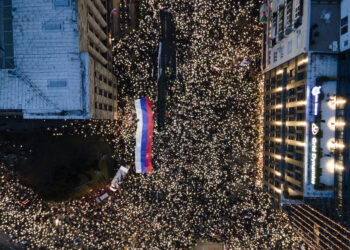
The social situation and the political climate are steadily worsening, Auštrevičius continues: “In recent months we have seen arbitrary arrests, judicial persecution and the conviction of opposition leaders and a journalist. In the streets, however, the protesters are not stopping to raise the level of confrontation with the authorities: a few days ago, the peak was reached with the attempted raid on the presidential palace.
Protestors against the Russian-backed government in Georgia have begun storming the Presidential Palace.
Unlike Maduro, Lukashenko and Assad, when Ivanishvili calls Putin, no one is picking up the phone. pic.twitter.com/xedfLIXNok
— Jay in Kyiv (@JayinKyiv) October 4, 2025
The European Union stands by and watches, despite the fact that the twelve-star flags continue to fly in the squares of Tbilisi. The hope for pro-European Georgians is for joint action, before it is too late. However, “too late” sounds almost like a verdict. The journalist’s lawyer, Caoilfhionn Gallagher, knows this well: “I have looked after the interests not only of Mzia but also of Daphne Caruana Galizia (a Maltese journalist killed by a car bomb for her investigations into political corruption, ed.) The EU took very strong action in relation to Malta only after her death. Now we have a similar situation here: the time for action is now.”
English version by the Translation Service of Withub
![[foto: European Council]](https://www.eunews.it/wp-content/uploads/2025/02/ue-georgia-350x250.png)