




From the envoy in Strasbourg – Member countries’ views, as usual, on Israel and Gaza are “very divergent.” Faced with the ceasefire brokered by Donald Trump – admittedly already violated by both sides – the foreign ministers of the 27 decided to freeze the proposal of the European Commission to impose economic and political sanctions against Israel. “We are not moving with measures now, but we are not taking them off the table either,” said High Representative for Foreign Affairs, Kaja Kallas, exposing herself once again to criticism for being unable to play a role in resolving the conflict, if not outright accusations of double standards.
Yesterday (October 20), in Luxembourg, the EU Foreign Affairs Council chose to “keep the proposals on the table” but not to make any decisions on them, given the “fragility” of the situation on the ground. The head of EU diplomacy explained that the proposal will not be trashed because “we see an improvement in humanitarian aid in Gaza, the release of Palestinian entrances blocked by the Israeli authorities, the entry of journalists and aid workers into the territory, and the unrestricted registration of international NGOs.”

Kallas, along with Ursula von der Leyen and several EU capitals, assumes that the threats to suspend certain trade facilitations and sanctions against two extremist ministers of Israel were, in essence, just a means to call Tel Aviv back to international law and to bring the conflict closer to an end. However, one key point is missing: that of legal responsibility. Benjamin Netanyahu’s government has violated the terms of the association agreement that binds Israel and the EU – as well as several sacred and basic principles of international and humanitarian law – and the European Commission itself noted this back in June.
Setting aside proposals for sanctions simply because the situation on the ground has changed in the meantime risks undermining the credibility of the Union, which continues to present itself as the guardian of a geopolitical order based on the rule of international law. According to Nathalie Tocci, director of the Institute of International Affairs, this is a “foolish decision.” According to the political scientist, beyond the responsibility for violations of international humanitarian law—which “have not disappeared”—the issue of incentives should not be underestimated. If “the pressure fades, likely, the Israeli government will not implement the plan.”
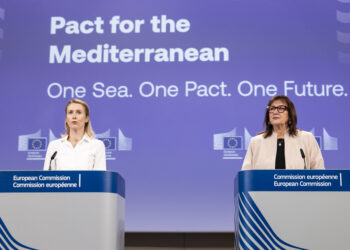
This morning, a debate was held in the European Parliament in Strasbourg on the prospects of the agreed ceasefire between Israel and Hamas and the role of the EU in building peace. The Commissioner for the Mediterranean, Dubravka Šuica, spoke in the hemicycle: “The situation is evolving rapidly and is also very fragile,” she said, stressing “the humanitarian situation remains catastrophic.” She added that “three critical aspects” remain for the implementation of the first phase of Trump’s plan: the return of the bodies of all deceased Israeli hostages, the Israeli army’s adherence to the agreed withdrawal lines, and the unrestricted access of humanitarian aid.

Šuica indicated the strategy that the European Commission will follow, insisting on the “crucial role” of Brussels in ensuring large-scale humanitarian aid to Gaza. “Through air bridges” and “deepening all access routes,” including the “Cyprus sea corridor.” The EU will be able to play its part in the medical evacuation of patients, by activating the civil protection mechanism, through which it “could also consider” supporting “decontamination and debris removal” operations.
Then there are the two EU missions, EUBAM Rafah, to facilitate the transit of people in and out of the southern crossing point between Gaza and Egypt, and EUPOL COPPS, with which the EU supported and trained the Palestinian police force in the West Bank, and which “could strengthen activity in Gaza.” Finally, Šuica reiterated the EU’s “interest in “contributing to the transitional governance” of the Strip and assured that the European Commission will “mobilize all available instruments” to promote the two-state solution.
Nothing, once again, on the urgency of ensuring Israel’s responsibility in the devastation of Gaza, in the massacre of tens of thousands of civilians, in the forced occupation of almost the entire territory that should constitute the future Palestinian state. The Belgian Liberal MEP, Hilde Vautmans, pointed out that “from 2023 until today, hundreds of EU-funded projects, including schools and hospitals, have been destroyed,” in Gaza and the West Bank, ed. “We say that he who breaks it pays for it,” Vautmans stated. A principle that so far, for Israel, no one in Brussels has dared to invoke.
On Sunday, Israel launched a series of air strikes and cut off all aid to Gaza “until further notice” after two Israeli soldiers were killed in an armed attack by Hamas.
Benedetta Scuderi, an AVS MEP who personally participated in one of the Global Sumud Fotilla’s humanitarian expeditions, recalled that “checkpoints remain, aid is controlled by those who used it to starve, land is still confiscated.” Scuderi stated that “since the beginning of the truce at least eight Palestinian children have been killed by Israel” and that “peace cannot exist without an end to the occupation and justice for the war crimes committed.” Otherwise, peace “is just a cover for oppression.” Or a pretext to continue not taking action.
English version by the Translation Service of Withub






![La video riunione dell'Eurogruppo [27 marzo 2026. Foto: European Council]](https://www.eunews.it/wp-content/uploads/2026/03/eurogruppo-260327-120x86.jpg)
