From the correspondent in Strasbourg – Reckless lawsuits “have taken the place of bullets.” Sigfrido Ranucci, the investigative journalist and presenter of Report, who was the victim of an assassination attempt on16 October, spoke today (21 October) at a seminar at the European Parliament in Strasbourg, on the occasion of the journalistic prize event dedicated to the Maltese reporter Daphne Caruana Galizia. He lashed out against SLAPPs, the gag lawsuits, “an instrument of delegitimisation” on which the Union has legislated but which Italy still does not fight decisively. The anti-SLAPP directive has not yet been transposed by the Italian government.
Ranucci, who was remotely connected to Strasbourg on the day the hemicycle was holding a debate on his case, actually denounced a problem that is now “global in scope”: attacks on the right to information. “Without knowledgeable information, one cannot make choices aimed at the common good,” said the Italian journalist.
From the chamber, Enlargement Commissioner Marta Kos expressed the European Commission’s “full solidarity and support for Sigfrido Ranucci, his family and colleagues” and welcomed “the condemnation by all Italian political forces.” Kos stressed that “these are heinous crimes that the authorities must investigate,” because “impunity for such crimes undermines our democratic societies.”

A few rooms away, recounting the bomb attack in front of his home, Ranucci reiterated the feeling of a “quantum leap” compared to the “activities of false dossier, delegitimisation, constant threats” he had received in recent years.
Without naming him, the Report host pointed his finger at an EU MP “who distinguished himself by operating a machination against me, having him tailed, recorded, trying to stop a journalistic investigation into his administration. He is Flavio Tosi, the former mayor of Verona, now elected to the EU Parliament with Forza Italia. In 2014, during his second term in office in Verona, he accused Ranucci of attempting to fabricate a dossier against him using slush funds from Rai. Tosi, who ended up in the crosshairs of Report for the alleged electoral support obtained from businessmen close to the ‘ndrangheta, managed to have 19 lawsuits and claims for damages launched against the journalist, all of which were dismissed. The Forza Italia MEP (at the time a member of the Lega) was instead condemned at first instance.
“If the EU wants to have an impact on its core values, it must provide itself with more incisive tools to enforce them within individual countries,” insisted Ranucci, recalling that—in addition to the anti-SLAPP directive—the Media Freedom Act must be fully implemented. Here, too, “pathologically ill” Italy is an extreme case: not only the savage allotment of public television, but also the case of the publisher and Lega’s MP Antonio Angelucci, whose group “runs three important newspapers.”
The disturbing Italian data were revealed—this time in the hemicycle—by Sandro Ruotolo, MEP for the Democratic Party, who called for the debate. “The first country in Europe for threatened journalists: 516 in 2024 alone, over 7,500 since 2006. In the first six months of this year, incidents have already increased by 76 per cent. Today, 29 reporters live under police protection.” Ruotolo denounced “the climate in which the attack” on Ranucci exploded, and asked politics for “a concrete commitment: dismiss the reckless lawsuits and stop delegitimising those who provide information.”

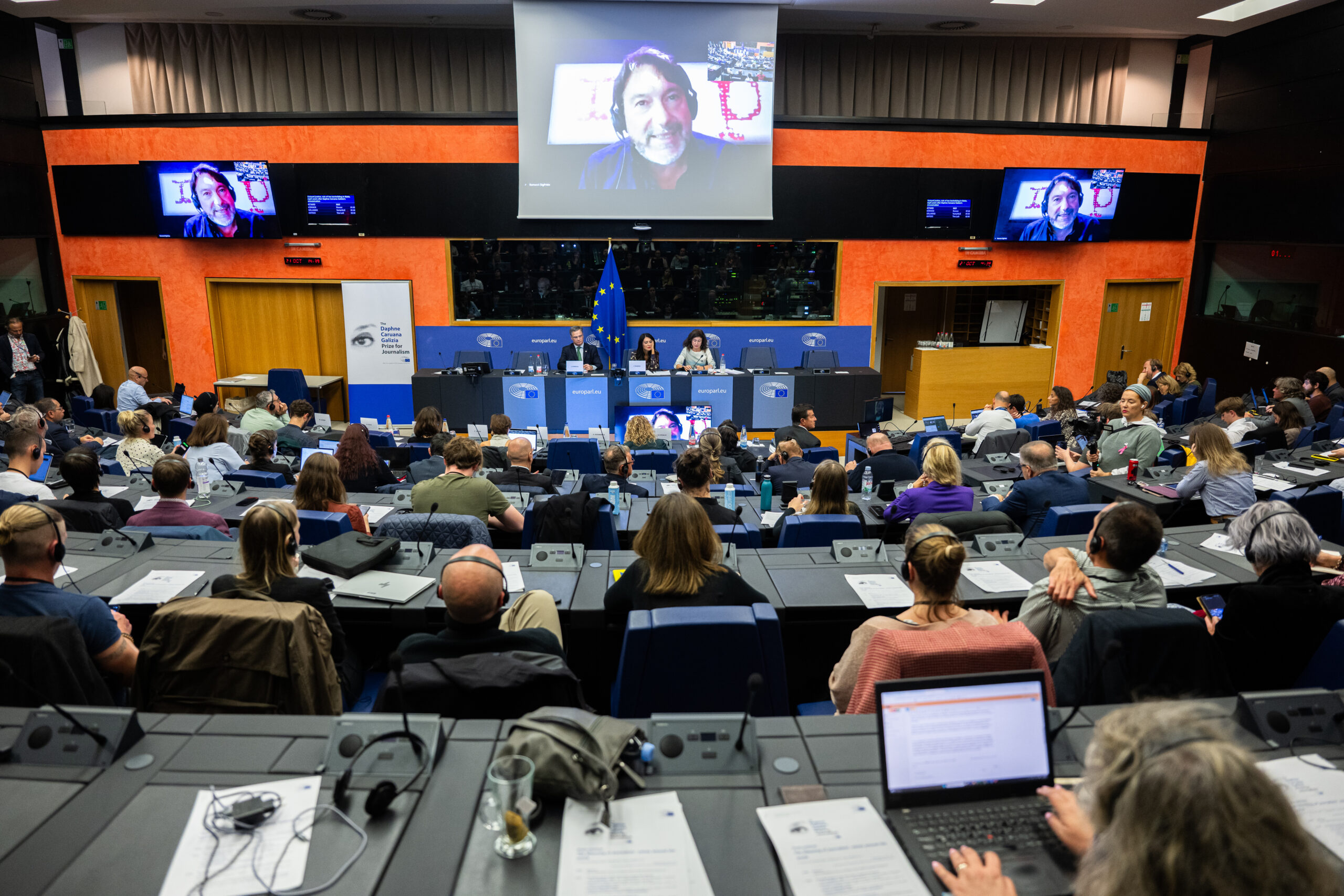
Roberto Saviano via video link to the European Parliament [Credits: European Parliament]
Back to the seminar. Before Ranucci, the event was opened by the Vice-President of the European Parliament, Pina Picierno, and the video link with Roberto Saviano. The Democratic Party MEP called the Daphne Caruana Galizia prize for investigative journalism a “political and moral act,” at a time when the “house of democracy,” the Strasbourg Parliament, is called upon to “defend the truth as a public good.”
The writer and author of Gomorrah pointed out that—especially in Italy—”when criminal organisations decide to act against a journalist or a thinker, they know that they will pay their consequences after decades.” Saviano also denounced the phenomenon of reckless lawsuits, which “takes oxygen away from free enquiry.” An “instrument of extortion” to obtain compensation. The j’accuse of the writer from Campania is peremptory: politics “targets the individual” and “never responds to issues, but attacks the person.” For Saviano, it has been happening “for decades” in Italy. Only that “before it happened to a few, but now it happens to everyone. Everyone pays the price.”
English version by the Translation Service of Withub