- Europe, like you've never read before -
Friday, 30 January 2026
No Result
View All Result
  • it ITA
  • en ENG
Eunews
  • Politics
  • World
  • Business
  • News
  • Defence
  • Net & Tech
  • Agrifood
  • Other sections
    • Culture
    • Diritti
    • Energy
    • Green Economy
    • Finance & Insurance
    • Industry & Markets
    • Media
    • Mobility & Logistics
    • Sports
  • Newsletter
  • European 2024
    Eunews
    • Politics
    • World
    • Business
    • News
    • Defence
    • Net & Tech
    • Agrifood
    • Other sections
      • Culture
      • Diritti
      • Energy
      • Green Economy
      • Finance & Insurance
      • Industry & Markets
      • Media
      • Mobility & Logistics
      • Sports
    No Result
    View All Result
    Eunews
    No Result
    View All Result

    Home » Politics » Dutch elections: Wilders’ ultra-right in the lead, but will probably not govern

    Dutch elections: Wilders’ ultra-right in the lead, but will probably not govern

    The polls will open on 29 October for the third time in four years. The failed experiment of the PVV-driven Schoof government may bring support back to the centre, but the formation of a new executive will almost certainly require lengthy and complex negotiations

    Francesco Bortoletto</a> <a class="social twitter" href="https://twitter.com/bortoletto_f" target="_blank">bortoletto_f</a> by Francesco Bortoletto bortoletto_f
    27 October 2025
    in Politics
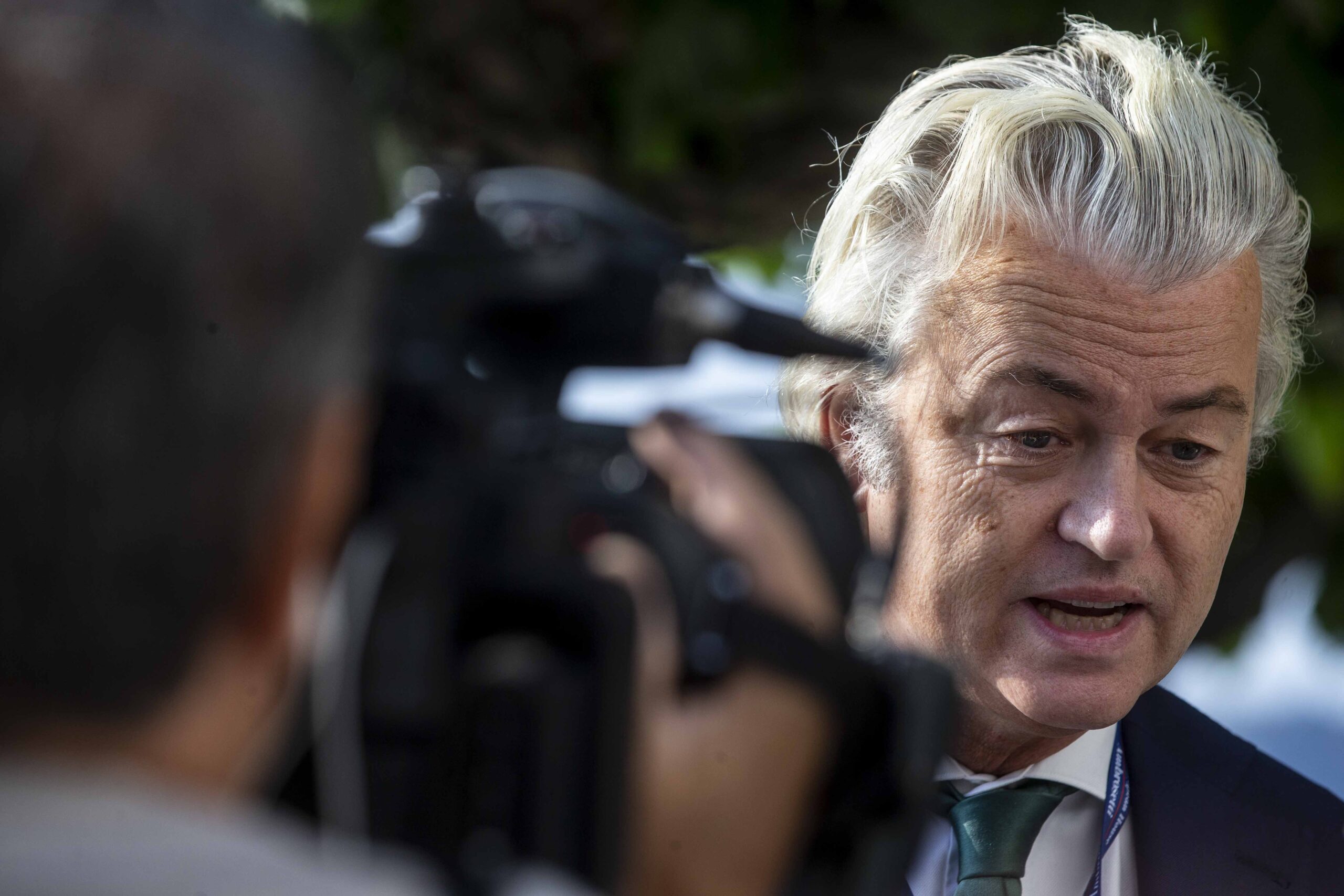
    Geert Wilders

    GEERT WILDERS POLITICO OLANDA - PARTY FOR FREEDOM

    Brussels – Uncertainty reigns over the upcoming early elections in the Netherlands. The ballot box date, scheduled for the day after tomorrow (29 October), is expected to confirm the extreme right-wing, anti-immigrant, and Eurosceptic Party for Freedom (PVV), led by Geert Wilders, as the leading political force. That is to say, the very man who, last June, pulled the plug on the government of Dick Schoof after less than a year of difficult co-existence between the four souls of the most right-wing coalition in recent Dutch history.

     According to the polls, the SPV is expected to take home between 17.6 and 20 per cent of the vote, remaining the party with the most elected seats in the Tweede Kamer (the lower house of the national legislature) but losing a few points (and a few deputies) compared to the early election in November 2023. There, having come out on top with 23.5 per cent of the vote, the xenophobic ultra-right had won 37 seats out of a total of 150. This time around, a group of 26-29 elected representatives seems more likely. 

    Chasing Wilders is the alliance of social democrats and environmentalists led by former European Commissioner Frans Timmermans, under the banner of Green Left-Labour Party (GL-PVDA). The polls credit the eco-socialists with around 15-16 per cent, in line with the result of two years ago. In short, the calls of the former number two at the Berlaymont for the construction (both at home and in the EU) of something similar to Italy’s “wide field” to bring together all the parties to the left of the centre under one roof seem to have fallen on deaf ears.

    Frans Timmermans
    The leader of the GL-PVDA, Frans Timmermans (photo: Dingena Mol/AFP)

    Also, according to the projections, the centre-right Christian Democratic Appeal (CDA), led by Henri Bontenbal, is projected to be between 13 and 16 per cent. Close behind is the liberal-progressive D66 party led by Rob Jetten, which is hovering around 11-13 per cent. Behind them should come the People’s Party for Freedom and Democracy (VVD), a liberal-conservative formation led by Dilan Yeşilgöz-Zegerius, which should not get much more than 10 per cent. 

    To date, the liberal derby between D66 and VVD—both members of Renew at the European level—already seems to be in the former’s hands. Jetten’s formation seems to have the wind in its sails, with sustained growth in consensus (plus 6 percentage points in the last few months). In contrast, the centrists orphaned by former premier Mark Rutte—current NATO Secretary General—are probably paying the price for having allied themselves with Wilders’s PVV after the last elections. 

    Finally, below the double-digit threshold, there are a number of smaller parties, which should nevertheless find representation in the Kamer by virtue of the peculiar electoral rules of the Netherlands, where voting is by a pure proportional system in a single national constituency. The distribution of seats is determined by complex calculations based on the D’Hondt formula, and the bar is set at 0.67 per cent of the vote, which increases fragmentation in the House and makes the formation of majorities proverbially complex. 

    There are the national-conservatives of JA21 (credited with around 8 per cent), the radical right of the Forum for Democracy (FVD, given around 3.5 per cent), the Socialist Party (SP) and the animal rights activists of the PVDD both close to 3 per cent, the Civic-Farmer Movement (BB) and the Reformed Political Party (SGP) just above 2.5 per cent, while in the vicinity of 2 per cent hover Denk, the Christian Union (CU) and Volt. The New Social Contract (NSC), on the other hand, seems close to disappearing.

    Dick Schoof
    The outgoing Prime Minister of the Netherlands, Dick Schoof (photo: European Council)

    Notwithstanding the polls’ margin of error, it seems likely that a three- or even four-way coalition, like the outgoing one (supported by PVV, VVD, BBB and NSC), will be needed to form the next executive. Schoof’s experience of government, paralysed by constant bickering between allies until Wilders’ exit, is certainly not edifying in this respect. Whoever wins, therefore, will have to engage in lengthy, complex negotiations to assemble a parliamentary majority. 

    All the major political forces have explicitly refused to ally with the PVV leader, but this will not necessarily make things any easier, given the political geography of the new hemicycle. The very fact that this is the third election in four years—and the second early one in a row—clearly illustrates the condition of increasing instability in the rich coastal state. 

    According to observers, a majority of the electorate would like to return to a more moderate policy after the earthquake triggered by the enfant terrible of the Dutch extreme right. However, as shown by the evolution of the Dutch public debate in recent years (within which, for example, positions on the issue of immigration have stiffened across the board), the xenophobic ultra-right is capable of heavily influencing the political balance of a country even without being inside the control rooms.

    English version by the Translation Service of Withub
    Tags: dick sheafelezioni paesi bassi 2025frans timmermansgeert wildersGL-PVDAmigrationpvv

    Related Posts

    Geert Wilders
    Politics

    Netherlands, Geert Wilders triggers government crisis: majority blows up over immigration

    3 June 2025
    Frans Timmermans
    Politics

    Frans Timmermans’ call for unity among European progressives

    5 February 2025
    La riunione del 17 ottobre 2024 su migrazione irregolare e rimpatri.
    Politics

    Dutch far-right wants to deport rejected asylum seekers to Uganda

    17 October 2024
    map visualization

    Compagnia delle Opere opens its first office in Brussels

    by Redazione eunewsit
    30 January 2026

    "A strategic step towards a deeper understanding of European policies and translating them into concrete opportunities for businesses and local...

    La Scala

    Precarious employment at La Scala: EU Court rules in favour of dancer without contract

    by Enrico Pascarella
    30 January 2026

    The use of temporary contracts for dancer Eliz Duygu was deemed abusive. The Court questions the limit on compensation provided...

    Abitazioni in bilico e carreggiate compromesse nell’area colpita dalla frana a Niscemi

    Cyclone Harry: Italy has three months to access EU Solidarity Fund. Brussels: “Ready to help”

    by Simone De La Feld @SimoneDeLaFeld1
    30 January 2026

    The procedure can take several months. For the floods in Emilia Romagna in 2023, the EU released €450 million after...

    [foto: Guillaume Baviere/WikimediaCommons]

    Cuba, the Commission fails to comment on Trump’s embargo: “No comment”

    by Emanuele Bonini emanuelebonini
    30 January 2026

    Although Kallas has expressed the need to end sanctions against the island, threats from the US president have led to...

    • Director’s Point of View
    • Letters to the Editor
    • Opinions
    • About us
    • Contacts
    • Privacy Policy
    • Cookie policy

    Eunews is a registered newspaper
    Press Register of the Court of Turin n° 27


    Copyright © 2025 - WITHUB S.p.a., Via Rubens 19 - 20148 Milan
    VAT number: 10067080969 - ROC registration number n.30628
    Fully paid-up share capital 50.000,00€


    No Result
    View All Result
    • it ITA
    • en ENG
    • Politics
    • Newsletter
    • World politics
    • Business
    • General News
    • Defence & Security
    • Net & Tech
    • Agrifood
    • Altre sezioni
      • European Agenda
      • Culture
      • Diritti
      • Energy
      • Green Economy
      • Gallery
      • Finance & Insurance
      • Industry & Markets
      • Letters to the Editor
      • Media
      • Mobility & Logistics
      • News
      • Opinions
      • Sports
    • Director's Point of View
    • L’Europa come non l’avete mai ascoltata
    • Draghi Report
    • Eventi
    • Eunews Newsletter

    No Result
    View All Result
    • it ITA
    • en ENG
    • Politics
    • Newsletter
    • World politics
    • Business
    • General News
    • Defence & Security
    • Net & Tech
    • Agrifood
    • Altre sezioni
      • European Agenda
      • Culture
      • Diritti
      • Energy
      • Green Economy
      • Gallery
      • Finance & Insurance
      • Industry & Markets
      • Letters to the Editor
      • Media
      • Mobility & Logistics
      • News
      • Opinions
      • Sports
    • Director's Point of View
    • L’Europa come non l’avete mai ascoltata
    • Draghi Report
    • Eventi
    • Eunews Newsletter

    Attention