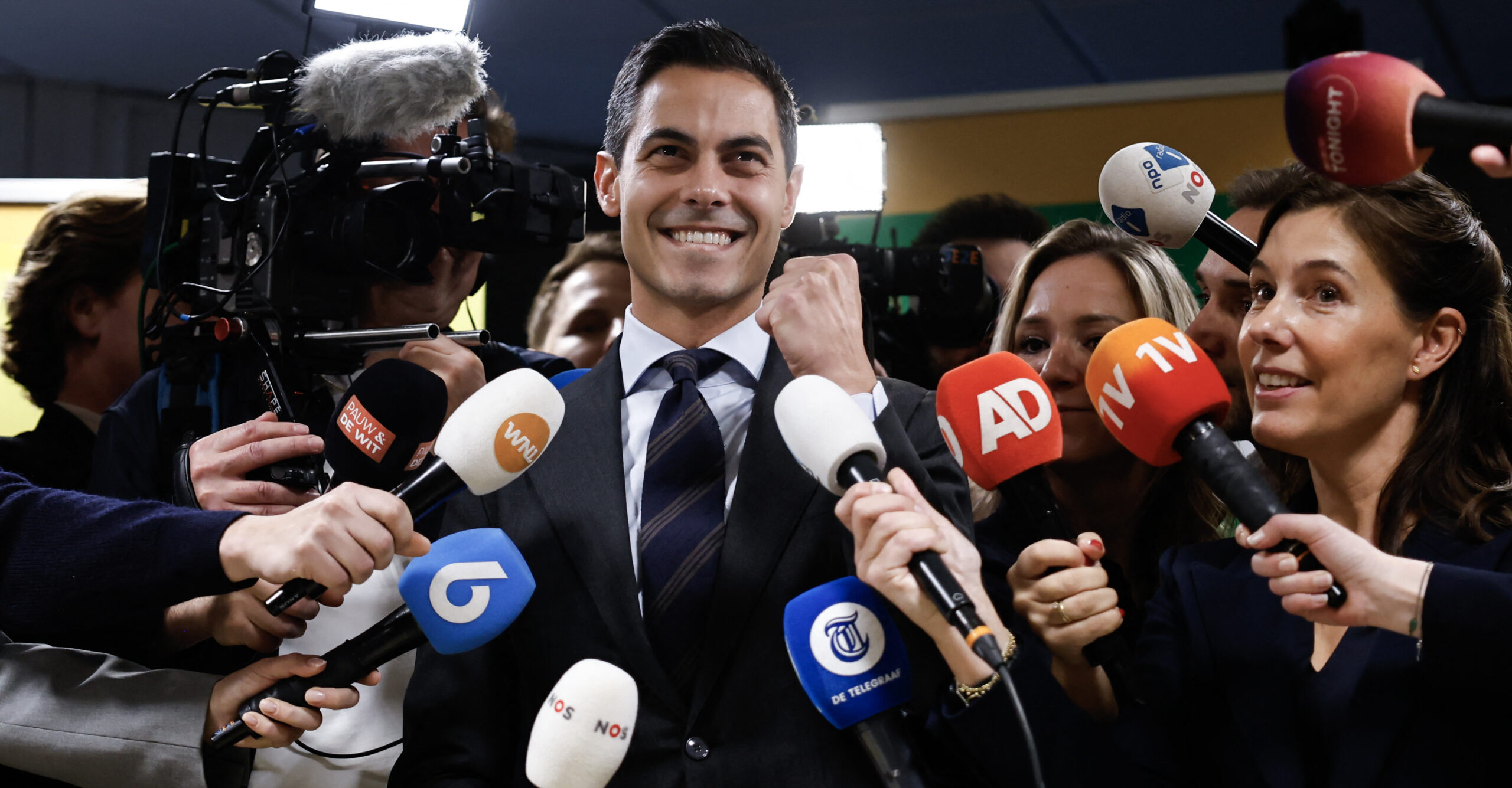
Brussels – Together until the last vote: In the Netherlands, even with 99.6 percent of the ballots counted, it is still unclear who won the most votes in the parliamentary elections. Competing for the top spot are the liberal center-left party D66 and the ultra-right formation PVV, led by Geert Wilders, both with 26 seats (but it is a collapse for the nationalist party, which had 37 MPs).
The other results speak of a center that is alive again. The Christian Democrats of the CDA improved compared with 2023 by winning 18 MPs, while Mark Rutte’s People’s Party for Freedom and Democracy remains stable (22 seats). Taking a step back, however, is the center-left. The leader of the Green Left and Labor (GL-PvdA) coalition, Frans Timmermans, and father of the Green Deal, has already announced his resignation. The Left has lost five MPs since 2023.

Goodbye Wilders, hello Europe
Although the result is not yet final —more than 12 hours after the polls closed —one thing is sure: the significant drop in Wilders’ ultra-right. Just two years ago, the Party for Freedom had elected 37 MPs, frightening the whole of Europe. A few months ago, it dissolved the government of which it was a part to call early elections.
Brussels is celebrating. “This is an encouraging signal for all of Europe. Pro-EU liberal and democratic forces can start winning again,” said liberal MEP Sandro Gozi, going out on a limb.
Driving the breakthrough coming from the center is Rob Jetten, 38, leader of D66. “We have succeeded,” he declared last night in front of a cheering crowd. “Millions of Dutch people have chosen positive forces, and a policy that looks to the future.” The man who is now one of the possible next prime ministers has managed to take D66 from 9 seats in 2023 to 26 in this election, a political windfall he must now manage to build solid alliances.
The ballots to be counted
Jetten’s jubilation, however, came a few hours early. According to the latest estimates released by the state broadcaster NOS, the PVV would have overtaken D66 by 1,382 votes: a handful of preferences that reinvigorate the populist leader. “If we are the ones with the most votes, we should be given the mandate,” Wilders said. A hope that is likely in vain, given that Wilders would have far more difficulty forming alliances.
In any case, at this point, every preference matters. According to information released by NOS, the 90,000 ballots from overseas voters have not yet arrived, and the count of 20 percent of the votes in Amsterdam is still missing. The final outcome will only be known in several hours.
D66 wins the Dutch election with 16.7%, narrowly beating PVV.
The result marks a comeback for pro-EU liberals after years of far-right momentum.
With no majority, tough coalition talks lie ahead as Europe watches the Netherlands’ next move. pic.twitter.com/FPJeZVMdZs
– Xavi Ruiz (@xruiztru) October 30, 2025
Possible alliances
For now, all that remains is to speculate on the future shape of the executive. The most concrete hypothesis is an alliance among D66, the VVD, and the Christian Democrats (CDA). This team, however, would be nine seats short. According to the independent think tank Center for European Reform, a possible alternative would be a union with the center-left. “The resignation of the leader of the Green/Labor Party (GL/PvdA), Timmermans, could make it easier for the VVD to engage in coalition negotiations with GL/PvdA and the Christian Democrats (CDA) under the leadership of D66,” the Center said in a statement. A line-up that, although it presents different political positions, is entirely favorable to European integration.
The extreme right is still there
The think tank, however, does not forget to point out that “the results of the Dutch elections are unlikely to mark the end of populism in the Netherlands. Although the Party for Freedom (PVV) lost seats, the far-right vote fragmented.” The ultra-right formation JA21, established only five years ago, elected nine representatives. There was also increased support for the Forum voor Democratie (FvD), which will have seven seats, four more than in 2023. The party is part of the radical Europe for Sovereign Nations (ESN) group at the EU level.
English version by the Translation Service of Withub