




Brussels – The epicentre is Milan, but the effects are reaching the whole of Europe. The investigation into snipers for tourism in the rubble of Sarajevo, launched by Italian journalist Ezio Gavazzeni, is spreading. Filing a complaint with the court in Milan this time was Croatian investigative journalist Domagoj Margetić. Even Aleksandar Vučić, the Serbian president, is allegedly in the eye of the storm. According to the documents brought to Milan by Margetić, Vučić, then only 20 years old, had enlisted as a volunteer in the paramilitary unit under the command of Slavko Aleksić, who operated in the Sarajevo area during the years of “snipers for fun.”
The accusations against the Serbian president were immediately denied by Vučić: “I have never killed or injured anyone,” he said, quoted by ANSA. Also in the same vein was the note published on X by the foreign ministry: “This is an attempt to disseminate disinformation in order to damage the reputation of the Republic of Serbia,” reads the document, which adds how the Serbian past is “once again being used as a means of political manipulation, fuelling tensions and fostering a destabilisation of our region.”
The political effects will be seen in the coming weeks. Certainly, this cannot please the European Union, which had already criticised Belgrade for its backward steps in the accession process. A controversial relationship between the EU and Belgrade. Yesterday, 20 November, during the conference on cooperation between the United Kingdom and the Western Balkans, the Serbian president was optimistic: “I think that the best place for everyone in the Western Balkans is the European Union.”

The “war tourists”
The case of the snipers for tourism requires great caution. The story is thirty years old, and only now have investigations been opened. The first elements date back to 1995, when the People’s Court of Trento (an Italian court without coercive powers founded in 1979)
condemned the violation of the fundamental rights of children and minors in the context of the siege of Sarajevo (1992–1995). The judgement mentions the presence of “war tourists” who had come to the Bosnian capital by “private flights from small European airports, equipped with camouflage suits, combat boots and weapons, to participate in ‘weekend sniping’ in the hills of Sarajevo.” These individuals, including several Italians, would arrive secretly between the Serbian lines and then be escorted to the conflict sites by militiamen. Once they had paid large sums, their abominable manhunt would begin. This, at least, is what is being contested.

Militiamen at Sarajevo Cemetery
The certainty of Croatian journalist Domagoj Margetić, however, is that among those paramilitaries was also the current president, Aleksandar Vučić. On social media, Margetić published the entire complaint filed with the Milan police headquarters. The document seeks to confirm the rumour that has been circulating in Serbia for some time, namely that of Vučić’s presence within the paramilitary unit under the command of Slavko Aleksić. Aleksić’s battalion operated, according to official testimonies during the trials held at the International Criminal Tribunal for the Former Yugoslavia (ICTY), in the Sarajevo cemetery during the siege of the city. Vučić would also have been among the ranks of the volunteers.
Margetić presents various elements in support of this, including an interview with the Belgrade weekly Duga in 1994, in which Vučić himself confirmed that he had been on the Sarajevo front as a volunteer. In the testimony, the current Serbian president said that his role, however, was only to bring food to the Serbs. The most relevant evidence, on the other hand, is the statement of Vojislav Šešelj, founder of the Serbian Radical Party (SRS), at the ICTY. During the 2013 trial against Radovan Karadžić, the Serbian leader sentenced to life in prison, Šešelj states that “our secretary general Aleksandar Vučić (at the time Vučić was secretary general of Šešelj’s Serbian Radical Party), before joining the party, was a volunteer with Slavko Aleksić at the Jewish Cemetery.”
The matter is decisive. The Jewish cemetery has always been identified as the epicentre of possible sniper actions for tourism, information also present in the papers presented by Gavazzeni. Vučić denied the accusations: “Never in my life have I been a sniper,” and then, referring to a video circulating about his presence in Sarajevo holding a sniper rifle, he added: “I have never had in my hands the rifle that is being talked about. Shame on you.”
On video is Vucic holding a sniper during the Siege of Sarajevo…or Sarajevo Safari hunting people. pic.twitter.com/ouRxmZvNEq
– Dritan Buzani (@Erton3112) November 21, 2025
From Milan to Belgrade
From the Milan Public Prosecutor’s Office to the most important palaces in Belgrade, the case of the rich Italians hungry for blood on the hills of Sarajevo could involve Serbian politics. In any case, before we can be certain of the truth, we will have to wait for the verdicts. It seems unlikely that it will be possible to determine with certainty the Serbian president’s involvement in the human safari incidents. Contacted by Eunews, Nicola Brigida, lawyer of the investigative journalist Ezio Gavazzeni, says he is unaware of Vučić’s involvement: “In our documents, there are no elements relating to the Serbian president.”
English version by the Translation Service of Withub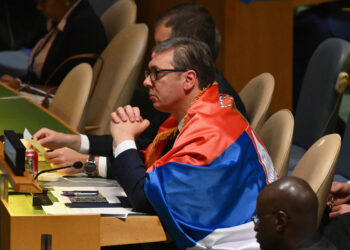



![[foto: Guillaume Baviere/WikimediaCommons]](https://www.eunews.it/wp-content/uploads/2026/01/Cuba_Che-120x86.jpg)
