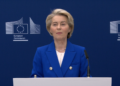
Brussels – Ursula von der Leyen visits what is now the great sick man of the Western Balkans. Compared to Albania, Montenegro, North Macedonia, and Bosnia and Herzegovina, Serbia’s path to EU membership seems to be going backwards. The President of the European Commission, on her annual tour of the region, stopped in Belgrade today (15 October), a guest of authoritarian,pro-Russian President Aleksandar Vučić. And she chose, once again, not to dump him, but without making concessions.
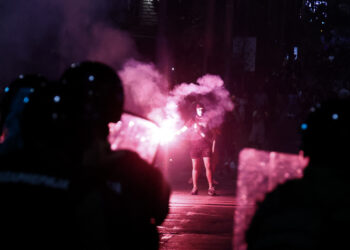
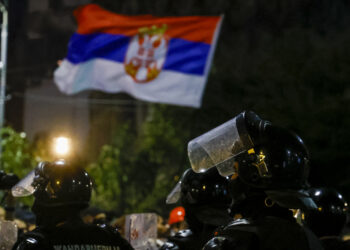

Serbia must “redouble” its efforts, von der Leyen urged in the joint press conference on the sidelines of the meeting with the Serbian president. It is high time, she added, for the Balkan country to “concretise” its membership in the 12-star club, which was initiated more than 15 years ago. Dispelling any doubts about Brussels’ stance on the harsh government repression of the protest movements that have been inflaming the country for almost a year, the EU leader said: “We stand for freedom instead of oppression, including the right to assemble peacefully.”
Belgrade’s shortcomings are well known in the EU capital: “We need to see progress on the rule of law, the electoral framework and media freedom,” von der Leyen listed. The carrot and stick strategy is used to keep candidate countries anchored in the arduous reform path necessary for accession. The president “welcomed the recent progress” made with the establishment of the unified electoral register and the appointments to the board of the Electronic Media Regulatory Commission (EMR).
“I have noticed the efforts made by everyone to work together, including civil society and the opposition,” von der Leyen acknowledged, aware at the same time that independence from political control of the media regulator is still to be achieved and that one cannot look away from Belgrade even for a moment. “It is a good first step, but now implementation is crucial, and that is why I would like to invite you to Brussels in a month’s time to take stock of the situation together,” she said, addressing Vučić.
The recipe indicated by the EU remains the same, even when it involves foreign policy. A “better alignment” is needed; the “61 per cent” indicated by von der Leyen is not enough. On the other hand, Vučić continues to wink at Russia and has not yet conformed to the European sanctions regime against Moscow.
This is despite the fact that, as the President of the European Commission pointed out, Belgrade and the entire Western Balkans benefited from the emergency measures put in place by the EU during the energy crisis “caused by Russia’s aggression in Ukraine.”

To accelerate a lengthy process, which in recent years has created quite a few frustrations in the candidate countries, in April 2024, the European Union set up a €6 billion instrument to support the socio-economic reform plans necessary for accession in the six Western Balkans (Albania, Bosnia and Herzegovina, Kosovo, North Macedonia, Montenegro, and Serbia). As part of the Growth Plan for the Western Balkans, von der Leyen recalled that the Commission has “already made available over €100 million in new EU investments for Serbia.”
Vučić, more than a little reluctant to the openings on the rule of law and media freedom expected to advance in the negotiations,
moved to pre-empt criticism: “I cannot promise anything, except that we will work hard to fulfil the reform agenda,” he said, hoping that “in all this we will have the support of the EU.” The conservative nationalist leader, who has led the country for more than a decade and whose popularity is now at an all-time low, knows that antagonising Brussels—which has not dumped him after the huge student protests—could lead to his ultimate isolation.
In turn, Ursula von der Leyen, European Council President Antonio Costa, High Representative for Foreign Affairs Kaja Kallas, and Commissioner for Enlargement Marta Kos, all reprimanded Vučić while extending a hand to him, in order not to sever a relationship that is part of a delicate geopolitical balance. And like a tightrope walker, Vučić tries to disentangle himself between promises to Brussels, winks to Moscow, and small concessions at home. Vučić asked von der Leyen to “find a way to mitigate the energy situation” of Serbia, whose oil company Nis is subject to sanctions by the US administration and “in fact, also by the EU.” Moral blackmail is served: “I hope that a candidate country has the support of the EU for its energy security,” he said.
English version by the Translation Service of Withub