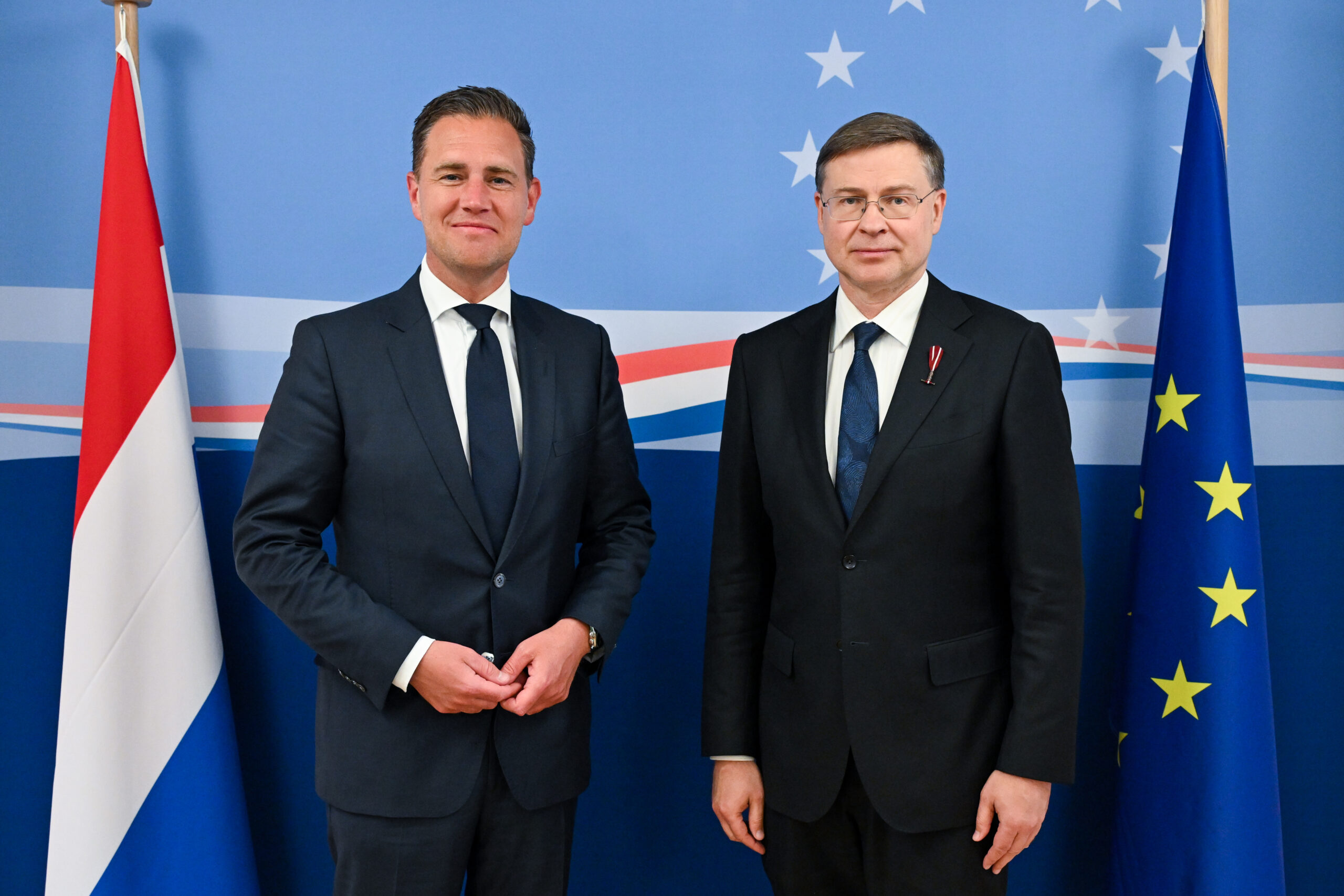
Brussels – “It cannot be that every time there is a shock, the response is more debt.” In other words, the Stability Pact will not be suspended. The Dutch Finance Minister, Eelco Heinen, is unequivocal on the matter. On the sidelines of the Eurogroup meeting, he answered a very precise question from the press, and the Dutch minister just as precisely rejected the requests from Spain and Italy, which would like to see the common budgetary rules put on hold in response to the energy crisis caused by the war in Iran.
“Our debt levels are too high,” states the Dutch Finance Minister. “The problem is that we entered this crisis with high levels of debt, and taking on new debt is not the solution,” he insists. Following the European Commission’s rejection, Italy has now come up against a “no” from the Netherlands. “It cannot be that every time we ask for more flexibility in the rules,” Heinen continues, in what is a clear call for reforms and the consolidation of public finances.
Dombrovskis says reforms are the answer to the crisis in the Middle East
Belgium’s Finance Minister, Vincent van Peteghem, has doubled down: “I do not see the conditions for triggering the suspension clause” of the Stability Pact, he emphasised on the sidelines of a Eurogroup meeting, therefore leaving Italy’s Economy Minister, Giancarlo Giorgetti, under pressure. This is also because the agenda includes strengthening the banking system and completing the banking union project, which, however, involves ratifying the reform treaty of the European Stability Mechanism (ESM), a source of discontent among the partners. Giorgetti also receives another warning: in the face of the crisis triggered by the war in Iran, “we must be careful not to overreact”, the Belgian minister emphasises once again. A call to avoid indefinitely extending measures such as the cut in fuel excise duties.
For the Italian government and its coalition partners, the challenge is becoming more complex. The approach adopted within the coalition to ease constraints on policy manoeuvre is encountering resistance from Europe, which is nevertheless attempting to offer a helping hand through the flexibility on National Recovery and Resilience Plans (PNRR) announced by the European Commission’s Executive Vice-President, Raffaele Fitto. The guidelines drawn up in Brussels allow and encourage Member States to submit targeted revisions by 31 May.
English version by the Translation Service of Withub![Il ministro dell'Economia, Giancarlo Giorgetti (destra), con il commissario per l'Econonia, Valdis Dombrovskis [Bruxelles, 9 marzo 2026. Foto: European Council]](https://www.eunews.it/wp-content/uploads/2026/03/giorgetti-dombrovskis-350x250.jpg)
![I partner dell'Ue chiedono meno debito. Posizioni che riaccendono il dibattito sulla riforma del patto di stabilità [foto: imagoeconomica]](https://www.eunews.it/wp-content/uploads/2023/02/Imagoeconomica_1556290-scaled.jpg)
![Il commissario per l'Economia, Valdis Dombrovskis, in audizione in commissione Affari economici [Bruxelles, 9 aprile 2026]](https://www.eunews.it/wp-content/uploads/2026/04/dombro260409-350x250.png)

![[Copyright: European Union]](https://www.eunews.it/wp-content/uploads/2026/10/euco-261015-120x86.png)