- Europe, like you've never read before -
Monday, 4 May 2026
No Result
View All Result
  • it ITA
  • en ENG
Eunews
  • Politics
  • World
  • Business
  • News
  • Defence
  • Health
  • Agrifood
  • Other sections
    • Culture
    • Diritti
    • Energy
    • Green Economy
    • Finance & Insurance
    • Industry & Markets
    • Media
    • Mobility & Logistics
    • Net & Tech
    • Sports
  • Newsletter
  • European 2024
    Eunews
    • Politics
    • World
    • Business
    • News
    • Defence
    • Health
    • Agrifood
    • Other sections
      • Culture
      • Diritti
      • Energy
      • Green Economy
      • Finance & Insurance
      • Industry & Markets
      • Media
      • Mobility & Logistics
      • Net & Tech
      • Sports
    No Result
    View All Result
    Eunews
    No Result
    View All Result

    Home » World politics » The West advances as the European Political Community meeting in Armenia challenges Putin

    The West advances as the European Political Community meeting in Armenia challenges Putin

    The meeting in Yerevan to discuss strategic issues, with Canada participating, is a political manifesto: borders, logics, and alliances have changed

    Emanuele Bonini</a> <a class="social twitter" href="https://twitter.com/emanuelebonini" target="_blank">emanuelebonini</a> by Emanuele Bonini emanuelebonini
    4 May 2026
    in World politics
    Il presidente del Consiglio europeo, Antonio Costa (sinistra), con il primo ministro armeno, Nikol Pashinyan [Yerevan, 4 maggio 2026. Foto: European Council]

    Il presidente del Consiglio europeo, Antonio Costa (sinistra), con il primo ministro armeno, Nikol Pashinyan [Yerevan, 4 maggio 2026. Foto: European Council]

    Brussels – The future of the European Union is being debated at the very heart of Russia’s interests. The European Political Community (EPC), which is meeting in Armenia, is far from a mere formality: the EU wants to send a clear message to Russian President Vladimir Putin that the West is moving forward, that it means business, and that Central Asia is no longer an area under Moscow’s exclusive influence.

     Armenia is a member of the Eurasian Economic Union (EEU), the international organisation that also includes Belarus and Kazakhstan, but it is also part of the Collective Security Treaty Organisation (CSTO), a military and defence alliance led by Russia and comprising Belarus, Kazakhstan, Kyrgyzstan, and Tajikistan. The European Union, together with its EPC partners, is therefore entering with renewed force into a part of the world where Russia’s geostrategic interests are well known and openly stated.

    These decisions are no coincidence: the EU began to invest politically in its relations with Armenia through the 2017 bilateral cooperation agreements (in force since 2021). This initiative gained fresh momentum with the Yerevan government’s decision to join the EU. Moreover, the conflict over Nagorno-Karabakh has prompted the Armenian government to reconsider its participation in organisations led by Moscow: Russia did not intervene to defend Armenia from Azerbaijani operations, undermining the trust in Moscow and the functioning of the alliance system Moscow sought to establish in the wake of the dissolution of the Soviet Union. This prompted Armenia to look westwards, and the EU is trying to seize the moment.

     https://www.eunews.it/2023/09/19/ue-puo-e-fara-poco-in-nagorno-karabakh/

    Azerbaijan’s gas, the EU for Armenia

    The European Union has been unable to do much about the Nagorno-Karabakh issue, but this has not prevented it from making two choices and acting on two fronts: on the one hand, forging closer ties with Azerbaijan over gas, which, unlike Armenia, can be supplied to help the EU break free from Russian supplies, and, on the other, offering Armenia the prospect of EU membership in return. A formula that could be mutually beneficial, with gains for all parties involved: the EU would wrest spheres of influence from Moscow, Armenia would find itself safe under the European umbrella, and Azerbaijan could thus continue to keep a foot in both camps.

    Putin’s warnings

    Armenia’s moves have not gone unnoticed. On the contrary, during the bilateral meeting on 3 April, Russian President Vladimir Putin took the opportunity to remind Armenian Prime Minister Nikol Pashinyan that “it should be obvious and honestly stated in advance that membership of a customs union with either the EU or the Eurasian Economic Union is impossible.” These clarifications were offered a month ago, well in advance of today’s meeting (4 May). 

    With the war in Ukraine still raging, opening up new fronts seems hardly feasible, but Moscow always has its energy weapon ready: at present, Russia is selling gas to Armenia at prices far lower than those in Europe (177.5 dollars per thousand cubic metres in Armenia, over 600 dollars per thousand cubic metres in Europe). A “substantial” difference that the Kremlin leader has not failed to point out to Armenia.

    Europe moves forward, with NATO and the Turkey issue

     Europe remains unfazed and openly challenges Putin in what the Russian president considers his own backyard, bringing in Canada as well, a non‑European country but an active NATO member. It is the West pushing forward, worrying the Russian leader, who had already expressed his concerns at the Munich Security Conference in 2007. With Turkey still the real question mark in this European ambition to draw Armenia closer.

    Turkish-Armenian relations have historically been tense and complex. The Armenians accuse the Turks of genocide, with a part of the EU that shares this historical interpretation. The inclusion of Armenia in the EU risks alienating Turkey’s support for the EU. With the United States threatening to leave NATO and Turkey being the Alliance’s second-largest military contributor, the situation risks becoming precarious.

    English version by the Translation Service of Withub
    Tags: armeniacentral asiaeuropean political communityrussiaue

    Related Posts

    Kaja Kallas Ararat Mirzoyan
    World politics

    Armenia moves towards visa liberalization with the EU — but remains in Moscow’s orbit

    1 July 2025
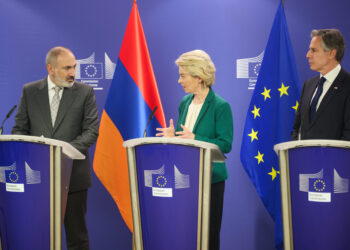
    Pashinyan Armenia von der Leyen Blinken
    World politics

    EU to allocate €270 million for Armenia’s Resilience and Growth Plan

    5 April 2024
    map visualization
    Eelco Heinen, ministro delle Finanze dei Paesi Bassi, con Valdis Dombrovskis, commissario europeo per l'Economia. Fonte: Consiglio UE

    The Netherlands against Meloni: “The response to shocks cannot be more debt”

    by Emanuele Bonini emanuelebonini
    4 May 2026

    The Dutch Finance Minister, Eelco Heinen: "It is unacceptable that calls are made to suspend the Stability Pact every time."...

    SERVIZIO DI ACCESSO PRIVILEGIATO AI DISABILI AGLI SPORTELLI. Fonte: Ipa Agency

    Disability doubles the likelihood of perceived discrimination in European public offices

    by Redazione eunewsit
    4 May 2026

    According to Eurostat data, the rate stands at 9.4 per cent. At the national level, Italy is among the countries...

    Il presidente del Consiglio europeo, Antonio Costa (sinistra), con il primo ministro armeno, Nikol Pashinyan [Yerevan, 4 maggio 2026. Foto: European Council]

    The West advances as the European Political Community meeting in Armenia challenges Putin

    by Emanuele Bonini emanuelebonini
    4 May 2026

    The meeting in Yerevan to discuss strategic issues, with Canada participating, is a political manifesto: borders, logics, and alliances have...

    Karel Van Miert, European Commissioner for Competition between 1993 and 1999. Source: Imagoeconomica

    The Price of Exceptions

    by Roberto Zangrandi
    4 May 2026

    State aid, national champions and the rules

    • Director’s Point of View
    • Opinions
    • About us
    • Contacts
    • Privacy Policy
    • Cookie policy

    Eunews is a registered newspaper
    Press Register of the Court of Turin n° 27


    Copyright © 2025 - WITHUB S.p.a., Via Rubens 19 - 20148 Milan
    VAT number: 10067080969 - ROC registration number n.30628
    Fully paid-up share capital 50.000,00€


    No Result
    View All Result
    • it ITA
    • en ENG
    • Politics
    • Newsletter
    • World politics
    • Business
    • General News
    • Defence & Security
    • Health
    • Agrifood
    • Altre sezioni
      • Culture
      • Diritti
      • Energy
      • Green Economy
      • Gallery
      • Finance & Insurance
      • Industry & Markets
      • Media
      • Mobility & Logistics
      • Net & Tech
      • News
      • Opinions
      • Sports
    • Director’s Point of View
    • Draghi Report
    • Eunews Newsletter

    No Result
    View All Result
    • it ITA
    • en ENG
    • Politics
    • Newsletter
    • World politics
    • Business
    • General News
    • Defence & Security
    • Health
    • Agrifood
    • Altre sezioni
      • Culture
      • Diritti
      • Energy
      • Green Economy
      • Gallery
      • Finance & Insurance
      • Industry & Markets
      • Media
      • Mobility & Logistics
      • Net & Tech
      • News
      • Opinions
      • Sports
    • Director’s Point of View
    • Draghi Report
    • Eunews Newsletter

    Attention