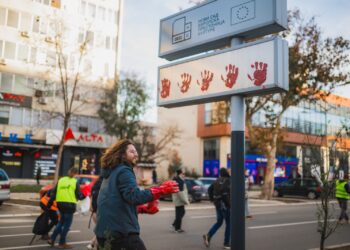
Brussels – A few hours after the first anniversary of the roof collapse at the Novi Sad railway station, which cost 16 people their lives, tens of thousands of Serbian citizens are moving towards the city north of Belgrade: tomorrow (1 November) they will remember the victims and reaffirm that they have no intention of stopping the largest protest movement in the country’s history, despite the ferocity with which the president, Aleksandar Vučić, has so far been determined to remain in power.
Last night, in Inđija, halfway between the capital and Novi Sad, some 3,000 young people slept under the open sky in the city’s main street, on mattresses and blankets provided by citizens. The mayor of Inđija, a member of the president’s party (SNS), refused to open any public space to accommodate the students. The appointment is at 11:52 tomorrow morning—the exact time of the tragic accident—at Novi Sad station, where 16 symbolic minutes of silence will be observed.
After a year of massive protests against corruption and authoritarian management of the state apparatus, it is time to take stock. According to Srđan Cvijić, chairman of the International Advisory Committee of the Belgrade Centre for Security Policy, “no opening has been made” by the president. Since the huge demonstration in Belgrade on 28 June, Vučić has only tightened the grip of repression, “going beyond any red line seen so far” in the long-standing EU candidate country. Several reports by independent media and civil society organisations have alleged sexual harassment of female students arrested in police stations and
the use of illegal weapons and chemicals to disperse protesters. Meanwhile, the government has reinforced the narrative that the Novi Sad incident was in fact a terrorist act.
Also publicly supporting this “conspiracy theory” is Ana Brnabić, President of the Belgrade Parliament, who will speak at the EU Forum on Enlargement in Brussels on 18 November. The European Union, on the other hand, is in great difficulty due to the situation in the country at the heart of the Balkans. The annual report on the state of affairs in the candidate countries, to be unveiled on Tuesday, 4 November, is expected to adopt very harsh language towards Belgrade. And a few days ago, the European Parliament adopted by a large majority a resolution calling on Vučić to stop the repression and “be serious” on the path to accession.
Nevertheless, one after the other, EU Commissioner for Enlargement Marta Kos, European Council President Antonio Costa, and European Commission President Ursula von der Leyen travelled to Belgrade to confirm support for Vučić, in what Cvijić called a “masochistic need for Europe to believe in this government, because it is afraid of a leap in the dark.” A fortnight ago, in a press conference together with Vučić, von der Leyen used the carrot and stick: after emphasising that Brussels is on the side of “freedom instead of oppression, including the right to peacefully assemble,” she “welcomed the recent progress” made with the establishment of the unified electoral register and the appointments to the board of the Electronic Media Regulatory Commission (EMR).

It is precisely this last point—commented Cvijić—that shows the “difficult game” the president is playing. According to the political analyst’s reconstruction, it is true that several independent organisations have “entered with difficulty and many risks to their public legitimacy” into dialogue with the government in order to elect the members of the REM, but “for the umpteenth time” the executive “has used ploys” to secure the majority of the members of this control commission.
Vučić’s game is on several fronts: to show fake openness to Brussels, to delegitimise the protesters and their supporters (Cvijić himself was attacked by a high-ranking government official after publishing an editorial in the British newspaper The Guardian), and meanwhile, “use every opportunity to deepen rifts in the democratic movement“. Because some cracks in the student front on the strategy to be pursued do exist, and they revolve around how to behave in view of one of the primary objectives, that of obtaining early legislative elections.

At first, the student movement had strongly rejected any interaction with established political institutions, including opposition parties. Now, students who strongly support the need to return to the polls have announced they will present an electoral list, which will be made public only when and if elections are called. A large part of Serbian society supports this demand and has called on all opposition parties not to participate in the possible elections, as a sign of support for student candidates. This is inevitably leading to fears and tensions in the broad democratic movement.
That is where Vučić is trying to insert himself to widen the cracks. According to Cvijić, the president is not calling elections because he is “not sure he can win them,” and is therefore “working to break the front” of the opposition and regain ground. According to the institutional calendar, Serbia must, in any case, hold presidential elections in the spring of 2027 and those for the renewal of the parliament before the end of the same year. Time is on Vučić’s side. History is on the side of the students. And of those 16 citizens crushed by the roof of a railway station inaugurated a few months earlier, which revealed the inadequacy of the works and the rampant corruption of the country’s state apparatus.
English version by the Translation Service of Withub