The Breton
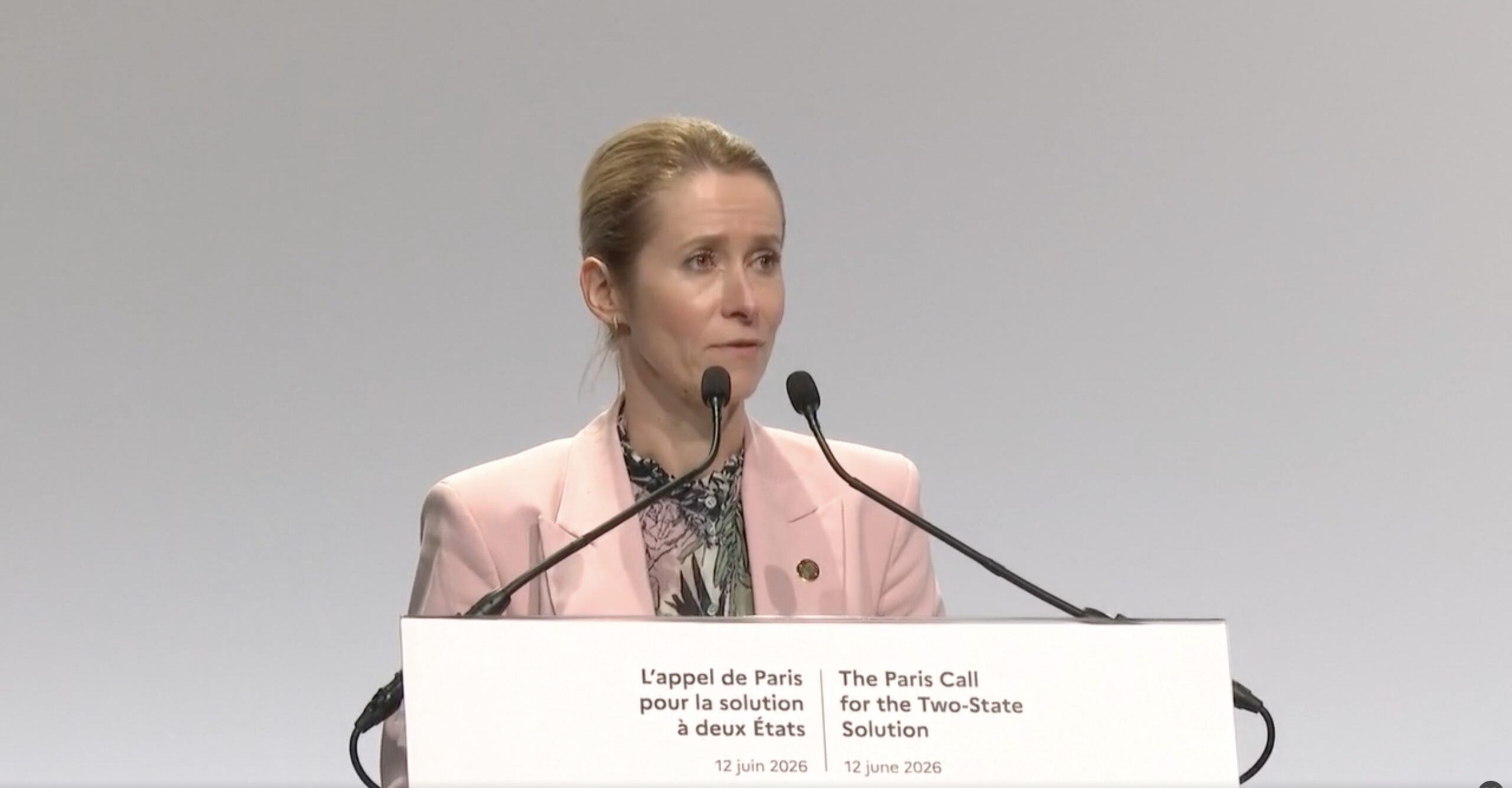
Brussels – “The two-state solution remains the only viable way to bring lasting peace and stability to the Middle East.” With these words, the High Representative of the European Union for Foreign Affairs, Kaja Kallas, opened the event “Paris Call for the Two-State Solution, Peace and Regional Security” today (12 June) in Paris, an initiative aimed at reviving the political process towards the creation of a Palestinian state alongside Israel.
The meeting was organised by the Paris Peace Forum, a French think tank founded in 2018 with the support of the Élysée Palace, and brought together representatives of Israeli and Palestinian civil society alongside European, Middle Eastern, and international government officials. The event comes one year on from a previous meeting held in the French capital, which resulted in the so-called Paris Call, a declaration calling for a permanent ceasefire, the release of hostages, humanitarian access to Gaza, the recognition of the State of Palestine, and a renewed commitment from the international community to bring the two-state solution to fruition.
It was precisely this experience that Kallas referred to in her speech, noting how the proposals drawn up by civil society were subsequently incorporated into the New York Declaration. Adopted in July 2025 by the United Nations General Assembly, the document sets out a roadmap for a definitive solution to the Israeli-Palestinian conflict based precisely on the two-state solution. “The lesson is clear: civil society is not an afterthought in diplomacy; it is indispensable for building peace,” emphasised the EU’s foreign policy chief.
On the subject of civil society, Kallas was keen to highlight in particular the role played by Israeli and Palestinian organisations which, in an era of radicalisation, remain steadfastly committed to dialogue. Addressing the participants, Kallas stressed that “Israelis and Palestinians working together for peace amidst war, division and polarisation is not only an act of courage, it is also a source of hope.”
The High Representative then addressed the situation on the ground. While referring to the ceasefire and the most recent diplomatic developments, she warned that “the situation remains fragile.” According to Kallas, as part of a comprehensive solution to the conflict, it is necessary to ensure the complete disarmament of Hamas, while “Israel must withdraw its forces and ensure the full reopening of the crossings.” At the same time, she added, “humanitarian aid must flow into Gaza unhindered and reconstruction efforts must begin.”
As for the West Bank, the former Estonian prime minister condemned the ongoing expansion of Israeli settlements, arguing that “illegal settlements continue to expand at an unprecedented rate,” while “settler violence is on the rise without sufficient accountability.” Just last month, moreover, EU Member States have managed to reach an agreement to sanction violent settlers, refraining, however, from going so far as to impose economic sanctions on products from the settlements.
Kallas’s words seem clear, but the risk is that Brussels’s role in the peace process will remain limited to a few token rhetorical statements at international conferences such as today’s. The fact that—a year on from the previous meeting in Paris—the organisers have been forced to meet again to reiterate what was already called for in 2025 is an indisputable sign that little progress has been made. And that, so far, Europe has failed to make an impact.
English version by the Translation Service of Withub![Manifestazioni per la Flottilla e la Palestina [foto: unsplash]](https://www.eunews.it/wp-content/uploads/2026/06/nikolas-gannon-DNN_008JieA-unsplash-350x250.jpg)

![[foto: European Council]](https://www.eunews.it/wp-content/uploads/2026/03/euco-260319-120x86.jpg)