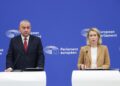

Brussels – “We are not fighting fossil fuels so much as emissions from fossil fuels.” The President of the European Commission, Ursula von der Leyen, is playing a political balancing act to relaunch the European Commission’s agenda without displeasing her partners, particularly the United States, which is unconvinced of the need for alternative production models. She is going to the G20 in South Africa to relaunch clean investments in Africa, without creating rifts with other partners. Hence, the necessary clarification: not a distancing from those who continue to invest in traditional approaches, but rather a need to reconcile reluctant stakeholders with those more open to possibilities.
The Trump presidency, with its hard-line, “bully” policy, remains a prominent element. Without explicitly stating so, both von der Leyen and the President of the European Council, Antonio Costa, repeatedly emphasize the EU’s reliability as a partner, its belief in rules, and its respect for them. All these points underline that, unlike the United States, the European Union will never resort to unilateral moves. “We are here because we believe in multilateralism, and in the rules-based order,” said Costa, convinced that “climate change, inequality, and poverty are three main issues on which we must mobilise the whole world.” Beginning with Africa, where it is especially necessary to advance Europe’s sustainability goals and ambitions
“Last year, investments in clean energy reached two trillion euros globally, but only 2 percent of these investments went to Africa, the continent with 60 percent of the world’s best solar potential,” said von der Leyen, according to whom “this cannot be possible.” This is why the Scaling Up Renewables in Africa campaign aims to bring together governments, investors, and philanthropists to achieve a fossil-fuel-free future for Africa.
Because, insists von der Leyen, “the real issue, when it comes to climate change, is energy.” In the EU, she claims, “in the last twenty years, we have reduced [greenhouse gas] emissions by 50 percent, thanks mainly to emission cuts in energy.” It is possible to repeat the experience outside of Europe: “This potential is strong on the African continent,” the German admits.
At the G20 summit, the EU turns its attention to Africa, beginning with South Africa’s presidency, seeking a green, sustainable alternative to Trump’s America and aiming to push it aside in shaping the international order. It is primarily to Africa and South Africa that Costa calls for “engaging in the reform of international financial institutions and the reform of the United Nations so that they reflect today’s world, because today’s world is no longer the same as 1945.” The new course in EU-Africa relations, therefore, passes through the G20 and the intentions Europe brings to the meeting.
English version by the Translation Service of Withub