Brussels – “We have a clear stance: no decision on Ukraine and Europe without Ukraine and Europeans.” This was stated by German Chancellor Friedrich Merz in Berlin, alongside Polish Prime Minister Donald Tusk, during a state visit. In the meeting between the two leaders, the agreement on the Ukrainian conflict and border defence is common ground that can overshadow old frictions from World War II.

“The Copernican Revolution”
War and its derivatives were, in fact, the main topics of today’s meeting, 1 December. The promise wrung from Warsaw to Berlin is the deployment of German fighter jets on Polish soil, as well as joint work on drones, with a plan to sign a new defence agreement in 2026. A “Copernican revolution”, as defined by Tusk, which is impressive when you think back to just forty years ago.
The meeting, which is a Polish response to Merz’s visit a few months after his election to the Bundestag, also puts new rail connection plans on the table. The facilities are crucial, given that freight worth around €180 billion circulated between Poland and Germany in 2024. This figure is growing thanks to Polish economic development, but it must be supported by adequate infrastructure.
The issues at stake
The issue of people’s circulation does not enjoy the same favour. In July, a case had erupted between the two chancelleries, with Warsaw accusing Berlin of rejecting irregular migrants into its territory without a justified reason. The friction is not only on migration issues. In Berlin, Tusk wastes no time in getting something off his chest regarding Germany’s blind economic alliance with Russia until 2022. “When we were talking,” Tusk continues, “about the threats arising from, for example, investments such as Nord Stream, linked to Europe’s dependence on Russian gas, I often felt isolated in Europe,” welcoming, however, the change of direction of the Teutonic policy.
The repairs of 1945
The most difficult wound to heal, however, comes from the past. Poland and its citizens have not yet digested the abuses suffered during World War II. The conservative PiS (Law and Justice) party of President Karol Nawrocki has always nurtured a certain anti-German sentiment, recalling that they are still owed war reparations. A mood that Tusk, despite a different political orientation, has no difficulty in confirming: “Everyone, without exception, believes that Poland has not received any compensation for the losses and crimes of the Second World War.”
The meeting has much more value than just everyday politics. This is well analysed by Professor Robert Traba, vice-chairman of the advisory board of the Foundation for German-Polish Cooperation, in an interview with The Guardian: ‘While Germany has been a hot topic in Poland for years… in Germany, Poland has been and remains a cold topic, or… more precisely, a neglected topic.” An asymmetry of knowledge (and thinking) that still weighs in the relations between the parties.
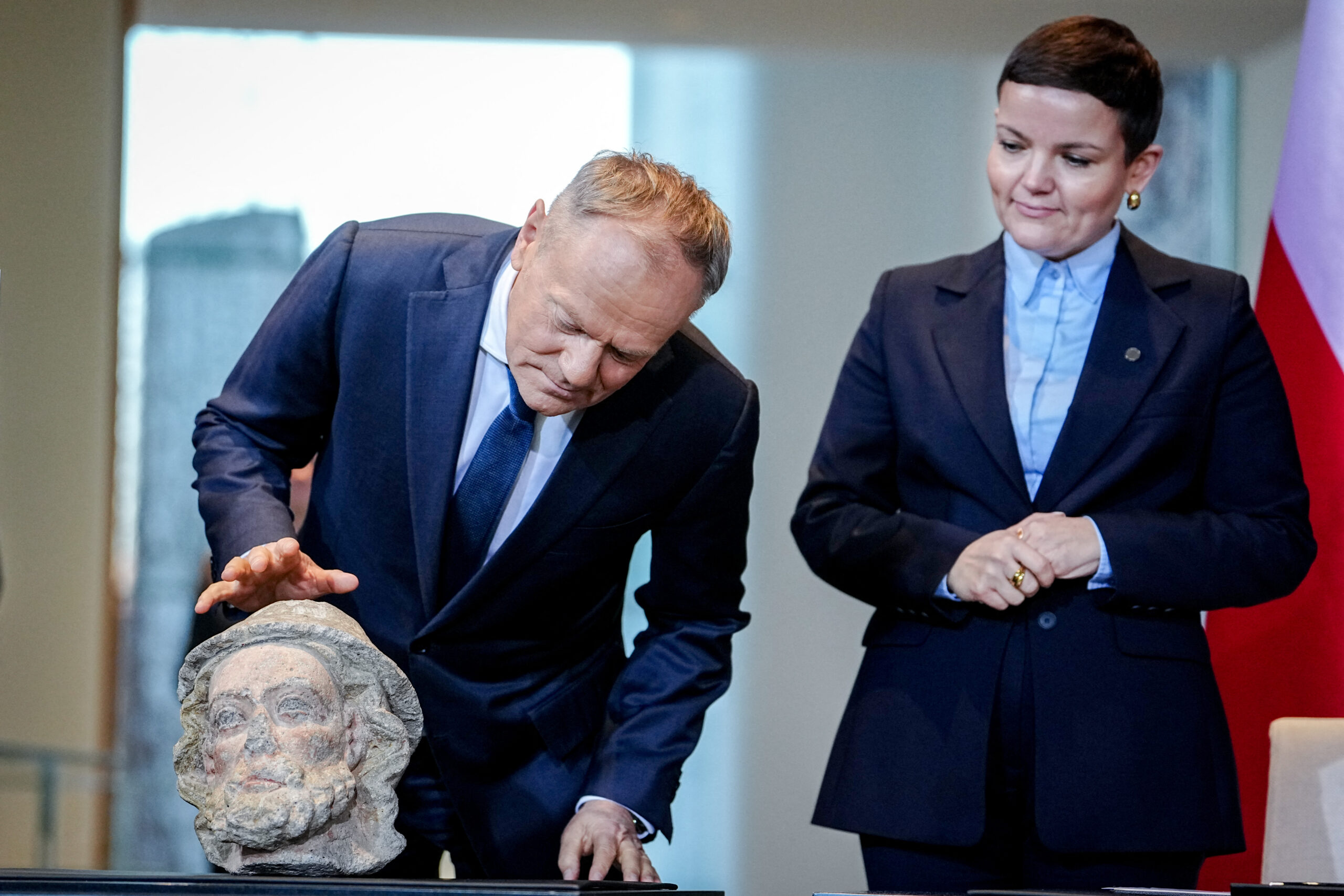
Berlin has handed over 73 historical manuscripts to Poland, Chancellor Friedrich Merz said after meeting Polish Prime Minister Donald Tusk, announcing a gesture seen as designed to improve bilateral relations. pic.twitter.com/fWkKRW4vPI
— TVP World (@TVPWorld_com) December 1, 2025
German Restitutions
“I will not say that the past or the future is more important. In everyone’s life, the future is more important, but there is no good future without an awareness of what the past was and what is looming over us in relation to that past,” Donald Tusk said at the press conference. Precisely because of this sentiment, the prime minister came to Berlin not only to talk about the future but also to bring home 73 items stolen by the Germans between 1940 and 1945.
The debate over findings and reparations, dating back eighty years, seems out of time. The truth is, however, that for the first economy of the Union (Germany) and the sixth (Poland) to be able to talk to each other without reticence and cooperate in the prosperity of the Union, the old dramas of the past must be overcome.
English version by the Translation Service of Withub


![Da sinistra: il presidente del Consiglio europeo, Antonio Costa; il presidente dell'Ucraina, Volodymir Zelensky: la presidente della Commissione europea, Ursula von der Leyen [Bruxelles, 18 giugno 2024. Foto: European Council]](https://www.eunews.it/wp-content/uploads/2026/06/euco_ua260618-120x86.jpg)
![[foto: Saverio De Giglio/imagoeconomica]](https://www.eunews.it/wp-content/uploads/2026/10/cpt-120x86.png)