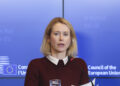
Brussels – The EU watches from the sidelines as the crisis in Venezuela unfolds, following the U.S. military operation that captured the self-proclaimed president, not recognised by most world governments, Nicolas Maduro, and his wife, Cilia Flores. A blitz that reportedly claimed at least 80 victims in Caracas, including civilians and military personnel. The EU High Representative for Foreign Affairs, Kaja Kallas, called for “calm and restraint by all actors,” and reminded Washington that, as a member of the UN Security Council, it “has a particular responsibility” to uphold the principles of international law.
The statement released by Kallas has the backing of 26 member states – Hungary opted out – and it is the first coordinated reaction of the EU bloc, almost 48 hours after the unprecedented attack ordered by Donald Trump against the Venezuelan leadership. Brussels has avoided an explicit condemnation of the US military incursion – only Spanish Prime Minister Pedro Sanchez has openly accused Washington of violating international law – and has preferred to emphasise the illegitimacy of Maduro, who has been in power in Caracas for over a decade and is responsible for a ferocious repression against the democratic opposition in the country. A risky balancing act, which once again exposes the EU to accusations of double standards. And to the extreme unpredictability (and aggressiveness) of the US administration.

In line with what Italian Prime Minister Giorgia Meloni has stated, the note from Brussels offers support to the Atlantic ally and its alleged motivations. “The EU shares the priority of combating transnational organised crime and drug trafficking, which pose a significant security threat worldwide,” the 26 member states claim. Maduro is, in fact, charged with narcoterrorism and conspiracy to import cocaine. Already indicted in 2020 by a UN commission, which called for his trial at the International Criminal Court, the Chavista leader has been fingered by prosecutors as the head of a state-sponsored cocaine trafficking network that collaborated with some of Latin America’s most violent and prolific drug trafficking groups.
However, the Trump administration, which has been waging a campaign to delegitimise multilateral bodies for months, has no intention of taking Maduro to The Hague: the Venezuelan president is currently in jail in New York and will appear in a Manhattan federal court as early as today. In the face of Trump’s low regard for the Venezuelan opposition leader, Maria Corina Machado, the EU is trying to put its foot down: “Respecting the will of the Venezuelan people remains the only way for Venezuela to restore democracy and resolve the current crisis,” the Brussels note underlines. According to Trump, the winner of the Nobel Peace Prize enjoys neither the support nor the respect in Venezuela, whereas the EU has long since pointed to her as the legitimate winner of the July 2024 elections, and the European Parliament awarded her and her party’s candidate, Emundo Gonzalez Urrutia, the Sakharov Prize for Freedom of Thought.
Consistent with the new “Donroe Doctrine” (from the policy of influence in Central and South America, the ‘backyard’ of the United States, theorised by President James Monroe in the early 1800s), Trump stated after the military operation that Washington would run Venezuela and warned Caracas of the possibility of a second attack in case of non-cooperation. Yesterday, in an interview with The Atlantic, he directly addressed the acting president, Delcy Rodríguez, Maduro’s former number two: “If she doesn’t do what’s right, she is going to pay a very big price, probably bigger than Maduro,” Trump threatened.
It remains to be seen what the right course of action is, according to the White House. In the middle is not only the severing of ties with the drug trade, but also the American sights on Venezuela’s immense oil fields. The American president explicitly stated that “the United States needs total access to oil and other resources in Venezuela.” Then, speaking to reporters aboard Air Force One, he renewed the threat to Greenland: “We need it for a national security situation, it’s so strategic. Right now, Greenland is covered with Russian and Chinese ships all over the place. We need Greenland from the standpoint of national security, and Denmark is not going to be able to do it,” Trump said.
English version by the Translation Service of Withub