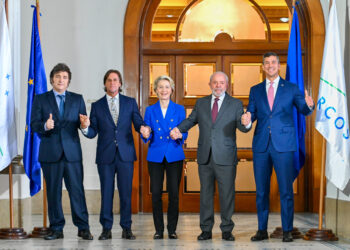
Brussels – After more than a quarter of a century of negotiations, the world’s largest free trade area, covering 700 million people in the European Union and Mercosur countries – Argentina, Brazil, Paraguay, and Uruguay – is finally being signed and is nearing its effective implementation.
First, the EU ambassadors, and then, formally, the 27 Member States today adopted two decisions, supported by Italy, authorising the signing of the EU-Mercosur Partnership Agreement (EMPA) and the Interim Trade Agreement (iTa) between the two parties. France, Poland, Austria, Ireland, and Hungary voted against the EMPA, with Belgium abstaining. Budapest opposed the iTa, with Vienna and Brussels abstaining. Now, European Commission President Ursula von der Leyen has the support to fly to Paraguay, which has recently taken over the rotating presidency of Mercosur from Brazil, to sign the agreement.
The date currently being considered is 17 January. “At a time when trade and dependencies are being weaponised, and the dangerous, transactional nature of the reality we live in becomes increasingly stark, this historic trade deal is further proof that Europe charts its own course and stands as a reliable partner,” said European Commission President Ursula von der Leyen. “I look forward to travelling to Paraguay so we can start this new era together,” she added. European Council President António Costa was also satisfied, saying that the agreement is “positive for Europe” because “it brings concrete benefits to European consumers and businesses; it is important for the sovereignty and strategic autonomy of the EU: with this agreement, the EU is shaping the global economy; it strengthens workers’ rights, environmental protection and guarantees for European farmers; it demonstrates that rules-based trade partnerships are beneficial for all parties.” In essence, for Costa, “today is a good day for Europe and for our Mercosur partners.”
Rome supported both decisions. “We have improved an agreement that brought undoubted advantages for the Italian industrial and agricultural system but which was critical for some sectors,” commented the Minister of Agriculture, Food Sovereignty and Forestry, who celebrated today’s result of “lowering the threshold of the safeguard mechanism from 8 percent to 5 percent and strengthening the system of controls on goods entering the European Union.” Therefore, “farmers will have a more effective protection mechanism in the event of disruptions to agricultural product prices and will be able to count on the effective application of the principle of reciprocity,” he added. The minister was referring to the so-called emergency brake. The measure provides that, for sensitive products such as beef, poultry, rice, honey, eggs, garlic, ethanol, and sugar, the Commission will conduct an investigation upon a 5 percent increase in imports or a 5 percent decrease in import prices. If the investigation reveals a risk to the EU market, the Commission may revoke the cancellation of duties and reinstate the previous ones. Initially, the threshold was set at 8 percent by member states and Parliament, but it was lowered today at Italy’s request.
The agreement will give European companies access to a market of 270 million people and remove around 91 percent of current tariffs, currently 35 percent on car parts, 20 percent on machinery, 18 percent on chemicals, 18 percent on pharmaceuticals, for example, and 92 percent of those on Mercosur exports to the single market (including beef, poultry, and sugar), leading to an estimated saving of 4 billion per year for European exporters. “It will also strengthen our economic security by protecting and diversifying our supply chains, including in the area of essential raw materials. It will create enormous commercial opportunities, opening up export opportunities worth billions of euros not only for the 30,000 SMEs” out of the 60,000 European companies “that already export to the region, but also for the many companies for which the agreement will open up new export markets, thus supporting hundreds of thousands of jobs in Europe,” said a Commission spokesperson.
The agreement brought tractors and the agricultural sector onto the streets. On this point, the Commission, through its spokesperson, reiterated that “the agreement offers new opportunities, with a potential 50 percent increase in EU agri-food exports to the region and protection for high-quality traditional EU food and drink products (GIs) from imitations”. These include 58 Italian GIs: from Balsamic Vinegar of Modena to Gorgonzola, from Mozzarella di Bufala Campana to Parmigiano Reggiano, Pecorino Romano to S. Marzano tomatoes, Prosciutto di Parma, San Daniele, Grappa, and over 30 wines: from Barolo to Chianti, Lambrusco to Prosecco. “In response to the concerns of farmers and EU Member States, the agreement also includes a series of unprecedented measures to protect sensitive agri-food sectors, including: very limited import quotas for sensitive products, introduced gradually,” such as beef, poultry, or sugar, and “the strongest safeguards ever against any increase in imports that could cause damage to EU producers,” the spokesperson noted. “At the same time, the Commission has adopted a series of measures to support the competitiveness of farmers on the world stage: strengthened import controls and audits to ensure strict and effective enforcement of EU food health and safety standards; a concrete commitment to work towards the alignment of production standards; and a 6.3 billion euros safety net,” he added.
However, the process does not end today. The agreements will require the approval of the European Parliament before they can be formally concluded by the Council, and endorsement by all EU Member States will also be necessary for the EMPA to enter into force, replacing the iTa, which will remain in effect in the meantime. On this front, Polish Deputy Prime Minister Władysław Kosiniak-Kamysz stressed that “the matter is not closed.” “We will prepare an appeal against the agreement at the European Court of Justice and continue to fight for uniform standards for European farmers,” he wrote on X. For German Chancellor Friedrich Merz, on the other hand, “the EU-Mercosur agreement represents a milestone in European trade policy and a strong signal of our strategic sovereignty and our ability to act.” Meanwhile, in Paris, President Emmanuel Macron’s rejection of the agreement is not enough: for the president of the Rassemblement National and the Patriots for Europe group in the European Parliament, Jordan Bardella, this is a “stunt” and he has therefore announced that “the National Rally will launch two motions of censure: in the National Assembly against the French government and in the European Parliament against the von der Leyen Commission”. Spanish Prime Minister Pedro Sanchez commented positively: “Finally, after three decades of negotiations, the EU will conclude a new trade agreement with the Mercosur countries. Thanks to this agreement, Spanish companies will be able to enter new markets, export more, and create more jobs. And Europe will be able to maintain a strong link with that sister and strategic region that is Latin America.”
However, the agreement does not convince a large part of civil society. “The simple truth is that this unpopular agreement is a disaster for the Amazon rainforest, and no progressive MEP committed to protecting forests should ever support it,” commented Lis Cunha, Greenpeace activist for the EU. Romulo Batista, head of Greenpeace Brazil’s forest campaign, specified that it is “a harmful agreement that will undermine countries’ efforts to tackle the climate emergency and ensure a just transition” and that “it is deplorable that an agreement with such an economic, social, political, and environmental impact on Brazilian society, the Amazon rainforest, and other Mercosur countries has been negotiated behind closed doors, without social participation or transparency.”
English version by the Translation Service of Withub