Meloni-Merz, Europe’s new best mates want to abolish EU bureaucracy
In bilateral talks in Rome, the two leaders take a moderate stance with Trump but a hard line with the EU. Merz and Meloni declare war on internal tariffs. The Chancellor: "We want to dismantle bureaucracy to be more competitive"
Brussels – Meloni and Merz are the new best mates among EU leaders. The prime ministers of Italy and Germany met today, 23 January, in the opulent Roman setting of Villa Doria Pamphilj. The bilateral meeting aligned the two democracies on various issues: from defence to the economy, including a vision of the European Union that needs ‘a change of pace on competitiveness’, said Prime Minister Giorgia Meloni at a press conference after the agreements were signed.
Three documents were signed today, all of which are of considerable strategic importance. The first is a cooperation protocol on economics, culture, and migration. The second is an agreement on security and defence cooperation. The third is an informal document on simplifying European bureaucracy. When asked about the two leaders’ role as driving forces behind the Union, they respond evasively. Merz, however, does not deny it: “The convergence is very strong.”
The two leaders’ commitment at the European level is to reforms aimed at harmonising markets and removing internal barriers. “We want to dismantle bureaucracy in Europe to be more competitive,” Chancellor Merz stated unequivocally, noting that this will be one of the main issues for 2026. The goal follows the path set out in Draghi’s agenda and is also welcomed in Rome.
Mercosur must be done
Getting back to the Italian-German agreement, the greatest proof of friendship was seen in December in Brussels on the Mercosur issue. After months of reflection, Italy decided to vote in favour of the EU-Mercosur trade agreement, which is dear to Berlin. Merz thanked Italy for its commitment and insisted that the agreement “must come into force“even after the stop requested by the European Parliament. Merz did not hide a certain “regret” at the Parliament’s decision. Meloni, on the other hand, did not comment on the matter but noted that, for Italy, the agreement remains valid even after the MEPs’ hesitations.
To those who suggest that Italy could replace France in its privileged relationship with Germany, Meloni responds: “I’m not interested in replacing anyone, I’m interested in Italy playing its role on the international stage.” However, she did not fail to take a dig at French President Macron: “We are not in a historical era in which we can afford childishness in our interpretation of foreign policy.” She was referring to Macron’s aggressive response to Trump’s threats regarding Greenland and the European Union.
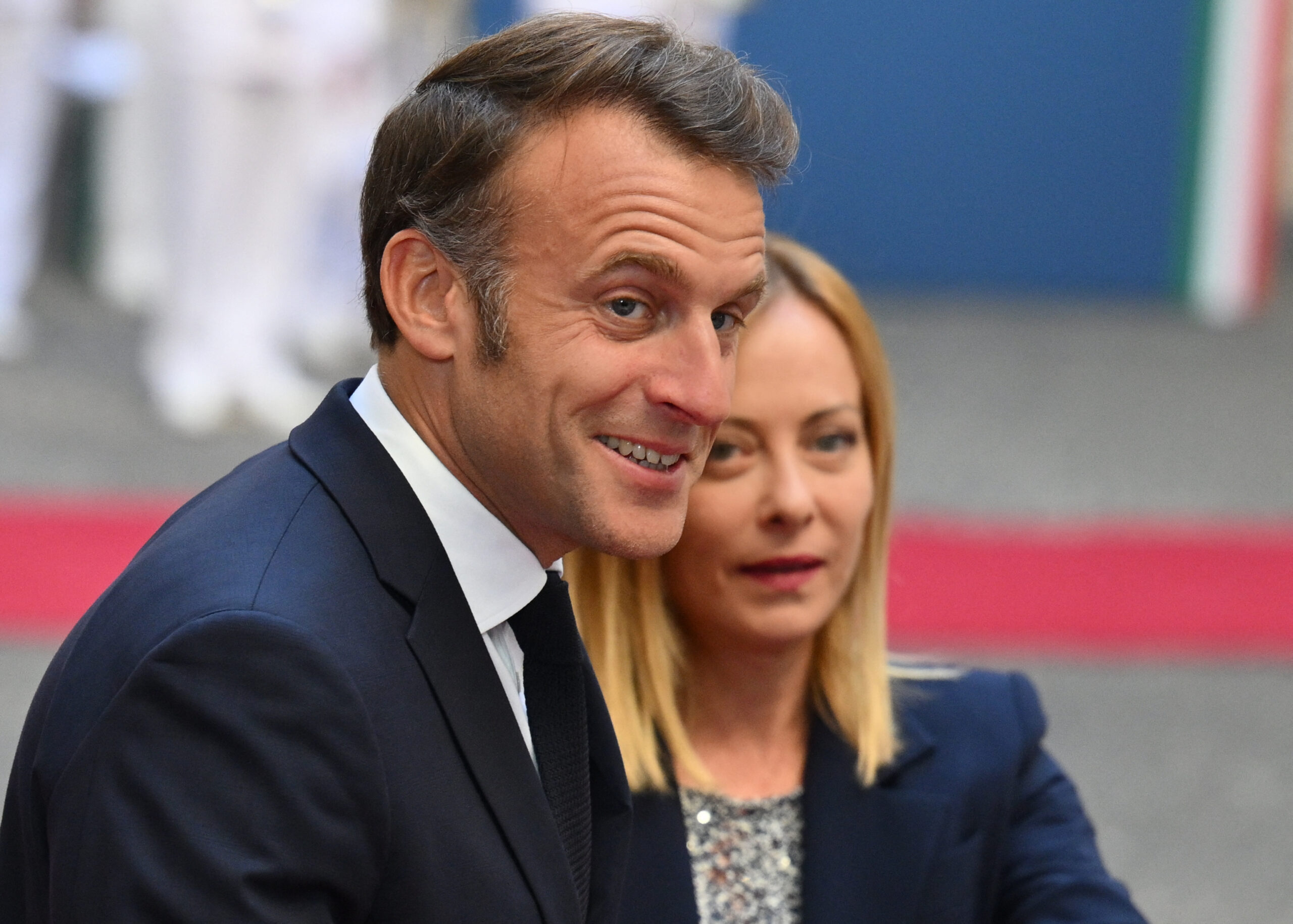
French President Emmanuel Macron (left) and Italian Prime Minister Giorgia Meloni (right) react as they meet at Palazzo Chigi in Rome on 3 June 2025 (Photo by Alberto PIZZOLI / AFP)
You have to be nice to Trump
It is precisely the American president and his threats that are calling the two friends to moderation. Berlin and Rome, in fact, have been the most accommodating towards Washington in recent weeks, letting numerous outbursts from the MAGA leader slide. For Meloni, the agreement with the Americans “remains solid” and the relationship must maintain “a pragmatic and non-instinctive approach.” Merz, on the other hand, sidesteps the issue, stating that Europeans “must focus on threats coming from outside NATO,” effectively shelving the Greenland question.
In any case, not everything that comes out of the tycoon’s mouth is gospel: for the German, the governance structures for Board of Peace for Gaza. are “unacceptable.” This time it is Meloni who is stalling: “I asked Trump to reconfigure the organisation. For us, as it stands, there would be constitutional problems.”
Viktor Orban and Donald Trump at the launch ceremony for the Board of Peace [Photo: Viktor Orban’s account]
Kyiv and the Nobel Peace Prize
Given the turmoil that has shaken the Atlantic Alliance in recent weeks, the conflict in Ukraine has taken a back seat. Yesterday, in Davos, Ukrainian President Volodymyr Zelensky called on Europeans, denouncing the lack of “political will” to support Kyiv’s cause. The German Chancellor, speaking today, was keen to clarify that “we are increasing our aid but at the same time we support the peace negotiations.”
However, the feeling is always that someone will pull a rabbit out of the hat and put an end to the conflict. The Merz-Meloni duo, in fact, has not revealed any grand strategy on the issue other than the usual litany of a “just and lasting peace'”. The only step forward has been taken by Giorgia Meloni, but it is somewhere between serious and desperate: “I am confident that Donald Trump can make a difference for peace;” in that case, “we can nominate him for the Nobel Peace Prize.”







![[foto: European Council]](https://www.eunews.it/wp-content/uploads/2026/03/euco-260319-120x86.jpg)