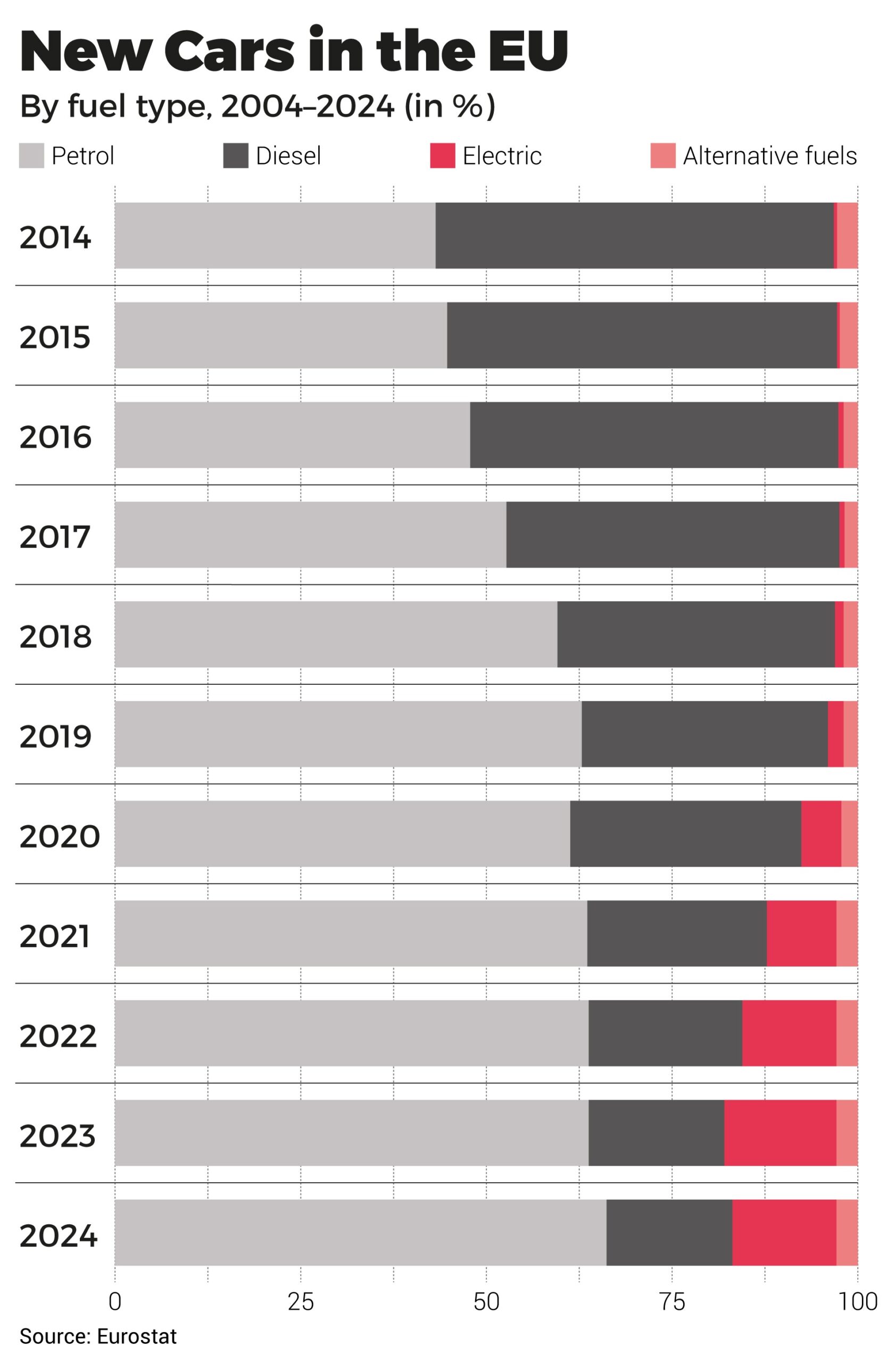
Brussels – Over the course of ten years – from 2014 to 2024 – the number of diesel cars (including hybrids) registered in twenty European Union countries (for which data are available) decreased by 67 per cent, compared to a 60 per cent increase in petrol-powered vehicles (including hybrids). In terms of alternative fuels, however, the number of battery electric cars registered in Europe in 2024 was 45 times higher than in 2014, rising from 0.3 per cent of the total to 13.9 per cent. Finally, registrations of alternative fuel vehicles (LPG, natural gas, hydrogen fuel cells, bioethanol, biodiesel, bi-fuel vehicles, and others) also grew by 13 per cent from 2014 to 2024.
The overview, which covers twenty Member States representing 93 percent of all cars registered in the EU in 2024, comes from a report released today by Eurostat, the EU’s statistical office. The document is part of the 2025 edition of the study ‘Key Figures on European Transport,’ which is dedicated to analyzing data on European passenger and freight transport and their impacts on the economy, energy, and the environment.
Although the trend toward a gradual increase in more sustainable passenger cars is common across the entire Union, significant differences emerge between the more virtuous countries and the less virtuous ones. At the top of the ranking for the percentage of electric cars registered in 2024 are Denmark (51.3 per cent), Malta (37.7 per cent), Sweden (34.9 per cent), and the Netherlands (34.6 per cent). At the bottom of the table are Croatia, Slovakia, Poland, Bulgaria, and Italy. In all these countries, the percentage of electric cars is less than 5 per cent, and petrol cars still remain the clear majority, with percentages ranging from 60 to over 70 per cent. These figures seem to suggest a “two-speed” transition to electric vehicles.
From the published charts, it is clear that 2020 was the turning point, with the decline in new diesel vehicles and the rise in electric cars becoming notably more pronounced at the same time. 2020 was the first year of application of Regulation 2019/631, which required European car manufacturers to comply with stricter CO2 emission limits in the manufacture of new vehicles.