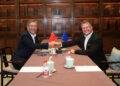
![Il ministro dell'Economia, Giancarlo Giorgetti (destra), con il commissario per l'Econonia, Valdis Dombrovskis [Bruxelles, 9 marzo 2026. Foto: European Council]](https://www.eunews.it/wp-content/uploads/2026/03/giorgetti-dombrovskis.jpg)
Brussels – Beware of raising interest rates, “no” to inflexibility and changes of course. The war in the Middle East and rising energy prices have put Italy on high alert, with the government calling for measured responses. The current situation put Economy Minister Giancarlo Giorgetti in a position to dictate terms, one above all: no rate increases. “The economic risk is once again the surge caused by rising energy prices, and it would be serious to think that the solution could be monetary tightening,” he said at the G7 finance ministers’ meeting, ahead of the Eurogroup meeting.
Whether it is the Fed or the European Central Bank, in the face of the feared risk of stagflation, raising interest rates would further damage growth. The Treasury Secretary also addressed this warning to his European partners, reminding them that Italy’s economic difficulties would be a problem for everyone. High energy prices “destroy the purchasing power of families and alter the competitiveness of our businesses,” he emphasised during the Eurogroup meeting. Translation: Be careful how you move, because Italy could suffer. Be careful about the choices you make, because Italy could also get in the way at a time when prompt responses are essential.
Italy is therefore calling for a radical change of course in energy policy. A change of pace is needed at the European level because the EU is too exposed to the volatility of geopolitical events. “Energy instability jeopardises not only the competitiveness of our companies but also our economic security,” warned the Minister of Economy, in what sounds like a call to take the necessary measures to support a national economy considered anaemic even before the Middle East crisis.
Giorgetti placed Italy at the centre of his speech, recalling the country’s specific weight in the European economy, “a leader in Europe for manufacturing,” yet at risk because Italy “does not have energy independence,” as is the case for the entire European Union. This is where the call comes in for the EU-27, including Italy, to break out of a structural situation that is weighing heavily and increasingly threatening to undermine everyone’s competitiveness.
For such a reson, Giorgetti insisted, “Europe should consider adopting extraordinary measures, along the lines of those adopted in 2022 in the aftermath of the Russian attack on Ukraine”. This means, in practical terms, “acting immediately to stop energy prices before they spread to all consumer goods like in 2022,” he pointed out. These words and requests further confirm the gravity of the situation and the sense of unease animating the government and the European Union.
English version by the Translation Service of Withub