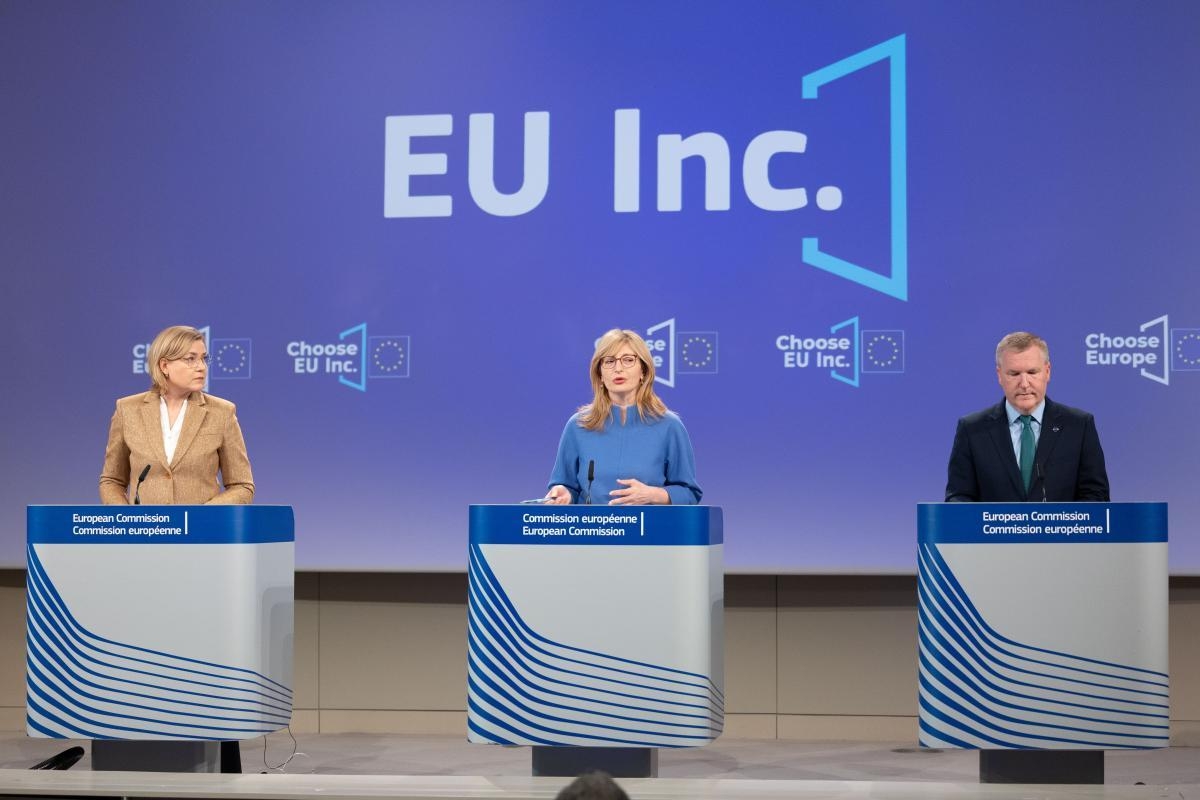
Brussels – A level playing field for all, moving beyond the 27 different national regulations currently in force. So here comes the 28th regime: a set of EU rules designed to overcome fragmentation and barriers between Member States, thereby enabling businesses to start up and grow more quickly. Registration and business launch within 48 hours at a cost not exceeding 100 euros for companies of any size (small, medium, or large), provided they are based in the EU and carry out all procedures digitally. This is the main innovation introduced by the European Commission’s proposal, which is also determined to attract investment with a pan-European brand, EU Inc., for the most competitive new businesses, through an initiative for which it hopes to secure a political agreement between the Council and Parliament by the end of the year, with approval to follow by December 2026.
“This is just the beginning,” the President of the European Commission, Ursula von der Leyen, assures in a press briefing – therefore without questions – held prior to the conference of her commissioners. “Our goal is clear,” she said. “One Europe. One market, by 2028,” she added.
Beyond national systems: the EU steering group and worker share ownership
The European Commission believes that operating within the single market on the basis of 27 different national legal systems and 60 different types of company – including public limited companies, private limited companies, general partnerships and similar entities – does not promote competitiveness. Hence the “optional” choice to adopt the new business model, as emphasised in Brussels. The von der Leyen team intends for the 28th regime to eliminate in-person formalities, provide digital procedures for financing operations and simplify the transfer of shares. Furthermore, the involvement of intermediaries for share transfers and liquidation procedures will no longer be mandatory, and Member States will also be permitted to grant EU Inc. companies access to the stock exchange.
To attract highly qualified persons, the labour law will not be amended, but employers will be given the opportunity to set up employee share option schemes at the European level. Stock options are a form of distributing company shares to employees. “Employee share ownership” is intended to foster greater involvement in the company’s activities, because the more stable the company is, the higher the returns on the shares. Under the 28th regime, stock options will be taxed only on the income generated at the time of sale. “This is a crucial factor in ensuring attractiveness, particularly for innovative start-ups,” the EU executive emphasised. Furthermore, the EU is willing to “explore the possibilities of 100 per cent cross-border remote working for start-ups and expanding companies.“
https://www.eunews.it/2025/10/28/nasce-lo-scaleup-europe-fund-la-commissione-ue-accelera-sugli-investimenti-nelle-tecnologie-avanzate/
Companies wishing to operate beyond national frameworks can use the special European steering group led by the Commission. EU-based companies will only have to submit their company information once, via an EU-wide interface linking national business registers. In a second phase, the Commission will establish a new central EU register. Companies based in the EU will obtain their tax identification number and VAT number without having to resubmit documentation; they will be able to interact with the administrations of the various Member States and also benefit from digital insolvency procedures.
“Under this new EU corporate legal framework, EU Inc. companies will benefit from simplified governance procedures throughout the company’s entire lifecycle,” the Commissioner for Justice and Consumer Protection, Michael McGrath, said. “This simplicity ensures that talent and ideas remain in Europe, whilst attracting valuable investment.”
‘Innovation’: here is the new definition for businesses to support
Another defining feature of the 28th regime is the new definition of “innovation” and, consequently, for the enterprises to which financial and administrative support is to be provided. It is therefore established that “innovation” is to be understood as a new or improved product, service, or process that “differs significantly from previous versions and is made available to potential users.” Consequently, a company should be considered innovative even if it is not active in the research and development sector, but “able to demonstrate that it has developed, is in the process of developing, or intends to develop in the near future, within the last three years, products, services or business processes intended for commercialisation, which are new or substantially improved compared to the state of the art in the sector and which involve a risk of technological or industrial failure.”
Changes to Draghi’s name
The Commission’s proposals are intended to address the Draghi report on competitiveness, which highlighted the need to focus on improving the EU’s competitiveness, including by facilitating the growth of innovative companies in Europe. “The Single Market is too fragmented for our companies to thrive, to the extent that innovators are looking elsewhere for opportunities for growth and expansion,” laments Henna Virkkunen, Executive Vice-President for Technological Sovereignty. With the 28th regime, “we are bringing about a pragmatic revolution, giving future entrepreneurs good reasons to grow and develop in Europe and making things easier for those with good ideas,” she explains.
The concerns of the trade unions and the European Parliament
The real sticking point, however, is now labour law. Brussels insists it will not be touched, but there are fears that a parallel regulatory framework could be created, which might circumvent national regulations. This concern has been raised by the trade unions, in particular by Esther Linch, General Secretary of the ETUC, the European Trade Union Confederation: “We must not underestimate the technical complexity of harmonising a new corporate regime with 27 national legal systems governing labour law,” she warned. “Experience shows that ill-conceived company law instruments are quickly exploited to circumvent workers’ rights,” she emphasised.
This concern has also been expressed by the European Parliament, in the resolution approved on 20 January , which clearly acknowledges “the risk that a 28th regime might allow the circumvention of mandatory national safeguards for workers, their representatives and trade unions, and other vulnerable groups,” and therefore the 28th regime “must under no circumstances become a means of undermining, reducing, weakening or circumventing current levels of protection at Union or national level”.
![La presidente della Commissione europea, Ursula von der Leyen, e il presidente del Consiglio europeo, Antonio Costa, al termine del vertice informale dei leader UE sulla competitività [Alden Biesen, 12 febbraio 2026]](https://www.eunews.it/wp-content/uploads/2026/02/euco-260212-350x250.png)