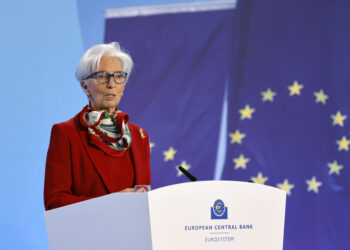
Brussels – The decision to keep interest rates unchanged was the right one, dictated not by political considerations but by the board members’ ability to keep their cool, and the European Central Bank wants this to be known. “Given the rapidly evolving circumstances, it was the duty of the Executive Board to maintain calm, focus, and responsibility towards European citizens and to remain fully committed to fulfilling its mandate,” read the minutes regarding the latest meeting, that of 19 March. On that occasion, it was acknowledged that the war in Iran was immediately rewriting projections and forecasts, with upside risks to inflation and downside risks to growth, but nevertheless, the decision was taken not to give in to emotional reactions.
The ECB therefore emphasises its ability to act with focus and composure in the face of challenging situations. Because, as the Frankfurt-based institution acknowledges, at the time of the March meeting, “there were many unknowns regarding how the energy and inflationary shock would unfold,” and at the same time,“ there was too little evidence to form firm judgements on its medium-term implications.” The European Central Bank has therefore remained true to its policy of making monetary policy decisions on a case-by-case basis, based above all on data and information that is certain and therefore more reliable.
https://www.eunews.it/en/2026/04/07/elderson-ecb-fossil%e2%80%91fuel-dependence-poses-risks-to-price-stability/
In essence, by deciding to leave interest rates unchanged and not allowing itself to be swayed by the negative implications of the conflict in Iran—however these are viewed and having already materialised in the form of rising energy prices—the ECB “ensured sufficient flexibility to respond to the inflationary shock, whilst protecting against the risk of a premature and excessive tightening of financial conditions.” In other words, the European Central Bank remains ready to raise the cost of borrowing if necessary. A hypothesis that has already been made public, but one that is set down in black and white in the meeting minutes: “Keeping rates unchanged in March while retaining optionality for future meetings was a prudent approach.”
Risks to growth
There was no shortage of negative information. Following the war in Iran, the ECB notes in the meeting minutes that the March baseline projections indicated growth of 0.9 per cent in 2026, 1.3 per cent in 2027, and 1.4 per cent in 2028. Compared with the December projections, growth was revised downwards by 0.3 percentage points for 2026 and by 0.1 percentage points for 2027, while remaining unchanged for 2028.
In general, it is noted that the closure of the Strait of Hormuz or attacks on wider transport infrastructure could lead to the misallocation of shipping resources and more widespread supply chain disruptions, with the ECB explicitly citing such risks for refined products, fertilisers, petrochemicals, metals and helium. “This could lead to higher food prices, shortages of key products such as semiconductors, higher transport costs, and longer delivery times” in global trade, against a backdrop of trade tensions that still have “the potential to give rise to more fragmented global supply chains, reduce the supply of critical raw materials and exacerbate capacity constraints in the euro area economy.” The ECB could have raised interest rates immediately, but chose to wait. In the name of responsibility and nerve.
English version by the Translation Service of Withub![[fonte foto: CEPS. Elaborazione: Eunews]](https://www.eunews.it/wp-content/uploads/2021/01/recessione-1.png)