




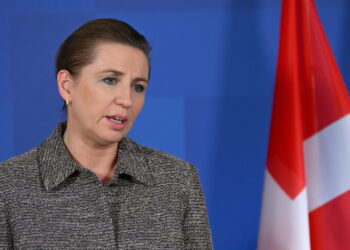
Brussels – It is the eve of the elections in Denmark. These snap elections were called a month ago by the Social Democratic Prime Minister Mette Frederiksen in an attempt to capitalise on the rise in support she has gained thanks to her firm response to Donald Trump’s threats against Greenland. However, the latest polls suggest a “Pyrrhic victory” is on the cards: Frederiksen could win with a historically low score, and the centre-right coalition with which she has governed for the past four years risks falling apart in the spring warmth.
The Social Democratic leader is seeking a third term. The first time, she led a left-wing government; the second time, a centre-right coalition. Following months of declining popularity for her party, confirmed by the defeat in the local elections in November, she has carefully chosen the moment to call new elections, scheduled for October. In the wake of her handling of the dispute with the United States over Greenland, an autonomous territory under the Danish Crown, support for the Social Democratic Party has risen from 17 per cent to over 20 per cent.
While the international stage has given the Prime Minister a new lease of life, it has not had the same effect on the other parties in her coalition: the Liberal Party could face its worst result in history, with polls placing it below 10 per cent, and the centrist Moderates also risk a setback. Meanwhile, the so-called “red bloc”, the coalition of left-wing parties that historically includes the Social Democrats, appears to have a slight lead. That is why, in a political landscape as complex and fragmented as Denmark’s—with twelve parties in Parliament in the current legislature—Frederiksen has chosen to maintain a decidedly ambiguous stance throughout the election campaign.
According to a poll conducted by Megafon, the left-wing bloc is expected to win 86 seats, four short of the 90 needed for a majority in the 179-seat Danish parliament. The “blue bloc”, which ranges from the Liberal Party through the Conservatives to the far right, could end up with 78 seats. The deciding factor, capable of heavily influencing the stance of the political chameleon Frederiksen, will then be the likely 11 elected Moderates, led by the current Foreign Minister, Lars Løkke Rasmussen. In the Danish parliamentary system, a government does not need to secure a majority vote of confidence to govern. Conversely, it is necessary to ensure that no majority can bring down the new government.
In short, Frederiksen risks failing to secure a majority either with the left-wing bloc—not even with the four representatives elected from the Faroe Islands and Greenland—or with the current centrist coalition, an unprecedented arrangement that defies the logic of the “blocs” which has dominated modern Danish politics. And the sense of national cohesion the Prime Minister had hoped for evaporated as soon as discussions turned to national issues, ranging from economic and environmental matters to the increasingly acrimonious debate on immigration.
Frederiksen, with a nod to the left, has reiterated her commitment to introducing a wealth tax, an idea that has been completely rejected by the entire right-wing bloc and even by the Moderates. On the other hand, the Social Democratic leader does not seem willing to back down on further tightening of the rules on irregular immigration, of which she is the main advocate in Europe alongside Giorgia Meloni. She remains in the middle, safe with that 20 per cent that makes her party a giant amongst dwarfs.
English version by the Translation Service of Withub





![La video riunione dell'Eurogruppo [27 marzo 2026. Foto: European Council]](https://www.eunews.it/wp-content/uploads/2026/03/eurogruppo-260327-120x86.jpg)
