- Europe, like you've never read before -
Wednesday, 1 April 2026
No Result
View All Result
  • it ITA
  • en ENG
Eunews
  • Politics
  • World
  • Business
  • News
  • Defence
  • Health
  • Agrifood
  • Other sections
    • Culture
    • Diritti
    • Energy
    • Green Economy
    • Finance & Insurance
    • Industry & Markets
    • Media
    • Mobility & Logistics
    • Net & Tech
    • Sports
  • Newsletter
  • European 2024
    Eunews
    • Politics
    • World
    • Business
    • News
    • Defence
    • Health
    • Agrifood
    • Other sections
      • Culture
      • Diritti
      • Energy
      • Green Economy
      • Finance & Insurance
      • Industry & Markets
      • Media
      • Mobility & Logistics
      • Net & Tech
      • Sports
    No Result
    View All Result
    Eunews
    No Result
    View All Result

    Home » Green Economy » In 2024, the amount of waste per European will rise to 517 kg, a 6 kg increase compared to 2023

    In 2024, the amount of waste per European will rise to 517 kg, a 6 kg increase compared to 2023

    Eurostat data also show that Italy has met its 2020 targets with a recycling rate of 50.8 per cent. Meanwhile, the European Commission has published guidelines for the implementation of the new Regulation on packaging and packaging waste

    Caterina Mazzantini by Caterina Mazzantini
    30 March 2026
    in Green Economy
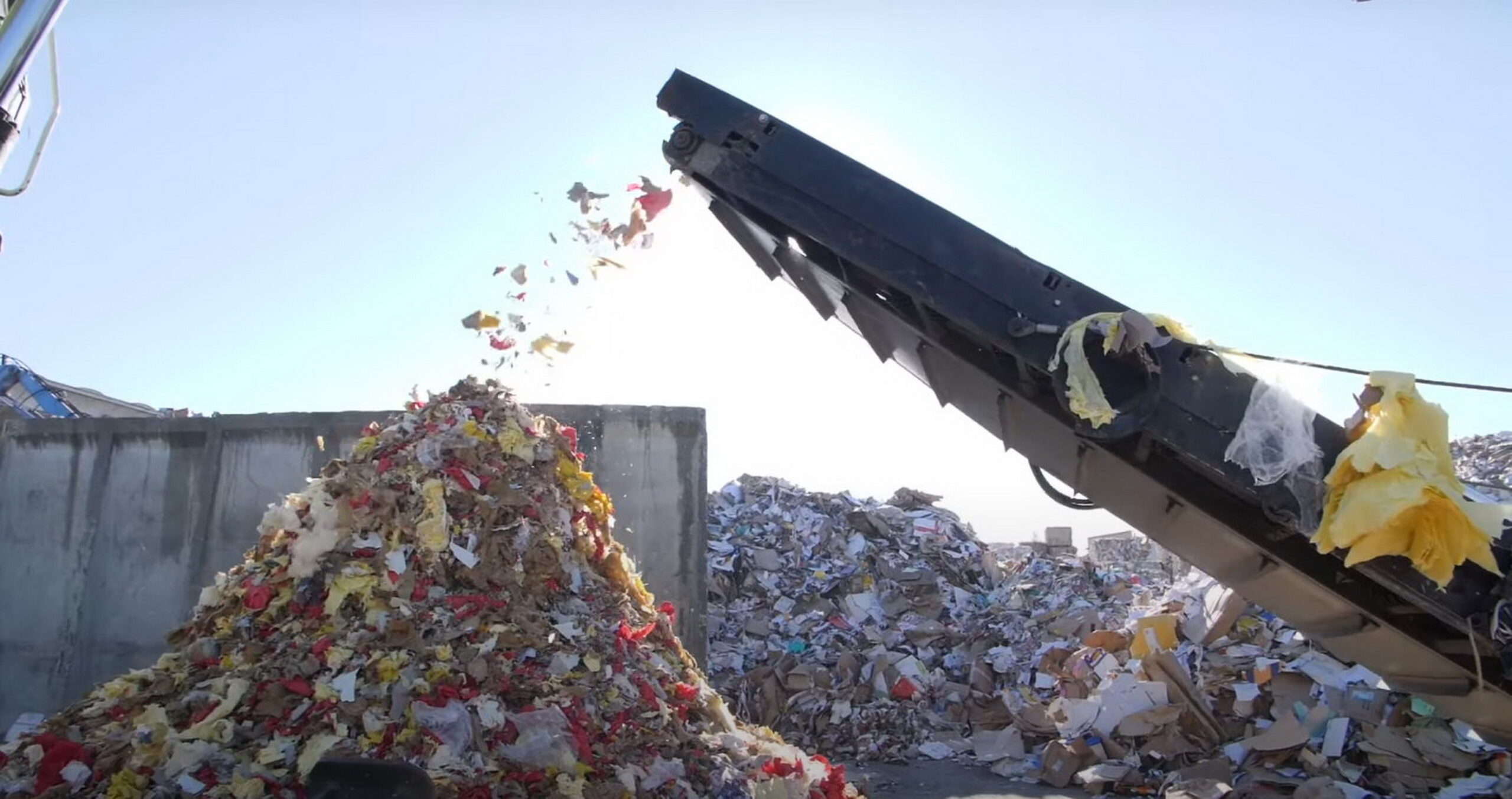
    Impinato Spazzatura Recycling Raccolta Differenziata. Fonte: Imagoeconomia via YouTube

    IMPIANTO SITO RICICLO RIFIUTI RICICLAGGIO RECUPERO SPAZZATURA RELIFE RECYCLING RACCOLTA DIFFERENZIATA

    Brussels – In 2024, the European Union generated an average of 517 kg of municipal waste per person, an increase of 6 kg from the previous year and a significant rise of 38 kg (+8 per cent) from 2014. The data released today (30 March) by Eurostat, the European Union’s statistical office, reveal marked differences between Member States. Among the biggest producers are Denmark (755 kg) and Belgium (699 kg), while Estonia (375 kg) and Poland (387 kg) have the lowest figures. For seven countries, the available figures date back to 2023 and show Austria (782 kg per person) at the top, followed by the Czech Republic (538 kg), Greece (523 kg), Bulgaria (490 kg), Italy (489 kg), and, finally, Romania (305 kg). 

    Eurostat points out that, compared with twelve years ago, per capita municipal waste generation has increased in as many as 20 Member States, with the sharpest rises recorded in Belgium (+274 kg per person since 2014), followed by the Czech Republic (+228 kg) and Austria (+217 kg). By contrast, some northern European countries are bucking the trend: the Netherlands recorded a decrease of 54 kg of municipal waste per person, Denmark 53 kg, and Finland 25 kg. From a circular economy perspective, it is worth noting the data on the proportion of recycled municipal waste, which, in 2024, reached an average of 248 kg per capita, accounting for 48.1 per cent of the total produced at EU level: a modest increase compared to the 48.0 per cent (246 kg) recorded in 2023 but relatively significant compared to 2014, when Europe recycled only 43.0 per cent of its waste, amounting to 208 kg per inhabitant. 

    Italy appears to be among the leading nations in meeting EU targets. According to the latest available data, in 2023, the country achieved a recycling rate of 50.8 per cent, officially exceeding the 50 per cent target set for 2020. This result places our country among a select group of nations that have already met the calculation criteria “new rules” which have become binding for all from 2025. 

    Although more waste is generated in the EU, the total amount of municipal waste sent to landfill has decreased. According to Eurostat, analysing the period 1995–2024, the total amount of municipal waste sent to landfill in the EU fell by 72 million tonnes (59 per cent), from 121 million tonnes (286 kg per capita) in 1995 to 50 million tonnes (110 kg per capita) in 2024. This corresponds to an average annual decrease of 2.0 per cent. In the shorter period 2004–2024, landfill volumes fell by an average of 2.3 per cent per year. The figure has fallen from 121 million tonnes (286 kg per inhabitant) in the mid-1990s to 50 million tonnes (110 kg per capita) recorded in 2024. Consequently, the proportion of waste going to landfill has plummeted: whilst in 1995 landfills accounted for 61 per cent of waste produced, today that figure has fallen to 24 per cent. 

    This significant reduction is no coincidence: Eurostat acknowledges that the credit is largely due to the implementation of European legislation, in particular the

    1994 Directive on Packaging and Packaging Waste, which has imposed increasingly stringent recovery and recycling targets on Member States: by 31 December 2025, for example, 65 per cent of packaging waste must be recycled. The challenge remains: according to other Eurostat data, in 2023, every European citizen generated an average of 178 kg of packaging waste. Without new measures, it is estimated that this waste could increase by 19 per cent by 2030 compared to 2018 levels, with plastic waste potentially surging by up to 46 per cent. On this issue, the European Commission published today (30 March) guidelines for the implementation of the new Regulation on packaging and packaging waste, which entered into force last February, to provide “further clarity and support to businesses, Member States and stakeholders to ensure a smooth transition towards a more circular and competitive packaging value chain,” as stated by Jessika Roswall, Commissioner for the Environment, Water Resilience and a Competitive Circular Economy. These new guidelines include restrictions on single-use packaging and on the use of permanent chemicals (PFAS) in food-contact packaging, and clarifications on how to manage producer responsibility, requiring that whoever places the packaging on the market take legal and financial responsibility for its management once it becomes waste. Furthermore, it becomes mandatory to establish systems—such as bottle return schemes in exchange for a deposit—to ensure that materials are not dispersed and that standardised labelling formats are introduced for separate collection, thereby eliminating confusion across Member States.


    English version by the Translation Service of Withub
    Tags: eurostatlinee guida commissionepackaginguewaste

    Related Posts

    [Foto: European Council]
    Business

    Simplification and removal of barriers: leaders approve the EU’s competitiveness agenda

    20 March 2026
    Energia nucleare
    Energy

    The EU is once again focusing on nuclear power: €330 million invested in the development of fusion energy

    19 March 2026
    Il presidente esecutivo di Iren, Luca Dal Fabbro, e la
    Green Economy

    EIB provides €225 million for less waste and greater energy efficiency in Italy

    12 March 2026
    Case Green
    Green Economy

    EU launches infringement proceedings against Italy over single‑use plastics and ‘Green Homes’ directive

    11 March 2026
    map visualization
    Ricerca di lavoro. Fonte: Carlo Carino via Imagoeconomica

    Unemployment remains steady at 5.9 per cent in the EU, while it rises to 6.2 per cent in the eurozone

    by Caterina Mazzantini
    1 April 2026

    Eurostat figures show a slight increase in the overall rate for Italy, to 5.3 per cent, with a more marked...

    Teleworking. Fonte: Imagoeconomia

    European trade unions: “Teleworking as a solution to high energy prices? Not at the expense of workers”

    by Giulia Torbidoni
    1 April 2026

    Trade unions argue that the Commission must urgently finalise legislation to regulate remote working and guarantee workers’ right to disconnect

    ue medio oriente

    The EU is prepared to take drastic measures to prevent a new migration crisis from the Middle East

    by Simone De La Feld @SimoneDeLaFeld1
    1 April 2026

    Two months after the Migration and Asylum Pact came into force, the EU has, within the space of a year,...

    Il commissario europeo per l'Economia, Valdis Dombrovskis, la presidente della Commissione Europea, Ursula von der Leyen, e la commissaria per l'Allargamento, Marta Kos, alla conferenza stampa sul prestito a supporto dell'Ucraina per il 2026 e il 2027
Photo: EC- Audiovisual Service

    The EU is pressing ahead with the €90 billion package for Kyiv and is finalising the details of how and when the funds will be disbursed, with a focus on drones

    by Giorgio Dell'Omodarme
    1 April 2026

    The proposal from the Berlaymont Building must now receive final approval from the EU Council, but the obstacle of the...

    • Director’s Point of View
    • Opinions
    • About us
    • Contacts
    • Privacy Policy
    • Cookie policy

    Eunews is a registered newspaper
    Press Register of the Court of Turin n° 27


    Copyright © 2025 - WITHUB S.p.a., Via Rubens 19 - 20148 Milan
    VAT number: 10067080969 - ROC registration number n.30628
    Fully paid-up share capital 50.000,00€


    No Result
    View All Result
    • it ITA
    • en ENG
    • Politics
    • Newsletter
    • World politics
    • Business
    • General News
    • Defence & Security
    • Health
    • Agrifood
    • Altre sezioni
      • European Agenda
      • Culture
      • Diritti
      • Energy
      • Green Economy
      • Gallery
      • Finance & Insurance
      • Industry & Markets
      • Media
      • Mobility & Logistics
      • Net & Tech
      • News
      • Opinions
      • Sports
    • Director’s Point of View
    • Draghi Report
    • Eunews Newsletter

    No Result
    View All Result
    • it ITA
    • en ENG
    • Politics
    • Newsletter
    • World politics
    • Business
    • General News
    • Defence & Security
    • Health
    • Agrifood
    • Altre sezioni
      • European Agenda
      • Culture
      • Diritti
      • Energy
      • Green Economy
      • Gallery
      • Finance & Insurance
      • Industry & Markets
      • Media
      • Mobility & Logistics
      • Net & Tech
      • News
      • Opinions
      • Sports
    • Director’s Point of View
    • Draghi Report
    • Eunews Newsletter

    Attention