- Europe, like you've never read before -
Thursday, 23 April 2026
No Result
View All Result
  • it ITA
  • en ENG
Eunews
  • Politics
  • World
  • Business
  • News
  • Defence
  • Health
  • Agrifood
  • Other sections
    • Culture
    • Diritti
    • Energy
    • Green Economy
    • Finance & Insurance
    • Industry & Markets
    • Media
    • Mobility & Logistics
    • Net & Tech
    • Sports
  • Newsletter
  • European 2024
    Eunews
    • Politics
    • World
    • Business
    • News
    • Defence
    • Health
    • Agrifood
    • Other sections
      • Culture
      • Diritti
      • Energy
      • Green Economy
      • Finance & Insurance
      • Industry & Markets
      • Media
      • Mobility & Logistics
      • Net & Tech
      • Sports
    No Result
    View All Result
    Eunews
    No Result
    View All Result

    Home » Opinions » The EU is prepared to take drastic measures to prevent a new migration crisis from the Middle East

    The EU is prepared to take drastic measures to prevent a new migration crisis from the Middle East

    Two months after the Migration and Asylum Pact came into force, the EU has, within the space of a year, tightened its grip on irregular migration through a series of new measures. Now, faced with the prospect of a new migration crisis, it will be forced to drop the pretence of upholding fundamental values and rights

    Simone De La Feld</a> <a class="social twitter" href="https://twitter.com/@SimoneDeLaFeld1" target="_blank">@SimoneDeLaFeld1</a> by Simone De La Feld @SimoneDeLaFeld1
    1 April 2026
    in Opinions, Politics
    ue medio oriente

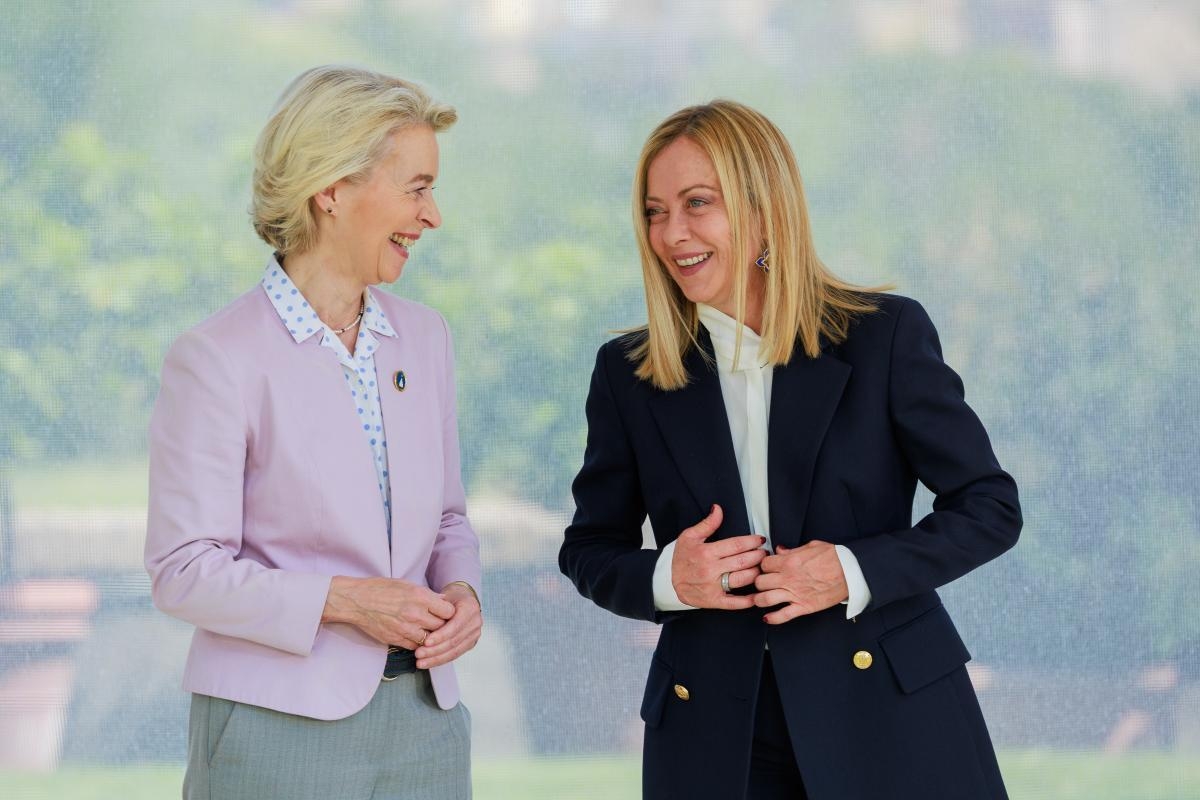
    Giorgia Meloni, on the right and Ursula von der Leyen [EU Commission]

    Brussels – Last week, following the European Parliament’s adoption of the regulation on returns, the European Union has put all the pieces in place for its new crackdown on irregular immigration: alongside the Pact on Migration and Asylum, which will come fully into force next June, the first EU list of safe countries of origin and the broadening of the definition of a safe third country will allow member states to severely restrict the right to asylum. Now the focus of EU leaders is entirely on the possible consequences of the conflict triggered by Israel and the United States in the Middle East, and the imperative is to avoid a repeat of 2015 and the migration crisis that engulfed the continent. 

    In the conclusions of the European Council meeting on 19 March, the heads of state and government of the 27 member states included a paragraph on migration in the section dedicated to the Middle East crisis: “Although the conflict has not given rise to immediate migration flows towards the European Union—the document states—the EU stands ready to fully mobilise its diplomatic, legal, operational, and financial instruments to prevent uncontrolled migration flows towards the EU and to preserve security in Europe.” And this “on the basis of the policy instruments the EU has developed in recent years”, but above all “the lessons learnt from the 2015 migration crisis and to avoid a similar situation”. 

    That year, fuelled by the war against Daesh in Syria and Iraq, more than a million people seeking international protection arrived at the EU’s borders, placing the 12-star club’s asylum system under severe strain. In a decision of historic significance, the then German Chancellor, Angela Merkel, opened Germany’s doors to 800,000 Syrian refugees. Ten years on, it is in Berlin that the European Union’s new approach to migration is most clearly evident, driven by the need to curb the more or less widespread rise of far-right parties across the continent. 

    Just yesterday, the German Chancellor Friedrich Merz, leader of the same CDU party to which Merkel once belonged, called on Syrians living in Germany to “return home.” Speaking on the sidelines of a meeting with the Syrian president, Ahmed al-Sharaa, Merz stated that “looking beyond the next three years”, the aim is for “around 80 per cent of Syrians currently living in Germany to return home.” Regardless of its feasibility—since the fall of Bashar al-Assad’s regime, only a few thousand Syrian citizens have voluntarily returned to Damascus—the plan reveals a shift in mindset away from the “wir schaffen das” (“we can do it”, a phrase uttered by Merkel in 2015). 

    Whilst the Return Regulation paves the way for the establishment of detention centres in third countries to which irregular migrants who have been ordered to leave the territory of a Member State can be deported, the Regulations on the management of asylum and migration (RAMM) and on asylum procedures (APR),  provided for in the Migration and Asylum Pact, will allow for the intensification of border procedures for processing asylum applications. Alongside the list of safe countries of origin (which currently includes Bangladesh, Colombia, Egypt, India, Kosovo, Morocco, and Tunisia, but suggests that all countries with an asylum recognition rate of less than 20 per cent should be treated as safe) and the revision of the concept of a safe third country, the Pact on Migration and Asylum will facilitate the use of accelerated procedures. 

    One of the most controversial aspects of the Pact is the Regulation on crises, exploitation, and force majeure, which deals with situations involving an exceptional or unexpected “mass influx of people”: in such a scenario, derogations from the general migration and asylum management system will be triggered, with the recognition rate threshold for admitting people to border procedures (set at 20 per cent under the APR Regulation) rising to 50 per cent in situations of force majeure, to 60–70 per cent in crisis situations, and to 100 per cent in cases of exploitation. 

    When it is not possible to stem the flow of arrivals through agreements with countries of origin and transit (see Tunisia), the explicit aim is, in all cases, to reduce the number of people being received as much as possible. The European Commission continues to assure us that this new framework “will help Member States process asylum applications more efficiently, in full respect of the EU’s fundamental values and rights.” But an initial test of its effectiveness—and of its impact on respect for migrants’ human rights—is likely to be just around the corner.

     According to figures released by the UNHCR as early as mid-March, due to Israeli and US airstrikes in Iran, around “3.2 million people are currently internally displaced” within the country. This figure is “set to rise as hostilities continue.” Meanwhile, the International Organisation for Migration (IOM) has recorded the displacement of over 130,000 people from Lebanon, affected by the conflict between Israel and Hezbollah, to Syria. According to the Lebanese authorities, there are already over one million internally displaced persons in the country. 

    Even if only a fraction of these figures were to result in asylum applications within the EU, it is by no means certain that the system would hold up or that Member States would be able to balance the responsibilities and solidarity required by the Pact on Migration and Asylum. Given the further hardening of policies and the narrative surrounding migration, it is more likely that countries of first arrival will seek to take cover and secure agreements with third countries in the wake of the Italy-Albania protocol. Certainly, in a crisis scenario, the European Union would be forced to drop the mask which—with increasing difficulty and embarrassment—it continues to wear: that of respect for the values it has set for itself and for people’s fundamental rights.

    English version by the Translation Service of Withub
    Tags: asylum seekersmiddle eastmigrationsrepatriations

    Related Posts

    Un momento del consiglio Affari esteri [Lussemburgo, 21 aprile 2026. Foto: European Council]
    World politics

    No EU sanctions against Israel; the Association Agreement will not be suspended. Italy stands by Netanyahu

    21 April 2026
    An Israeli soldier tries to prevent Palestinians from reaching their houses in Nur Shams refugee camp in the West Bank city of Tulkarm, Nov. 18, 2025. Palestinians took part in a demonstration demanding the right to return to their houses at the entrance of Nur Shams refugee camp, while Israeli soldiers assaulted the crowd and forced them to leave the area. Photo by Nidal Eshtayeh/Xinhua/ABACAPRESS.COM
    World politics

    France and Sweden call for EU sanctions against Israeli settlements in the West Bank

    21 April 2026
    Mandatory Credit: Photo by Omar Ashtawy/APAImages/Shutterstock (16497571m)
Palestinians inspect the damaged and largely destroyed building after the Israeli army targeted it in Nasser neighborhood of Gaza City, Gaza on January 31, 2026. At least 29 Palestinians were killed at dawn on Saturday in a series of Israeli airstrikes targeting various areas across the Gaza Strip. Since ceasefire took effect in early October, Israeli actions have killed more than 524 Palestinians.
Palestinians inspect the damaged and largely destroyed building after the Israeli army targeted it in Nasser neighborhood, Gaza city, Gaza Strip, Palestinian Territory - 31 Jan 2026
    World politics

    The EU: “The reconstruction of Gaza will cost €71 billion”

    20 April 2026
    L'Alta rappresentante per la politica estera e di sicurezza dell'UE, Kaja Kallas, tra il primo ministro palestinese,
    World politics

    Kallas: “No double standards—we are helping Palestine just as we are helping Ukraine”

    20 April 2026
    TERRORISTI ISLAMICI TERRORISTA TERRORE GUERRIGLIA MILIZIANI GENERATE AI IA ISLAMICO FONDAMENTALISTA FONDAMENTALISTI FONDAMENTALISMO ISLAM TERRORISMO
    World politics

    The Middle East is a cause for concern for the EU: “Keep a close eye on the threat of terrorism”

    17 April 2026
    Christine Lagarde arrives at the Governing Council meeting prior to the ECB press conference on 19 March 2026 in Frankfurt.
    Business

    ECB: “Rates unchanged in March, a decision driven by prudence and responsibility”

    16 April 2026
    map visualization
    IMAGOECONOMICA VIA YOUTUBE

    The EU’s plan to tackle the energy crisis sparks a political row in Brussels

    by Caterina Mazzantini
    22 April 2026

    Environmental NGOs are pointing the finger at the failure to tax windfall profits

    ucraina

    EU ambassadors approve a €90 billion loan for Kyiv and sanctions against Moscow. Zelenskyy: “A positive sign”

    by Giulia Torbidoni
    22 April 2026

    With the Druzhba pipeline back in operation, the Hungarian veto has been lifted and the ambassadors of the 27 member...

    In 2024, drought affected almost 157,000 square kilometres of EU territory

    by Giorgio Dell'Omodarme
    22 April 2026

    The Eurostat survey shows that the figure is essentially unchanged from 2023, but has risen by more than a third...

    [foto: By AlMare - Own work, CC BY-SA 2.5, https://commons.wikimedia.org/w/index.php?curid=3103104]

    Russia at the Venice Biennale: European Greens criticise Meloni

    by Emanuele Bonini emanuelebonini
    22 April 2026

    The party’s co-chairs: “We must prevent Russia from participating in the event. The Italian government’s failure to take action is...

    • Director’s Point of View
    • Opinions
    • About us
    • Contacts
    • Privacy Policy
    • Cookie policy

    Eunews is a registered newspaper
    Press Register of the Court of Turin n° 27


    Copyright © 2025 - WITHUB S.p.a., Via Rubens 19 - 20148 Milan
    VAT number: 10067080969 - ROC registration number n.30628
    Fully paid-up share capital 50.000,00€


    No Result
    View All Result
    • it ITA
    • en ENG
    • Politics
    • Newsletter
    • World politics
    • Business
    • General News
    • Defence & Security
    • Health
    • Agrifood
    • Altre sezioni
      • Culture
      • Diritti
      • Energy
      • Green Economy
      • Gallery
      • Finance & Insurance
      • Industry & Markets
      • Media
      • Mobility & Logistics
      • Net & Tech
      • News
      • Opinions
      • Sports
    • Director’s Point of View
    • Draghi Report
    • Eunews Newsletter

    No Result
    View All Result
    • it ITA
    • en ENG
    • Politics
    • Newsletter
    • World politics
    • Business
    • General News
    • Defence & Security
    • Health
    • Agrifood
    • Altre sezioni
      • Culture
      • Diritti
      • Energy
      • Green Economy
      • Gallery
      • Finance & Insurance
      • Industry & Markets
      • Media
      • Mobility & Logistics
      • Net & Tech
      • News
      • Opinions
      • Sports
    • Director’s Point of View
    • Draghi Report
    • Eunews Newsletter

    Attention