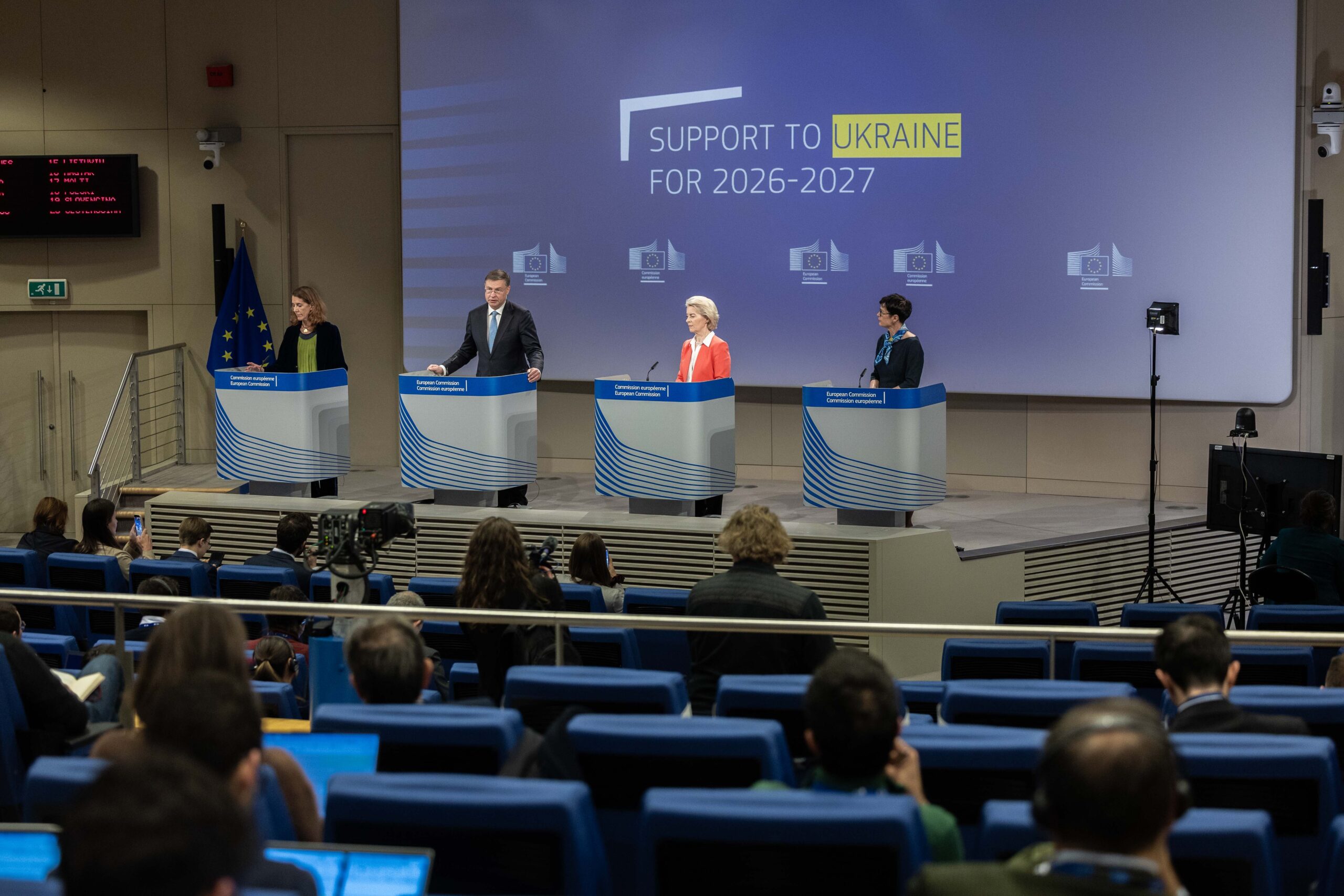
Brussels – Twenty-four hours after a large delegation of European foreign ministers visited Bucha to commemorate the fourth anniversary of the massacre of civilians perpetrated by the Russians in the Ukrainian town, the European Commission is seeking to send concrete signals of support to Kyiv. In a press release issued today (1 April), the EU executive announced its approval of the proposal to implement the €90 billion loan to support Ukraine (the so-called
Ukraine Support Loan) for the two-year period 2026–2027, which will now be submitted to the Council of the European Union for formal approval.
The Commission’s proposal is based on the Ukrainian Financing Strategy, presented by the government in Kyiv on 24 March. “With today’s approval of this document, we are clearly setting out how much money we intend to lend to Ukraine between now and next year, for what purposes and through which channels,” explained Balasz Ujvari, spokesperson for the Berlaymont, at the press briefing. According to the roadmap announced today, therefore, the €90 billion loan will not reach Kyiv all at once, but will be divided into two tranches of €45 billion each: the first is expected to be disbursed by 31 December 2026, whilst the second is scheduled for the end of 2027.
Looking in more detail at the funds earmarked for this year, approximately €16.7 billion will be allocated to budget support for Kyiv and, as stated in the Commission’s press release, their disbursement “will remain subject to strict conditions regarding respect for the rule of law, the fight against corruption, economic resilience, and sustainability.” This allocation of funds will be channelled through two different instruments: the
Ukraine Facility, which finances structural reforms and reconstruction projects, and the
Macro-financial assistance, which comprises loans granted by the EU to ensure immediate liquidity and cover budgetary needs. Regarding the second instrument, Ujvari explained that “as required by European rules, we must draw up a memorandum of understanding (a formal agreement between Brussels and Kyiv that specifies precisely how the funds will be used, ed.) and we are currently discussing this with Ukraine.”
The remaining €28.3 billion from the 2026 tranche, on the other hand, will be used to strengthen Ukraine’s defence industry. In this regard, particular attention has been paid to drones. Normally, when European funds are used to purchase military equipment, at least 65 per cent of the components must come from the European Union or other states participating in the SAFE mechanism (Security Action For Europe), such as Norway and Iceland. However, to speed up the supply of what Ujvari described as “crucial tools for Ukraine’s defence,” the Commission has granted an exemption: Kyiv will be able to purchase drones from non-European suppliers as well, without having to meet the minimum quota for EU components. In short, the aim is to ensure rapid procurement, even at the cost of compromising on geographical origin.
The President of the European Commission, Ursula von der Leyen, enthusiastically welcomed today’s outcome, emphasising that the Brussels executive had sent a “clear message: on the fourth anniversary of the Bucha massacre, we remain fully and firmly by the side of the courageous Ukrainian people and their fight for freedom”. But behind this optimism lies the main obstacle to the final approval of the €90 billion loan: Viktor Orbán and the veto he has maintained for weeks on the aid package, linking his approval to the resumption of Russian oil supplies via the Druzhba pipeline. Budapest claims that Kyiv wants to keep the flow from Ukraine interrupted, doing nothing to repair the damage, while President Volodymyr Zelensky has explained that he can work towards a full restoration of the pipeline’s operations within a month and a half.
Having offered its support for resolving the Druzhba situation—and with the Hungarian parliamentary elections on 12 April approaching, in which Orbán appears to be the underdog—Brussels has not ruled out resorting to a Plan B to secure the funds needed to finance Kyiv: the use of frozen Russian assets. “During the December Summit, the European Council made it clear that the option remains on the table, so Member States will return to it if necessary,” explained Ujvari. While, at least for now, the frozen assets remain unusable by the EU, the same cannot be said for the interest earned on the deposits. In this regard, the Commissionalso announced today that it had received €1.4 billion from profits on frozen Russian assets, and von der Leyen reiterated her intention to “use them for what is most needed: to support Ukraine and its brave armed forces.”
English version by the Translation Service of Withub