Brussels – The Hungarian Prime Minister, Viktor Orbán, made his position clear straight away upon his arrival at the European summit: “We will not support any position in favour of Ukraine until the oil issue has been resolved.” The EU leaders pulled no rabbits out of the hat and swiftly adopted the conclusions on support for Kyiv, with 25 member states, excluding Hungary and Slovakia. Not before emphasising—as Antonio Costa did personally, a senior official confirms—Orbán’s “unacceptable behaviour”, as he continues to block the €90 billion mega-loan to Ukraine, already agreed in December. Despite the deadlock, the European Council is striving to appear optimistic and “looks forward to the first disbursement to Ukraine by early April.”
The impression is that the only way to break the deadlock would be for Orbán to lose the parliamentary elections scheduled for 12 April in Hungary. This is because the nationalist leader has made the confrontation with Ukraine (and with Brussels) the centrepiece of his election campaign, and is unlikely to backtrack. But even if Peter Magyar were to win in Budapest, Orbán would remain in office until the end of spring. And for Kyiv, according to International Monetary Fund forecasts, stalling the loan until June could have disastrous consequences. Not to mention that the Slovak Prime Minister, Robert Fico, has already warned that, with Orbán out of the picture, he might throw a spanner in the works. Fico informed the European Council that he has already declared a “state of oil emergency in Slovakia”, due to Kyiv’s “unilateral decision” to halt oil transit via the Druzhba pipeline.

Orbán, however, as well as resorting to blackmail, has suggested a possible solution: “Hungary’s position is very simple. We will be ready to support Ukraine once we get our oil back, which is being blocked by them.” He frames it as a matter of national security: the disruption to crude oil supplies via the Druzhba pipeline, which has been hit by Russian bombing on Ukrainian territory, “is a matter of survival; it is no joke, no political game.” The issue has been ongoing for weeks: Hungary and Slovakia accuse Ukraine of deliberately holding up the transit of Russian oil to Budapest, whilst Kyiv maintains that the pipeline is damaged and difficult to repair due to ongoing Russian bombardment.
Orbán has skilfully linked the issue of the pipeline not only to the release of the 90-billion-euro loan, but also to the green light for the 20th package of sanctions against Russia, which the European Commission had hoped would be approved as early as 24 February, on the fourth anniversary of Russia’s invasion of Ukraine. On this point too, the European Council makes no attempt to untangle the knot and merely states that it is “looking forward to the swift adoption of the twentieth package of sanctions.”
At the leaders’ meeting, Costa reportedly reiterated that “the situation regarding the Druzhba pipeline is a separate matter,” and that “its restoration depends solely on Ukraine’s ability to repair it and on Russia’s willingness not to destroy it again.” The European Commission has taken steps for an inspection, some technicians are already on site, and Volodymyr Zelensky himself, speaking via video link with the leaders, chose to tone down his rhetoric and “committed to fully restoring the flow of oil as soon as possible and to fully honouring Ukraine’s role as a reliable energy partner of the EU.”
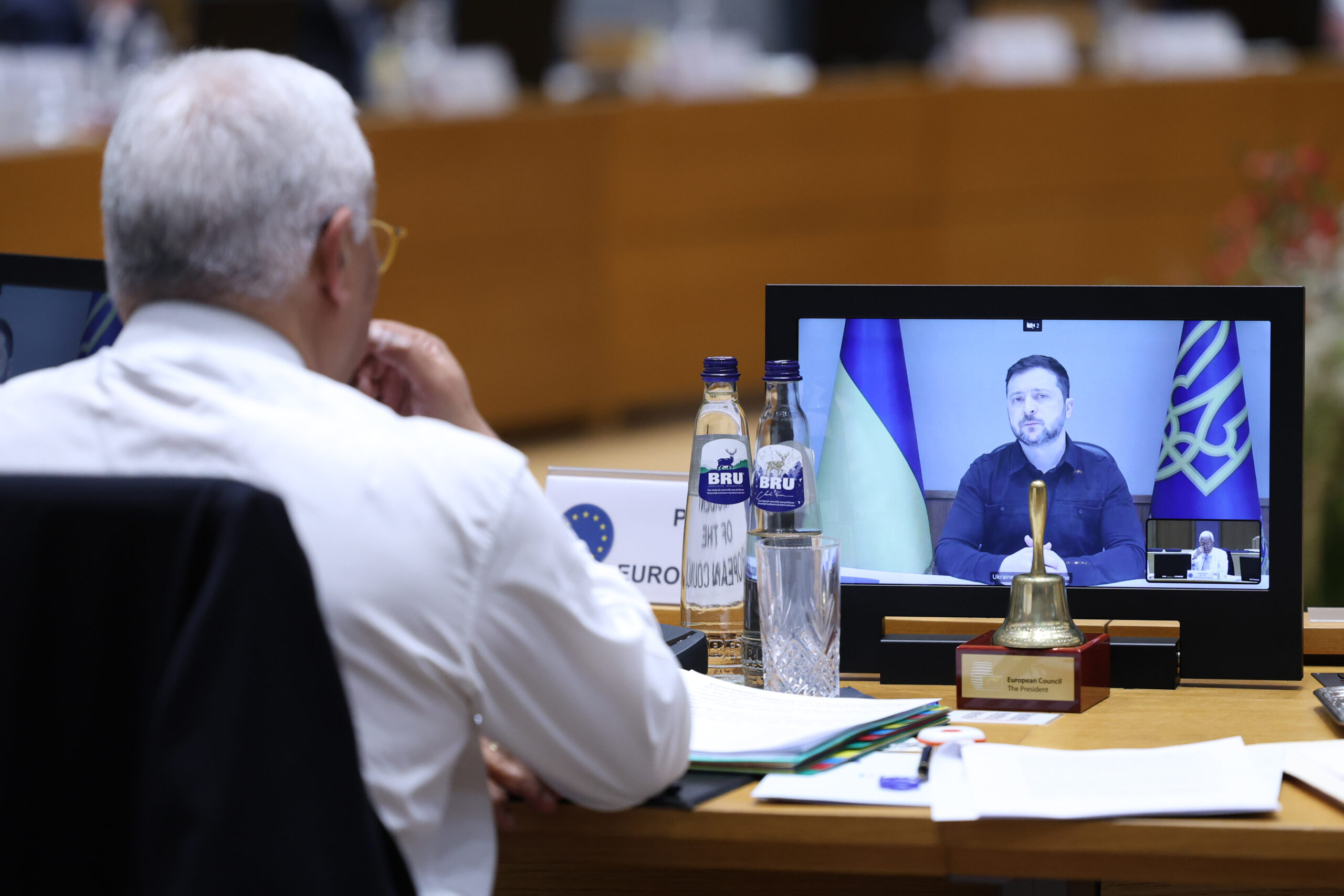
In his speech, the Ukrainian president expressed frustration over the 90-billion-euro loan, which “was supposed to come into effect in the spring but has been blocked,” and over the twentieth package of sanctions, which “could have continued to put pressure on Russia to move towards a genuine peace.” Zelensky assured that “Ukraine is doing everything necessary, including regarding the pipeline,” and that “our team of energy companies, Naftogaz and UkrTransNafta, is working productively to deliver on what we discussed.” But Zelensky highlighted the fundamental inconsistency: if the European Commission is indeed going to work to repair a pipeline transporting crude oil from Moscow to the EU, when, in April, a legislative proposal is expected to impose a ban on Russian oil imports from the end of 2027. “The decision is yours: do you want Europe to import Russian oil, knowing that this helps the aggressor?”
Another solution already exists, and it runs through Croatia via the Adriatic Pipeline. The Croatian Prime Minister, Andrej Plenković, reiterated that Zagreb “is already supplying” Budapest, and that, given the pipeline’s capacity, it could “guarantee energy security and oil supplies to Hungary and Slovakia even when Druzhba is not operational.” But Plenković also emphasised: “There is a difference in the price of oil purchased on the market elsewhere compared to that which passes solely through the pipeline from Russia, via Ukraine, to Slovakia and Hungary. And the price difference, they say, is 30 per cent lower. So perhaps this gives you a fairly clear answer as to where the problem lies.”
English version by the Translation Service of Withub

![[foto: European Council]](https://www.eunews.it/wp-content/uploads/2024/06/euco-strem-350x250.jpg)

![Riunione del consiglio Affari esteri [Bruxelles, 16 marzo 2026. Foto: European Council]](https://www.eunews.it/wp-content/uploads/2026/03/consiglio-esteri-350x250.jpg)