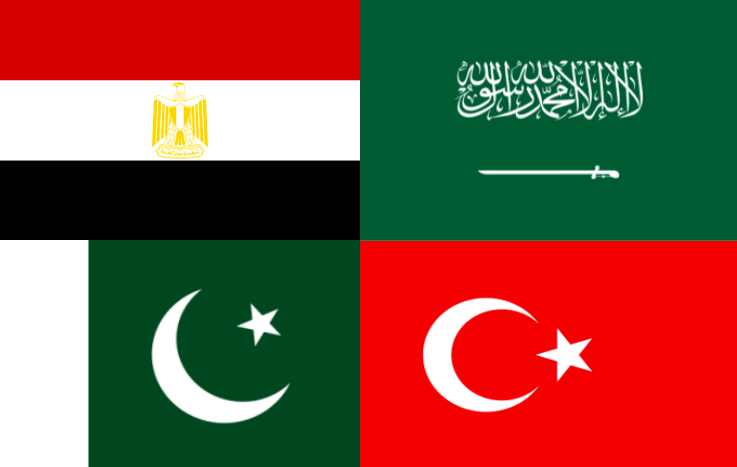
Brussels – The war in Iran is giving rise not only to economic crises and political tensions, but also to new balances of power and new orders. Not only has the United States created a standoff in the Strait of Hormuz from which it sees no way out other than by deepening its military presence, but its backing of Israeli operations in the Middle East has contributed to rewriting the rules of engagement on the international chessboard. Thus, in the great game of alliances, Pakistan, Saudi Arabia, Egypt, and Turkey are joining forces to try to end the conflict in the Middle East, giving rise to a completely new and alternative bloc at the international level through a strategic rapprochement that risks excluding the European Union.
The start of a new chapter in relations between Islamic countries – all of which have Sunni-majority populations – has gone largely unnoticed, whether by design or due to a misjudgment; yet the initiative announced by the governments of these four Arab-Islamic countries is by no means insignificant. Relations between the European Union and the United States, partly due to the conduct of US President Donald Trump, are now more than frayed. Trump’s response to European disengagement has been the threat to withdraw from NATO. Words that may not be followed by deeds, but it is not necessary to withdraw from the Atlantic Alliance to jam its mechanisms. The United States could simply do nothing, keeping NATO on standby. Without its “main shareholder,” NATO’s driving force becomes Turkey, with Ankara to host the second contingent of the organisation’s personnel (494,500 soldiers), and a foot in both camps.
With Euro-Atlantic relations swept aside by the current US administration, and Turkey focused on the Arab-Islamic world, EU member states that are also NATO members now risk being sidelined from the major maneuvers unfolding before their eyes. Europe is beginning to pay the price for its political choice to remain too closely tied to Washington and to be too soft and timid towards Israel, which, like the United States, is reshuffling the cards.
Israel’s unilateral strikes against Qatar in September have called into question the United States’ obligations within the Gulf Cooperation Council (GCC), of which Saudi Arabia is a member, which include the protection of capitals in exchange for oil and gas. On 17 September 2025, Saudi Arabia and Pakistan signed the Strategic Mutual Defence Agreement, a military alliance that strengthens long-standing bilateral relations and guarantees Riyadh with Islamabad’s nuclear umbrella. The pact is a direct consequence of Israel’s military actions and the suspected US approval behind them. The Saudis no longer trust the United States, nor Israel, and this is giving rise to new balances of power and new dynamics from which the EU is excluded. The EU could have exploited this space, presenting itself as a credible and reliable alternative to the US, a privileged interlocutor for the Western world; instead, Turkey is expanding, and part of the Arab-Islamic world is uniting, or at least attempting to do so.
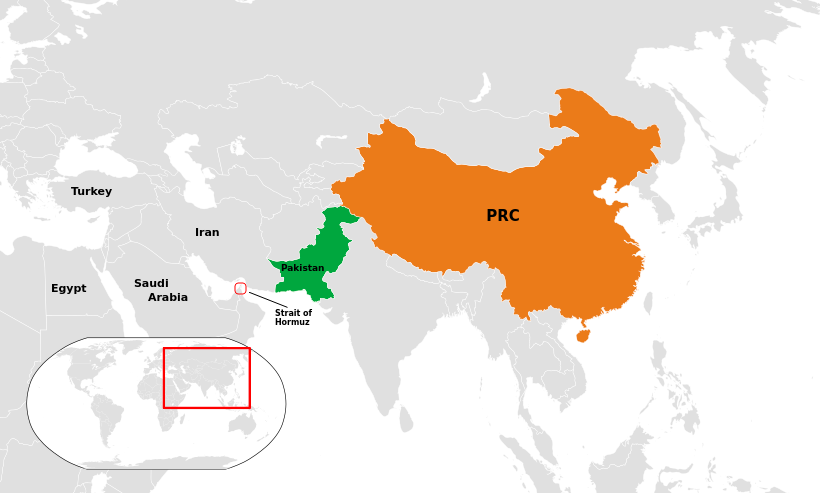 This is the context in which China operates. While Turkey lies on the Euro-Asian frontier from a geographical and politico-military perspective, Beijing has maintained solid relations with Pakistan since 1951, culminating in the China-Pakistan Economic Corridor (CPEC), an infrastructure network designed to secure Beijing’s energy supplies from the Middle East via direct transport routes that bypass the Strait of Malacca. Pakistan is bordered by the Arabian Sea, providing a direct sea-land link to the Chinese border. But beyond the Arabian Sea lies the Strait of Hormuz, now closed due to the war. The Sino-Pakistani alliance is commercial in nature, but also involves military cooperation.
While China regards Pakistan as a strategic partner and key ally for the region and its interests there, with the country now part of the “Group of Four” (Pakistan, Saudi Arabia, Egypt, and Turkey), the EU appears to be left out of the loop. This is also because Beijing has, over the years, forged strong ties with Turkey, which recognizes the One-China policy and effectively disregards Taiwan, whereas the EU, on the other hand, recognizes and supports it. With the US pulling back and suddenly becoming more unpredictable, and a NATO partner promoting interests contrary to those of Europe, the EU is being called upon to reorganize its foreign policy, and quickly. The world is moving on, and Europeans are left watching from the sidelines.
English version by the Translation Service of Withub
![Riunione del consiglio Affari esteri [Bruxelles, 16 marzo 2026. Foto: European Council]](https://www.eunews.it/wp-content/uploads/2026/03/consiglio-esteri-350x250.jpg)