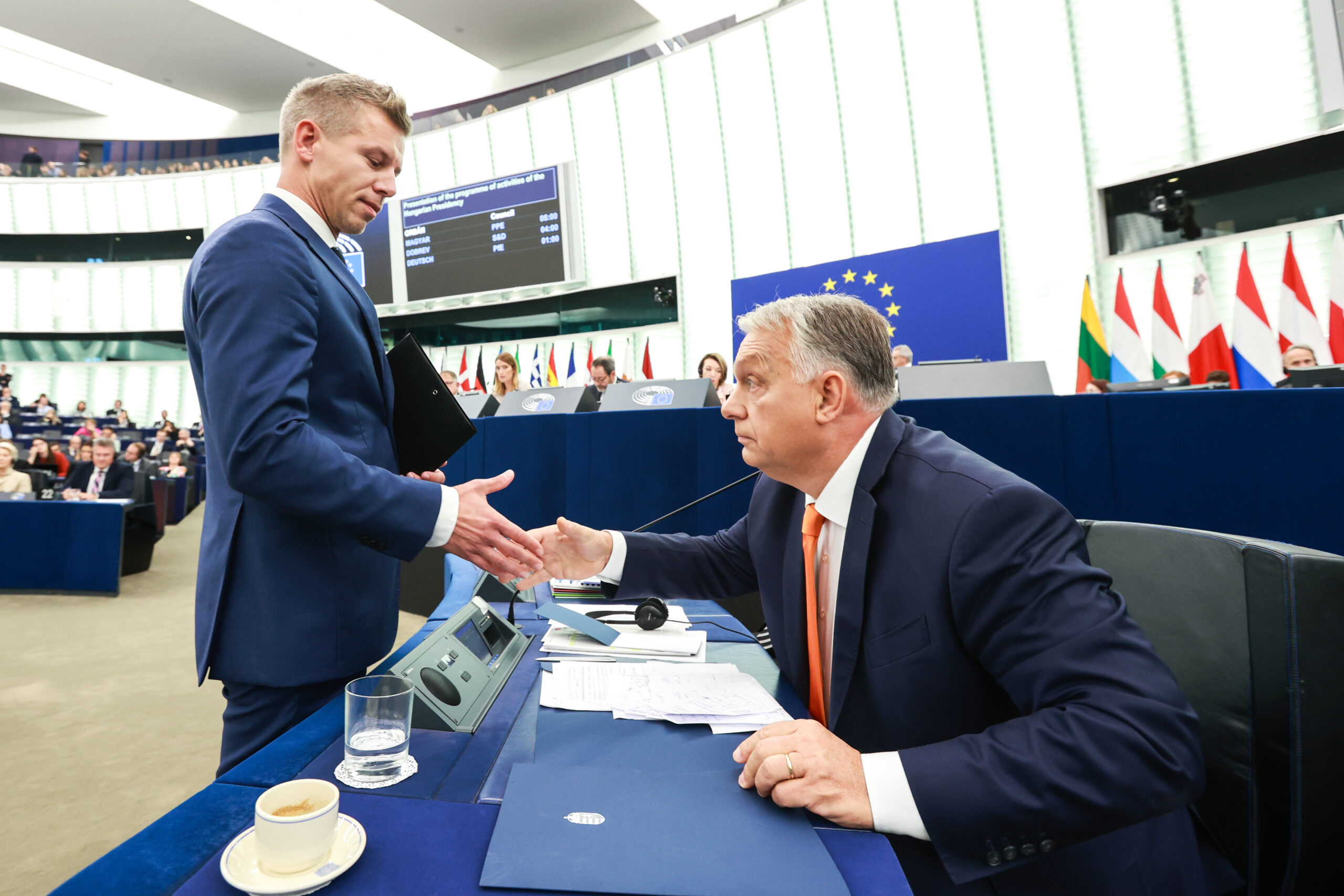
Brussels – To avert the risk that the former Hungarian Prime Minister, Viktor Orbán, might stand for election again in four years’ time and thus attempt to regain the power he lost in yesterday’s (12 April) Hungarian elections: This appears to be the aim of the first constitutional amendment being considered by Péter Magyar, the undisputed winner of the vote and Orbán’s future successor. “In Hungary, from now on, the Prime Minister may hold office for only two terms, for a total of eight years,” announced the leader of TISZA during a press conference held the day after the election victory. Magyar specified that the amendment would be retroactive and that this very aspect would make it a sort of tombstone for Orbán’s future ambitions to govern, given that the latter has already completed five terms as head of the executive.
It is likely that Magyar came up with the idea by looking back on the political career of the man who had been his “political mentor” until their split in 2024. The founder of Fidesz won his first election in 1998, only to be defeated in 2002 and spend eight years in opposition. In 2010, he emerged victorious from the polls once again, and it was precisely from his second term as prime minister that Orbán began dismantling Hungary’s democratic framework, transforming it into what he himself described, in 2014, as an ‘illiberal democracy’. Magyar, therefore, appears to be taking steps to prevent a repeat of this scenario, while also being able to rely on a parliamentary composition that would allow him to amend the Constitution with relative ease (TISZA holds 138 seats, five more than the “crucial” two-thirds threshold).
A few minutes after this announcement, Magyar received a piece of paper from his assistant and, after reading it, gave the journalists present in the room the second significant piece of news to emerge from this press conference. The prime minister-designate explained that he had just received reports that the current Hungarian foreign minister, Péter Szijjártó, “is currently in his office destroying documents relating to sanctions against Russia.” The news forms part of the wider context of the political controversy concerning regular telephone calls between Szijjártó and his Russian counterpart, Sergey Lavrov, in which the former allegedly revealed to the latter confidential information discussed among the foreign ministers of EU countries. In one of the calls published by the newspaper behind the investigation, The Washington Post, Lavrov asked Hungary to assist Moscow in its attempt to persuade the EU to lift sanctions imposed on certain prominent figures in the Russian oligarchy.
“Many people thought that (Szijjártó, ed.) would disappear and resign, but I would like to reassure everyone by telling you that he has reappeared today,” Magyar commented ironically, before turning serious and explaining that the attempt to destroy confidential information in order to evade responsibility “will not help them, but it is useful for understanding the context of the situation in Hungary.” Emphasising how news of this kind highlights just how difficult it will be for the new government to complete the transition from the Orbán era, Magyar pointed out that “normally, an elected prime minister should receive a briefing on matters relating to national security from the outgoing one, but that is not what is happening in Hungary.” “There are a great many international treaties costing Hungarians billions, but no one knows the details, not even I, who am the leader of the main opposition party and the future head of government,” he concluded.
While Magyar was once again highly critical of the “dangerous ties” between the Orbán government and the Kremlin, his comments on some of the thorniest issues relating to the Russian-Ukrainian conflict suggest that Hungary’s stance towards the EU’s line may change far less than a superficial reading of these elections would suggest. On the issue of the new €90 billion European loan to Kyiv, for example, the incoming prime minister has opened the door to the possibility of lifting Orbán’s veto, but at the same time has asserted Hungary’s right to the so-called “opt-out“, that is, to demand that the decision does not impose obligations on Budapest as well. A similarly cold response was given to the possibility of Ukraine being granted a fast-track route to EU membership. “It is impossible for a country currently at war to be admitted to the Union,” stated Magyar, emphasising that “all countries must undergo the same process” and that, even if Kyiv were deemed fully eligible for membership, “the Hungarian people will have their say in a referendum.” But it is on the issue of the European boycott of Russian gas that Magyar’s words seem almost to echo those spoken by Orbán in recent years. Although he has shown far greater openness to diversifying supply sources for reasons of “energy security and economic convenience,” the TISZA leader explained that “geography cannot be changed and Russia and Hungary will always be where they are now.” “For this reason,” he continued, “I hope that Russia’s aggression against Ukraine ends soon” and that at that point “Europe immediately lifts the sanctions on Moscow.” “We are neighbours of Russia,” Magyar remarked, “and it is not in Europe’s interest to purchase raw materials at higher prices, because that destroys our competitiveness.” A position that stands in stark contrast to that repeatedly emphasised by the European Commission, according to which reducing dependence on Russian energy sources should be permanent, regardless of how the conflict unfolds.
English version by the Translation Service of Withub
![Il ministro dei Trasporti, Matteo Salvini [Bruxelles, 5 dicembre 2024. Foto: Emanuele Bonini per Eunews]](https://www.eunews.it/wp-content/uploads/2024/12/salvini241205-350x250.jpeg)





![Il ministro dei Trasporti, Matteo Salvini [Bruxelles, 5 dicembre 2024. Foto: Emanuele Bonini per Eunews]](https://www.eunews.it/wp-content/uploads/2024/12/salvini241205-120x86.jpeg)