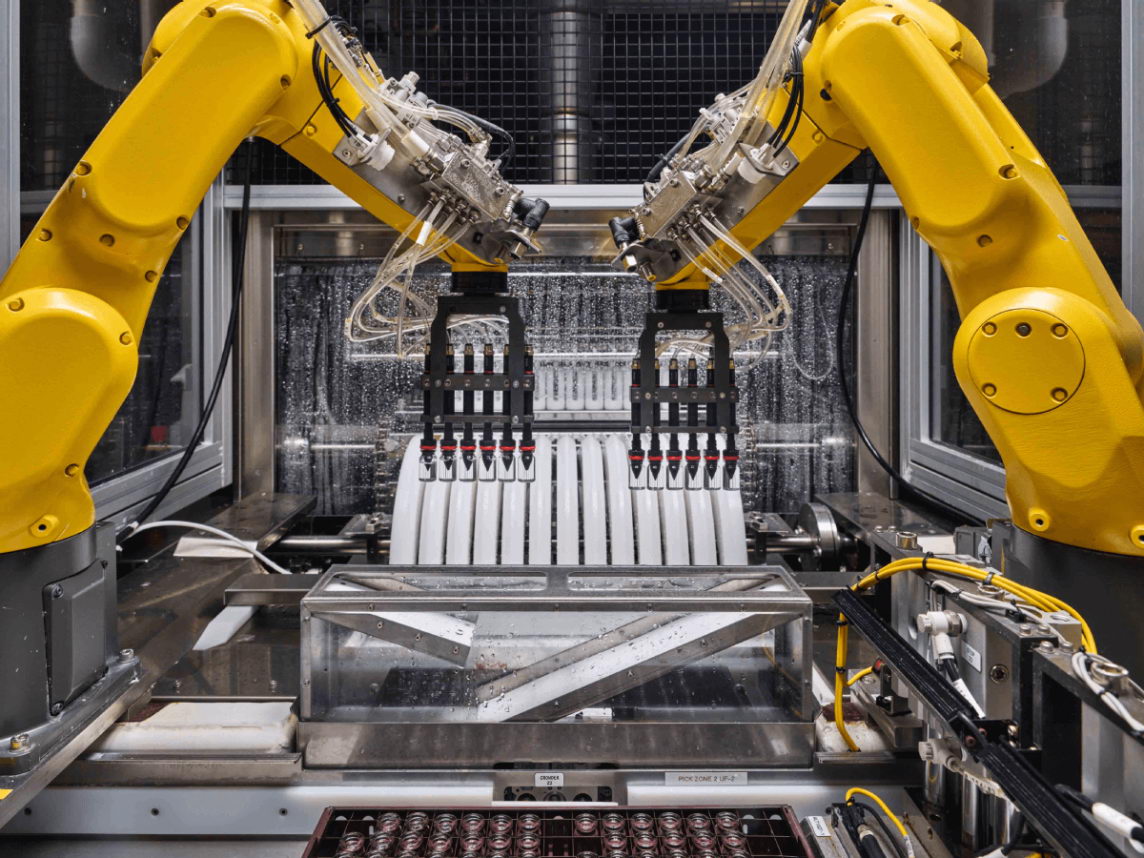
Brussels – Following a poor start to the year, the European industrial sector is showing slight signs of recovery. According to preliminary estimates from Eurostat, in February 2026, industrial production rose by 0.4 per cent in both the euro area and the European Union compared with the previous month. This figure marks a reversal of the trend compared to January 2026, when production had fallen by 0.8 per cent in the euro area and by 0.9 per cent in the EU. The figures from the EU Statistical Office are calculated by aggregating seasonally adjusted national values and are therefore free from variations that recur annually at the same time of year, such as the decline in production during the summer holidays or the increase during the Christmas period. In February 2026, compared with February 2025, industrial production fell by 0.6 per cent in the euro area and by 0.1 per cent in the EU.
Monthly growth in the euro area was driven mainly by non-durable consumer goods, which recorded a 2.6 per cent jump. Capital goods (+1.0 per cent) and intermediate goods (+0.5 per cent)—i.e. those products that are not intended for final consumption, but are used by other companies as raw materials or components to be transformed into finished products, such as steel or electronic components—also made a positive contribution. Conversely, there were significant contractions in the energy sector (-2.1 per cent) and durable consumer goods (-1.3 per cent).
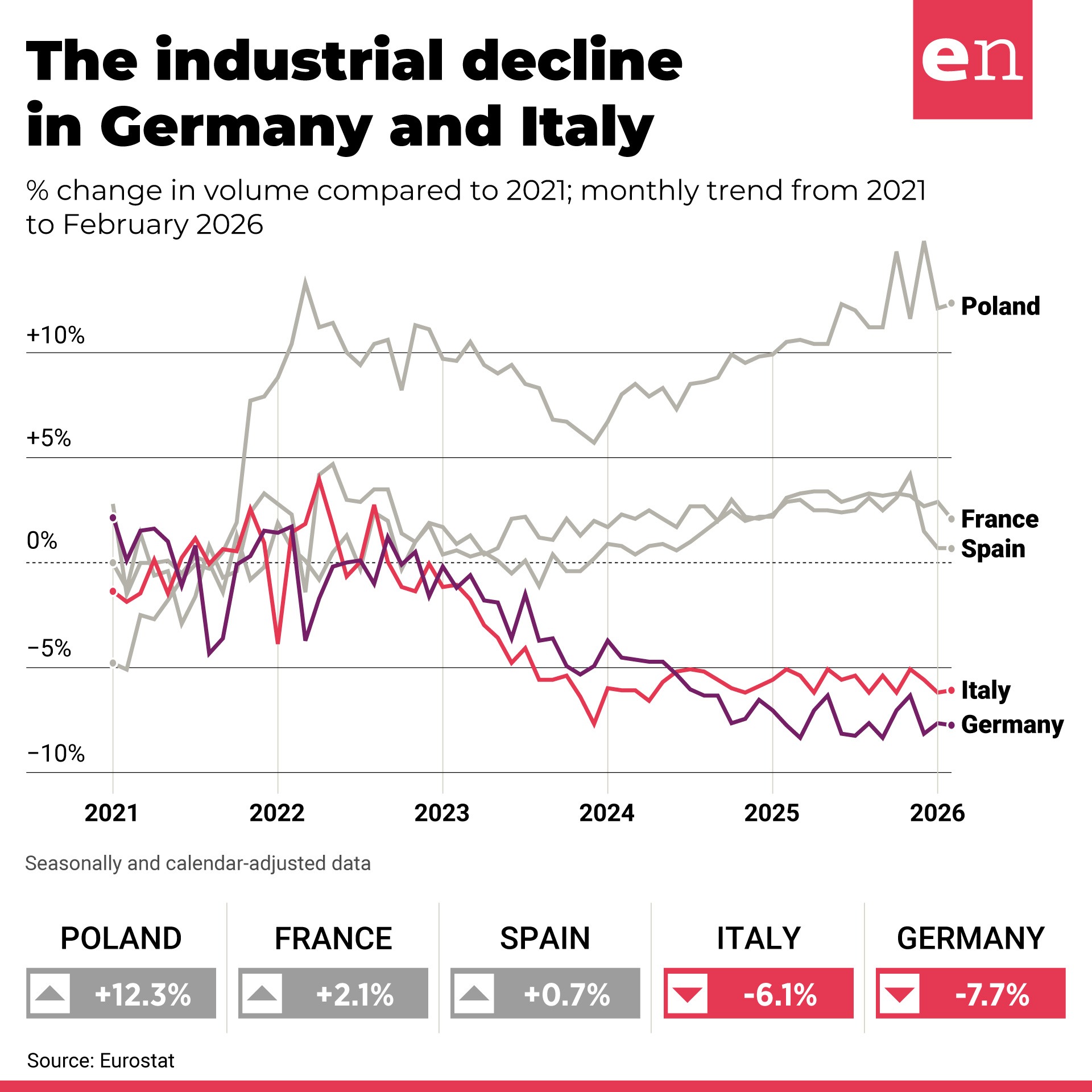
In the EU, the trend was similar, with capital goods rising by 1.1 per cent and non-durable consumer goods by 2.0 per cent, while the energy sector fell by 2.0 per cent.
Performance across Member States varies considerably: among the most dynamic countries, with the largest monthly increases, are Ireland (+5.7 per cent), Finland (+3.3 per cent), and Sweden (+3.2 per cent). Italy also recorded a slight increase of 0.1 per cent on a monthly basis. The sharpest falls were observed in Malta (-6.0 per cent), Luxembourg (-4.6 per cent), and Greece (-2.1 per cent).
Despite the monthly recovery, the year-on-year comparison remains slightly negative. Compared with February 2025, industrial production fell by 0.6 per cent in the euro area and by 0.1 per cent in the EU. On an annual basis, however, some countries are showing robust growth, notably Sweden (+7.7 per cent) and Belgium (+7.4 per cent). At the other end of the scale, Luxembourg recorded the sharpest annual decline, at -17.0 per cent, followed by Ireland (-10.0 per cent) and Bulgaria (-8.0 per cent).
English version by the Translation Service of Withub

![[foto: imagoeconomica]](https://www.eunews.it/wp-content/uploads/2025/03/risparmi-salvadanai-350x250.png)

![Da sinistra: il presidente del Consiglio europeo, Antonio Costa; il presidente dell'Ucraina, Volodymir Zelensky: la presidente della Commissione europea, Ursula von der Leyen [Bruxelles, 18 giugno 2024. Foto: European Council]](https://www.eunews.it/wp-content/uploads/2026/06/euco_ua260618-120x86.jpg)
![[foto: Saverio De Giglio/imagoeconomica]](https://www.eunews.it/wp-content/uploads/2026/10/cpt-120x86.png)