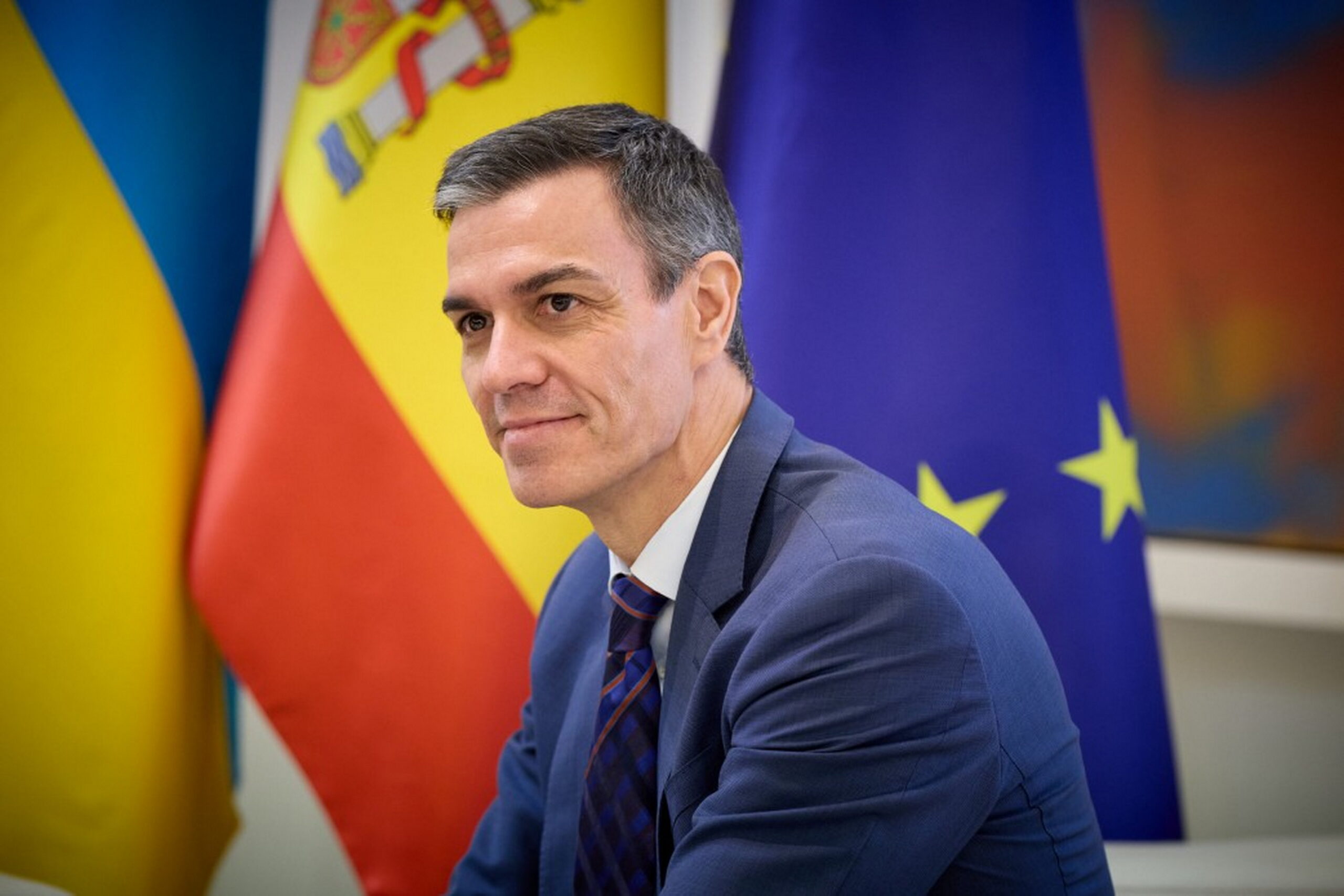
Brussels – Pedro Sánchez is the only leader among those of the major European Union countries to see his approval ratings rise, while the leading figures in European politics are facing widespread mistrust and pessimism. This emerges from the April 2026 survey by Polling Europe Euroscope, a Brussels-based market research and polling institute, the result of a joint venture between SWG and OpinionWay, —which has been exclusively previewed by Eunews. The interviews were conducted between 25 March and 7 April 2025, and based on the responses received, there has been a drastic drop in approval ratings, with double-digit declines for key figures such as Ursula von der Leyen, Giorgia Meloni, and Friedrich Merz.
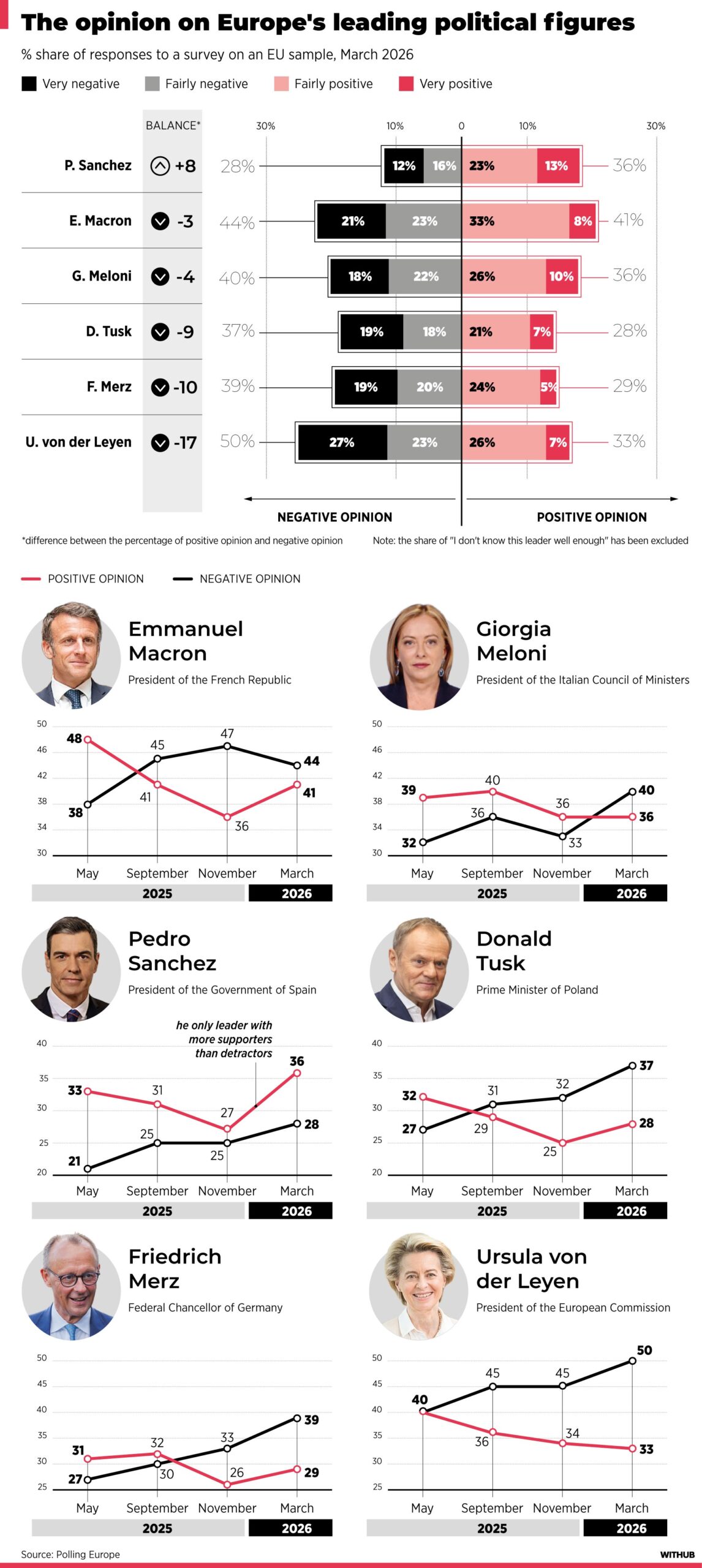
Against a backdrop of general mistrust, the only notable exception is the Spanish Prime Minister Pedro Sánchez. Thirty-six per cent of those surveyed hold a positive opinion of him, of whom 13 per cent view him as “very positively” and 23 per cent as “fairly positively”. Meanwhile, 28 per cent of those surveyed expressed a negative opinion of him. According to the responses, Sánchez boasts the only clearly positive (+8 points) Approval Index, indicating the gap between positive and negative opinions among the leaders analysed. In particular, approval for Sánchez has risen by 4 points compared to the previous survey in February. The Socialist leader is particularly popular among voters from the European Parliament groups of the Socialists and Democrats (60 per cent) and The Left (51 per cent), whilst the figure drops among voters from the Greens (49 per cent) and Renew Europe (39 per cent).
Emmanuel Macron remains the most popular leader in absolute terms, with 41 per cent of positive opinions (of which only 8 per cent are “very positive” and 33 per cent “fairly positive”), but he also attracts 44 per cent of negative opinions, bringing his approval rating for March to -3. The French president nevertheless maintains broad support across the so-called “Ursula Majority”, garnering 60 per cent approval among voters from the S&D and Renew Europe groups, 50 per cent among Green voters and 61 per cent among supporters of the European People’s Party (EPP).
For Giorgia Meloni, March marked a significant setback in her popularity: while remaining in second place in overall approval ratings (36 per cent), the Italian Prime Minister saw her Approval Index plummet by 11 points in a single month, to -4. Despite the decline, Meloni continues to consolidate support within the conservative and sovereigntist camp, securing 62 per cent approval among voters in the European Conservatives and Reformists (ECR) group, 53 per cent among the Patriots for Europe (PfE) and 45 per cent among those who vote for the Europe of Sovereign Nations political family (ESN).
A notable finding concerns Ursula von der Leyen: the Commission President has reached the lowest point in the survey, with 50 per cent of negative opinions (23 per cent “somewhat negative” and 27 per cent “very negative”). Her approval rating plummeted to -17 in March, a 12-point drop from February. This is the sharpest decline among the eight European leaders analysed in the survey, although the most drastic drop compared with February was seen in Friedrich Merz: his approval rating fell to -10 in March, a 14-point decrease from the previous month. His approval rating stands at 29 per cent. Finally, Donald Tusk and Roberta Metsola saw their approval ratings worsen, falling in March to -9 (with 28 per cent of positive opinions) and -3 (23 per cent approval), with the President of the European Parliament continuing to suffer from limited recognition among the electorate, given that 51 per cent say they do not know enough about Maltese politics to be able to express an opinion. This is something Metsola shares with the President of the European Council, Antonio Costa: approval of the former Portuguese Prime Minister stands at 25 per cent, but 29 per cent of respondents admit they do not know him well enough to form an opinion. His approval rating has fallen from +4 to -1 in February, a drop of 5 points.
The survey was conducted online using the CAWI (Computer-Assisted Web Interview) method on a representative sample of the EU population aged 18 and over. A total of 5,386 complete interviews were conducted—collected between 25 March and 7 April 2025—distributed proportionally across the population of the 27 EU countries with a slight adjustment to allow for pan-European analysis, with breakdowns for the five largest states (Germany, France, Italy, Spain and Poland) and across three different regions: Eastern Europe, Northern Europe and Southern Europe. For each country, proportional quotas were established for age and gender, based on the most recent parameters provided by Eurostat.
English version by the Translation Service of Withub
!["Niente valori, niente soldi". Il Parlamento europeo torna a chiedere provvedimenti contro l'Ungheria di Viktor Orban [foto: Renew Europe, sito internet del gruppo]](https://www.eunews.it/wp-content/uploads/2022/08/orban-rff.png)