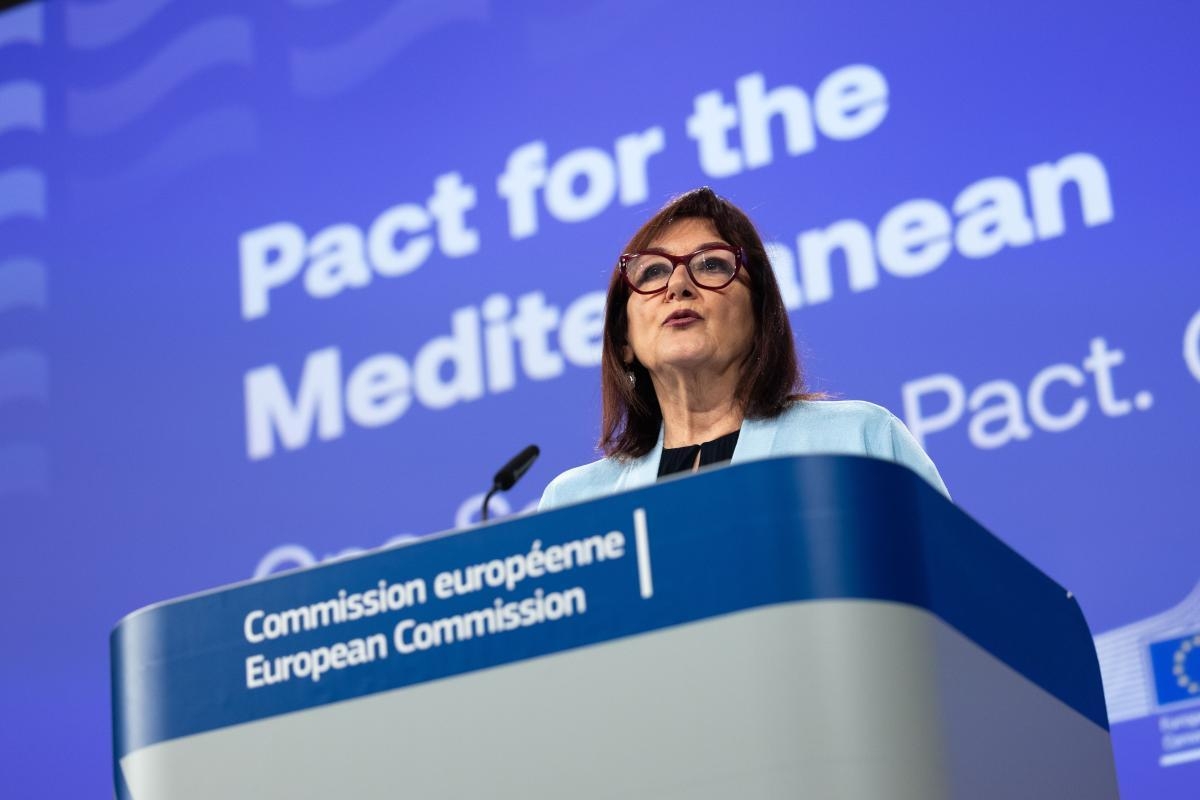
Brussels – “Turning current challenges” such as Conflict in the Middle East and its repercussions on the Mediterranean “into opportunities for growth, stability, and cooperation” between the European Union, the countries bordering the Mediterranean and partners in the Gulf. How? Through the Action Plan for the Mediterranean Pact presented today (17 April) by the European Commissioner for the Mediterranean, Dubravka Šuica. In the Commission’s conference room, Šuica outlined a programme of 21 strategic actions divided into three key pillars: people, the economy, security and migration. “I have already shared this plan with the Member States and partners in the Southern Mediterranean, and they have all welcomed it enthusiastically,” said the Commissioner, emphasising that the ultimate goal is the creation of “a common Mediterranean space, a space of peace, prosperity and stability.”
To bring this vision of shared growth to fruition, the first pillar places people at its heart as the “driving force for change and innovation”—because “people come first”—through eight specific actions. Among these, the Mediterranean University Initiative, designed to “deepen academic collaboration among students across the region,” and the establishment of a Youth Parliamentary Assembly, a platform that “will enable elected representatives from Europe and the Southern Mediterranean to contribute directly to regional policies,” explains the press release presenting the plan.
The second pillar, on the other hand, aims to build “stronger, more sustainable and integrated economies,” through four actions focused on the region’s energy and digital future. One example is the Trans-Mediterranean Initiative for Renewable Energy and Clean Technologies (T-MED), which, together with its investment platform, aims to “accelerate electricity grid projects by mobilising public and private funding and mitigating financial risks through new industrial partnerships.” A highly topical initiative that “plays a fundamental role given the current energy crisis we are experiencing.” In parallel, the plan introduces a “Tech” business offering to ensure secure digital interconnectivity across the entire region. This effort will result in “the enhancement of regional connectivity through new submarine cables and the improvement of telecommunications capabilities, while promoting close regulatory cooperation and ongoing technical exchanges on cybersecurity to make the entire Mediterranean region technologically resilient and reliable,” the press release states.
Finally, the third pillar addresses security, emergency preparedness, and the management of migration flows through nine targeted actions. In terms of disaster response, a European firefighting hub will be established in Cyprus, a regional centre that, for the first time, will extend its support to the countries of the southern Mediterranean, whilst the MED-OP initiative will support operational efforts against organised crime in synergy with the Justice and Home Affairs agencies. The strategy is complemented by the “Secure Borders” action, aimed at “strengthening governance in the security sector and institutional border monitoring capabilities.” As regards migration management, the European Commission intends to implement the “entire route” approach, namely a proactive and comprehensive approach that follows migrants at every stage of their journey, acts directly on root causes in countries of origin, and resolutely combats human trafficking. The aim is to “dismantle criminal networks and effectively pave the way for new legal routes of entry.”
The Mediterranean Pact has been under discussion since October 2025, when the programme was drawn up by the European Commission and the European External Action Service and adopted by the College of Commissioners in October 2025, prior to its official launch by EU and Southern Mediterranean partners on 28 November 2025, to mark the 30th anniversary of the Barcelona Declaration. Following this first step for the Action Plan, the second version, scheduled for autumn 2026, is awaited.
“This is just the beginning of progress,” Šuica explained to journalists at the Berlaymont Building. An interactive webpage will also be launched which “will enable stakeholders and citizens to identify concrete projects and initiatives; these can be explored by country and by sector, and progress can be tracked with full transparency, demonstrating the tangible impact of the pact.” According to the Commissioner, “realising that this plan has a tangible impact is, now more than ever, essential to give us strength in the face of the repercussions of the conflict in the Middle East“.
English version by the Translation Service of Withub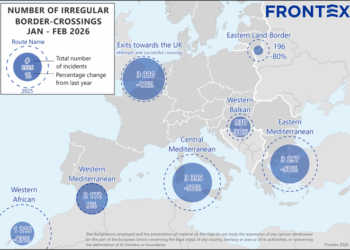


![Da sinistra: il presidente del Consiglio europeo, Antonio Costa; il presidente dell'Ucraina, Volodymir Zelensky: la presidente della Commissione europea, Ursula von der Leyen [Bruxelles, 18 giugno 2024. Foto: European Council]](https://www.eunews.it/wp-content/uploads/2026/06/euco_ua260618-120x86.jpg)
![[foto: Saverio De Giglio/imagoeconomica]](https://www.eunews.it/wp-content/uploads/2026/10/cpt-120x86.png)